Graduate survey

Welcome to the information pages for the University of Münster's broad-based graduate survey. Here you will find helpful information on the background and objectives, as well as the implementation and evaluation of the survey. During the 'field phase' (the active survey period from early October to mid-February), the link to the survey will also be posted here.

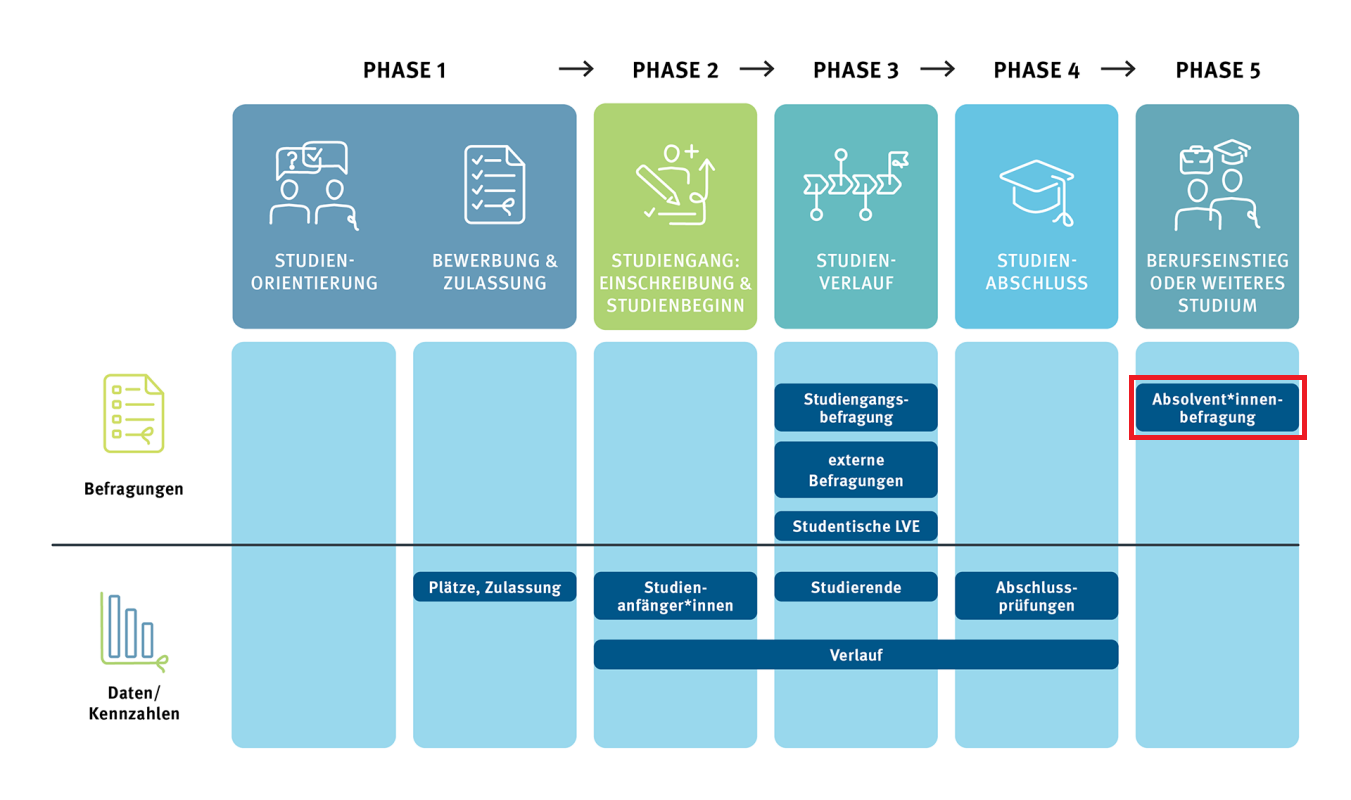
The figure shows the evaluation tools (surveys and key figures) of the QMS differentiated according to the phases of the student life cycle.
Placement of the graduate survey in the Student Life Cycle (SLC) and the evaluation tools
© Uni Münster - Web und Design
    • Since 2007, graduates and doctoral alumni of the University of Münster have been surveyed one to two years following the final examination of their programmes. Every year, more than 7,000 persons are contacted starting in October via letter and/or email and invited to participate in the survey. In the course of the process, participants are sent up to three reminders. Throughout the survey period, the graduates who had not yet completed the survey, were reminded a max. three times to participate. Sending out reminders allows the survey organisers to achieve as a high a response rate as possible so that statistically relevant analyses can be made. Those, who had already participated, were not contacted again. This method has consistently proven successful: the response rate typically ranges between 35 and 45 percent, which is a very high value for surveys of this nature.

    • Graduates of bachelor’s programmes were also invited to participate in the survey. Although many bachelor holders subsequently enrol in a master’s degree programme and therefore cannot say anything about their career entry, they can still share valuable insights into study conditions and the transition from bachelor’s to master’s degree programmes.

    • The University of Münster is very interested in learning about the different paths graduates take after their studies, for only then is it possible to analyse the impact of the University’s academic conditions on their future life and career. In addition, their assessment of academic conditions and the qualifications they obtained during their studies provide crucial information on what areas of academics and teaching the University of Münster can further improve. This aspect is a key part of the Quality Management System (QMS) for studies and teaching at the University of Münster (click here for more information).

    • A special feature of the graduate survey is that it is conducted as part of the nationwide cooperation project "Graduate Studies" (KOAB). This project is coordinated and scientifically supported by the Institute for Applied Statistics (ISTAT); the cooperation partners include approximately 80 universities from Germany and Austria, which have developed a common questionnaire and exchange findings with one another. Due to this collaborative nature, it is possible to obtain comparative data across state and national levels, even at the degree program level, which represents a significant advantage over other surveys in terms of the QMS for studies and teaching. Further information on the "Cooperation Project Graduate Studies (KOAB)" and the universities forming the KOAB network can be found here. 

    • Since 2012, all public universities in North Rhine-Westphalia (NRW) have been required by the Ministry of Culture and Science (MKW) to participate in the KOAB study every two years. ISTAT produces a statewide overall evaluation for NRW, in which meta issues relevant to higher education policy are analyzed. Universities also receive these evaluations, including data specific to their own institution. Seven detailed scientific reports on the situation of graduates from NRW universities have already emerged from this "NRW Project." Further information can be found here

    • At the end of the graduate survey questionnaire, respondents are asked for their consent to participate in a follow-up survey (panel survey). Those who give their consent are contacted and invited to this survey approximately three years later. This process of an individual-tracking longitudinal study is no longer managed by the University of Münster, but by ISTAT. The University of Münster receives the results of the panel survey on a university-specific basis from ISTAT upon request. This allows for a better analysis of career entries and trajectories after the initial professional induction phases, as well as after a subsequent Master's degree or doctorate.