“Our graduates should represent a cosmopolitan Islam”
The Faculty of Islamic Theology (FB 16) is the latest addition to the University of Münster. It is part of the new “Campus of Theology and Religious Studies”, to which the Faculties of Protestant and Catholic Theology also belong. With respect to its teaching activities, the first faculty of Islamic studies in western Europe wishes to make a lasting impact, as the founding Dean Professor Mouhanad Khorchide and research associate Faris Mansouri explain in the following interview.
Is the move to the new campus simply a change of scenery?
Mouhanad Khorchide: Definitely not, it’s much more than that. Coming together like this is both a powerful symbol and an expression of concrete common practice. The geographic proximity will engender thematic and spiritual proximity, from which the students will also benefit. We’re planning interdisciplinary lecture series and are working with the Faculties of Protestant and Catholic Theology to develop a shared profile. But what we already agree on is that we all want to assume responsibility for society – and that through our teaching activities.
Is there a typical teaching format in Islamic theology?
Mouhanad Khorchide: In our faculty, we focus on lectures and seminars. Of course, lectures are the format of choice at the beginning of a degree programme when we teach the fundamentals, such as defining the concept of Islamic religious education …
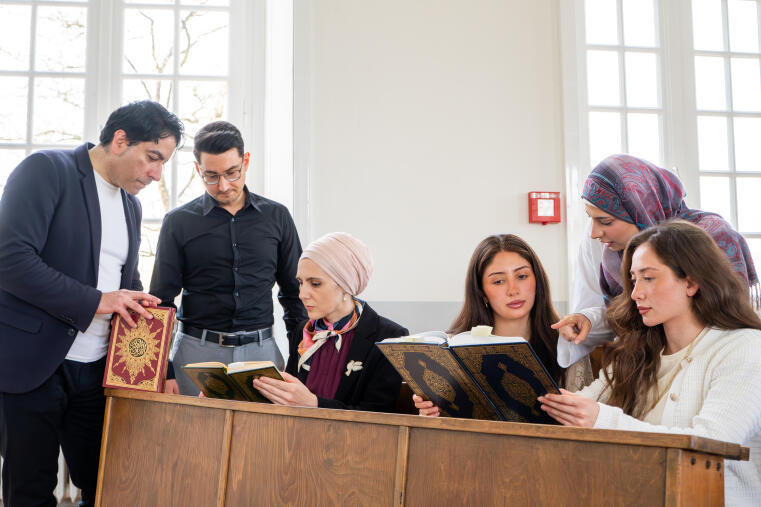
Faris Mansouri: … though we often combine our lectures and seminars. For example, we supplement the lecture on religious education with a seminar on the same topic, but at a far more interactive level.
Mouhanad Khorchide: It’s very important to us that we don’t only give “front-of-class” lectures but also encourage the young people to think about and discuss the topics themselves.
But many faculties and institutes have the same objective ...
Mouhanad Khorchide: That’s true. But there’s a special aspect to consider in Islamic theology. Our students are often socialised in a very staunchly religious environment, such as in mosque communities and families. As a result, many of them come to us with a very clear position on Islam. Even social media channels, where you’ll find many positions that don’t align with our basic democratic principles, exert a strong influence as well.
So you deliberately question the students’ firmly held opinions?
Mouhanad Khorchide: That’s usually the case. Because many of them are convinced that there’s only one version of Islam. We present counter arguments, for example, showing them how their position on gender roles or their relationship to Judaism is by no means as clear-cut as they’d like to believe. Initially this provokes and confuses them, but it helps them.
In what way exactly?
Mouhanad Khorchide: Many Muslims have to get used to being asked critical questions about Islam every day. What is Islam’s position on democracy? What does the Koran say about violence? Nowadays even first-semester students have to expect to be confronted with these and other questions. We prepare them for this.
Faris Mansouri: It’s also because 70% of our students are enrolled in the teaching degree programme. As teachers they’re going to be asked such questions by Muslim students and their fellow colleagues. We teach our students that their answers should not only be informed by the subject but should also consider the social environment. In our instruction, we simulate this reality of life.
Mouhanad Khorchide: And for young people, that includes their most important source of information – social media. That’s where Muslim students at schools and universities are confronted with extreme positions by so-called “authorities”, which they have to critically grapple with. They have to learn to debunk radical theories and build their own positions. Media competence means developing self-confidence and self-empowerment.
Is there a guiding principle in place regarding teaching at the faculty?
Mouhanad Khorchide: Our motto is “Islamic theology taking responsibility for Europe”. We represent an Islam that enriches our continent and supports the basic, free and democratic order. With respect to teaching, we divide this fundamental principle in multiple thematic fields, such as compassion, human rights, the human-God relationship and the diversity of religions and worldviews. Our graduates should represent a cosmopolitan and peace-loving Islam.
And in all this, the Koran is the focal point?
Faris Mansouri: Yes, because Arabic, as the language of the Koran, forms the basis of our work. We are now bringing these years of expertise to the new Arabic Language Centre (ZAS), through which we coordinate our four-semester Arabic language training programme for our teaching degree students, among other things.
Mouhanad Khorchide: But this is not about teaching everyday Arabic for daily life. We call the course “Islamic Arabic” or “Koran Arabic”. There are numerous terms and special expressions whose meaning one has to know to understand the primary Islamic texts.
To what extent does your faculty cooperate with other faculties?
Faris Mansouri: Since the Centre for Islamic Theology (CIT) was founded in 2012 as the predecessor institution of the faculty, we’ve co-operated with the Christian theologies by way of joint teaching formats, and with Religious Studies by reciprocally opening our modules. In addition, our module “Islam in Germany” is now firmly anchored in the Educational Sciences curriculum.
Is there a possibility for students to gain a fuller immersion abroad?
Mouhanad Khorchide: We maintain study abroad partnerships with universities in Morocco, Egypt and Turkey. Starting in September 2026, we’re planning to organise an annual excursion to the Bosnian capital of Sarajevo. The university there is the only one in Europe – aside from Münster – with a faculty of Islamic studies. Sarajevo is also a city where the religions cooperate with one another in almost ideal fashion and where people show each other tolerance. Many students don’t realise that a European Islam exists just one and a half hours away by plane which differs significantly from the Islam in Turkey or in the Arabic countries. When they talk with Muslim students on location, many of them come away positively surprised. In the medium and long term, we want to intensify our contacts with Indonesia, the most populous Islamic state in the world.
You mentioned that 70% of the students in your faculty want to become teachers. What kind of plans are the other students pursuing?
Mouhanad Khorchide: Many of them want to stay in academia, work for foundations or in politics, or become involved in their communities. There are also jobs in the welfare sector and in social organisations.
Faris Mansouri: Teachers of Islamic religious studies have very good career prospects. We need around 6,000 of them in Germany, and 3,500 alone are needed to teach the 600,000 or so Muslim students in schools in North Rhine-Westphalia. As you see, there are worthwhile perspectives in many respects for those who study at our faculty.
Text: Norbert Robers