Moving with the times
The Faculty of Philology is both large and complex. With twelve institutes and departments, students receive instruction that covers a vast range of epochs, regions and cultures and responds flexibly to changes and challenges.
Philologie, Filologia, Philology, Filologie, Філологія, ةغللا هقف, 语文学, Φιλολογία: No matter how you spell it, the “love for language” is the measure of all things at the Faculty of Philology. Not only is the study of linguistics of fundamental relevance, but also the literary and cultural contexts that are influenced by linguistic phenomena. Indeed, academic training in philology rests on three pillars: language, literature and culture. The faculty’s institutes and departments are dispersed across downtown Münster and, thanks to their excellently curated departmental libraries, are ideal places of learning and encounter.
Language
Although the Faculty of Philology is ‘more than language’, as Dean of Studies Professor Tobias Leuker points out, language training in the teaching subjects of German, English, French, Spanish, Italian and Dutch is especially important. Teaching degree students not only receive a solid foundation of linguistics and literary studies, but also training in language instruction, which can be applied in all types of schools including special and inclusive education. It enables them to meet current and future challenges in school education, e.g. with respect to New Media and artificial intelligence.
In addition to its three main language departments – German, English and Romance Studies – other disciplines enrich the faculty’s philological diversity, e.g. Slavic Studies which include Russian, Czech and Polish, Scandinavian Studies which include Swedish and Norwegian, Sinology with Chinese, Dutch Studies, Arabic Studies and Jewish Studies with Hebrew. These are accompanied by philological disciplines which have a strong cultural-studies orientation, such as Assyriology, Egyptology and Coptology. When it comes to pure language training, students are also taught to examine the linguistics of older language forms, dialects and grammatical phenomena.
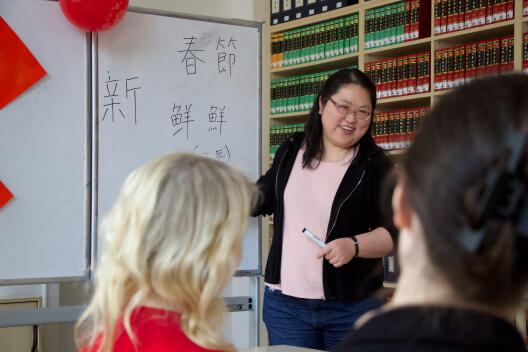
Philology at the University of Münster is not only exceptionally multilingual – it’s also distinguished by specific thematic focuses. For instance, Slavic Studies has broadened its language course offerings in response to the war in Ukraine, and Sinology is promoting better relations with China by participating in the “Bildungsnetzwerk China”, managed by the Goethe-Institut and the Mercator Stiftung. In the area of linguistics, courses are regularly offered on current topics like youth language, migration linguistics and second language acquisition.
Literature
Not only do instructors and students share a deep appreciation for language – they also share a love for literature, ranging from classics like The Imaginary Invalid, Jane Eyre and Buddenbrooks to contemporary works like Submission, Harry Potter and Why We Took the Car. Students majoring in literary studies are offered an abundance of reading material – and not only from Europe and North America, but also the Far East, North Africa, Latin America and Eastern Asia.
Teaching core skills in literary studies, e.g. interpretation and classification of texts, is just as important as continuously developing methodical tools, not least of all catering to students’ interests and wishes. For example, a recent seminar entitled “Bookstagram, BookTok & More” addressed the role of social media in contemporary reading culture. The master’s programme “Cultural Poetics of Literature and Media” is extremely popular as it applies textual interpretation to a broad range of genres. Here, students can analyse films in seminars like “Queer Cinema” and “David Lynch” or delve into the 100-year history of radio plays. Like German Studies, which also awards a lectureship in poetics to a notable writer every two years, all the other institutes and departments in the faculty regularly employ guest lecturers and, in so doing, continuously align their academic profile to the pulse of the times.
Culture
It goes without saying: without language, there’s no philology. Yet a country or region is not soley defined by how people communicate verbally or in writing. That’s why culture comprises the third pillar of instruction in the faculty. ‘Economy, culture and history play a role in those subjects which are less oriented to teaching degree students,’ explains Tobias Leuker. This applies, for example, to Sinology, which not only teaches students a writing system that is inscrutable to most Europeans, but also enables them to gain a more comprehensive understanding of China based on the study of historical events and developments in language, society and art.
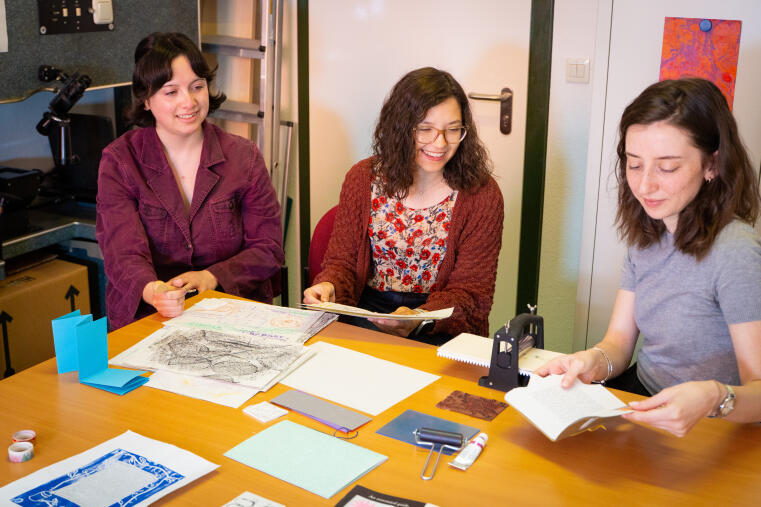
Material artefacts play a special role in teaching activities in several institutes. Students are introduced to “research-oriented learning” in Arabic and Islamic Studies using the institute’s own collection, which includes 1,000-year-old Koran fragments, rare theological and philosophical manuscripts and 9th-century Egyptian tombstones. But collection and archival work is not the only practice-based course in the curriculum at the Faculty of Philology. Students can also participate in excursions, e.g. to the Louvre in Paris (Institute for Ancient Near Eastern Studies), the book fair in Göteborg, Sweden (Institute of Nordic Philology) or a theatre festival in Spain (Department of Romance Studies).
Teaching and practical application
Knowledge transfer is a central component of philological teaching – from the world to the lecture hall and from the classroom into society. Partnerships with schools augment the subject-related didactic qualification. Various certificates, e.g. “North American Studies”, “Study India”, “Greater China”, “Islamic Cultures”, and “Islamic Law”, offer continuing education opportunities to students from other faculties. The “German as a Foreign Language/Second Language” certificate provides additional perspectives in the area of adult education and German language training abroad. Visits to foreign partner universities and institutes, as well as work placements, allow students to supplement their theoretical knowledge about numerous cultural spheres, obtain real-world experience and intercultural skills. The frequent contact that instructors and students maintain with the rest of the world is one of the faculty’s biggest strengths and makes its instruction flexible and adaptable. The programme coordinators not only react to the constantly changing school curricula and dynamic developments in their own disciplines, but also to new social and technical phenomena and geopolitical upheavals. All out of love for language – and for cultures.
Text: André Bednarz