New answers to old questions
Empty churches, sinking membership, dwindling church tax revenues – the era of mainstream churches appears to be over. But occupying oneself with matters of faith remains a rewarding endeavour – especially in view of our cultural heritage and the future of Europe.
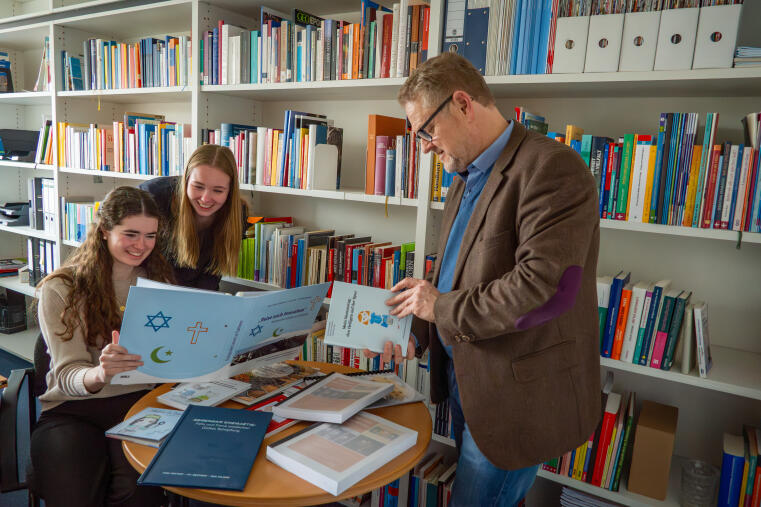
Why study theology nowadays? Because it offers us the opportunity to sit together with young people in religion class and discuss the Christian faith and its significance for leading a good life. To this end, students majoring in Religious Education at the Faculty of Catholic Theology develop their own methodological approaches and create new teaching materials. Some of these are printed in book form by educational publishers, including unconventional, interreligious learning products. For example, there’s the cookery book “Ich glaube, das schmeckt” (I Believe It Tastes Good), containing recipes from different religious cultures that highlight their respective traditions and eating rituals.
Empirical studies substantiate the public’s waning acceptance and the resulting declining legitimation of Christian theology. With regard to Catholic theology and in view of the most recent church crises (loss of members, reports of abuse), many are increasingly asking what theology as an academic discipline can contribute to our society. The potential is obvious – students of theology enhance their language skills, learn how to parse and discuss texts, and more fully comprehend how people and organisations interact.
The courses offered by the Faculty of Catholic Theology offer corresponding opportunities for co-determination and debate. In addition to the regular courses, e.g. language courses, the exegesis of Biblical texts and seminars on church history, there are also participative formats such as the award-winning “Brown Bag Lectures” where members of the faculty and University sit down to discuss structural problems and their potential solutions. Responding to and tolerating different opinions is one of the standards of instruction at the Faculty of Catholic Theology. This might appear to contradict the concept of papal infallibility. Researchers have long pointed out, however, that infallibility – historically speaking – is a more recent development in church history. Indeed, the church fathers of early Christianity often wrestled with tenets of the faith. Rules were put in place and later discarded. How this played out in everyday life is a different story altogether.
Today the ability to think critically and independently is a key skill in a discipline that aims to teach students how to competently defend their own viewpoints. These skills are also the building blocks for democracy. The module “Basics of Theology”, for example, is a kind of “tour d’horizon” through the entire subject, offered to all students by twelve professors in the faculty. In this module as well, ‘viewing society as a whole is important,’ emphasises Head of Faculty Professor Oliver Dyma.
In terms of didactic methods, the faculty employs a variety of approaches. One special format is the revision course organised by students for students, during which the content of the introductory lectures is re- viewed. In the “Peer-learning module”, bachelor’s students develop their own teaching materials, e.g. picture books and textbooks on topics like friendship, creation and human interaction – supplemented with didactic notes.
The material from this “didactic double-decker” that allows participants to both teach and learn is particularly well received by teaching degree students. The reason is that such materials can later be used during the practical semester or directly in class, e.g. the self-designed, topical and child-friendly book about saints.
The knowledge gained from instruction not only finds its way into schools around the region but also institutions beyond the University of Münster. For example, together with the heads of the Centres for Practical Teacher Training at Schools in North Rhine-Westphalia, Professor Clauß Peter Sajak coedited a practical handbook on lesson preparation.
Speaking of reaching out beyond Münster, the faculty encourages students to study at partner universities abroad, e.g. in Finland, Switzerland, Poland and Ireland. Excursions in Germany and abroad take students to key venues of religious history, for example, in the advanced seminar “Interreligious Learning in Sarajevo”, organised in cooperation with the Faculty of Islamic Theology. The chance to visit in person allows students to gain practical knowledge of religious life and learn how religions are instrumentalised in conflicts.
In many courses, instructors discuss current events, such as “ecumenism and war” in the module course “Systematic Theology” by Professor Regina Elsner. The course explores the history of the ecumenical ethics of peace, analyses the relationship between ecumenical dialogue on matters of doctrine and socio-ethical positions, and investigates the possibilities of church interventions in wars. In the introductory bachelor’s seminar “Historical Theology”, students focus particularly on Ukraine and the 1,000-year history of Christianity in that country. To this day, Ukraine is home to one of the largest Christian Orthodox communities in eastern Europe.
Those who complete a full-time degree programme in theology are qualified to work as pastoral assistants and can assume responsibility for one or more congregations. This career path has become increasingly relevant in recent years in light of the dwindling number of candidates for the priesthood. Graduates acquire a sense for people’s needs and hardships during their studies and are trained to integrate themselves in organisations. ‘These are skills that are valued in the business world as well,’ points out Oliver Dyma. That explains why some graduates pursue careers at coaching or consulting firms.
Text: Brigitte Heeke