Thinking about economics as relations
Studying the development of economic systems and the factors that influence them is the focus of one of the largest faculties at the University of Münster. At the School of Business and Economics, around 6,500 students learn the ins and outs of economic relationships and acquire a deep understanding of complex decision-making processes.
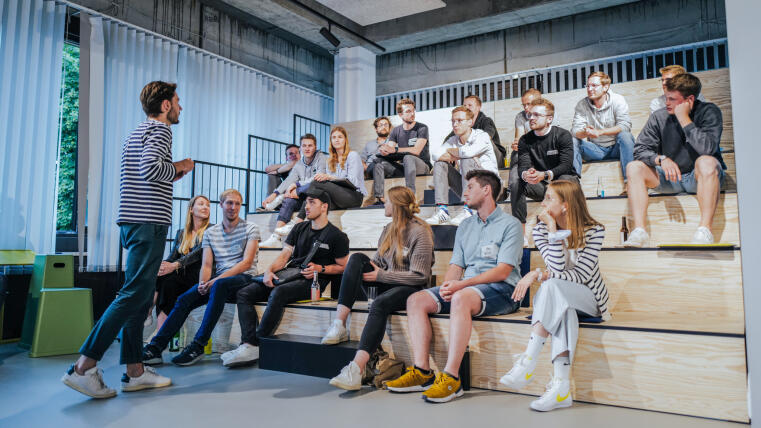
Memorising and plugging in formulas? That was yesterday. In order to get the several hundred first-semester students quickly up to speed and on the same page, the lecturers at the School of Business and Economics (FB 04) have developed the so-called “Onboarding module”. The students are motivated to “actively listen”, get involved and participate. This helps loosen up the “front-forward” teaching format so typical in lectures. In one such morning lecture, a wireless cube microphone weaves its away around the room, encouraging students to take part in the discussion. The professors regularly leave their post at the podium in lecture hall H 1 and speak directly to students seated in the upper gallery. The lesson plan is often augmented with guest lectures by top managers from international corporations like Henkel and Amazon, or successful German start-ups like Flaschenpost.
From day one, students are taught to regard business administration (BWL) as a science and participate in virtual-reality experiments. ‘We try to present the diversity of Münster’s BWL programme while conveying a bit of the emotional side, as well,’ explains Professor Thorsten Hennig-Thurau, who teaches and conducts research on the topic of marketing and media at the Marketing Center of the University of Münster. He and Professor Manfred Krafft have meanwhile established a tradition of asking two students “from the crowd” to come up on stage on the first day of class, greeting them with a handshake and welcoming them on board the “HMS BWL”.
It pays to keep the lectures lively and varied. Without inspiration, expertise has little value, explains Thorsten Hennig-Thurau. For him, the prospect that graduates might spend decades in a job they don’t like is a “horrible” thought. That’s why the faculty supports collaboration and student initiative – despite the high degree of preparation that goes into them. A mix of different course formats also helps in this regard. In addition to large lectures, numerous courses are offered in smaller formats.
Business administration is a subject distinguished by a diverse range of topics and didactic methods. By no means is it monolithic; students are also taught about finances, marketing, entrepreneurship and digital transformation. In addition to the BWL bachelor’s degree, the faculty offers master’s, doctoral and continuing education programmes that cover the economic spectrum – from business administration and macroeconomics to interdisciplinary programmes and information systems. By learning the respective theories through economic fundamentals, students are prepared to enter a highly diversified labour market. Starting on day one, the curriculum emphasises that economics comprises more than merely dealing with stock prices, markets and indicators. ‘People’s wishes and needs – whether they’re customers or employees – are what drive corporate success stories,’ says Thorsten Hennig-Thurau.
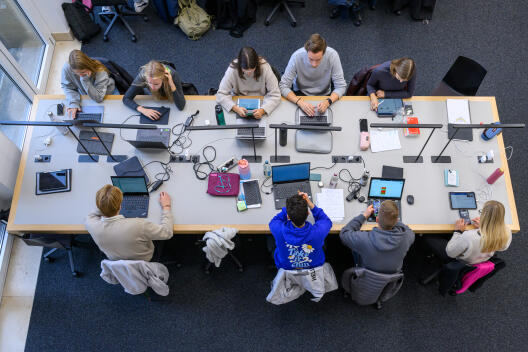
Even in the introductory phase of their programmes, students examine realistic problems that go beyond the classical “target-actual analyses”. For example, a group of information systems majors in the “Crisis Management” project seminar developed a simulation for a civil protection response that could be used by municipal governments to organise humanitarian aid in the event of a disaster. The students then presented their results and the material they developed to a regional company that supports them as a project partner.
For those thinking about starting their own company one day, the faculty’s instructors offer initial tools to do just that. These efforts are backed by the REACH – Euregio Start-up Center whose stakeholders work closely with the faculty. From brainstorming an idea in class to building a prototype to testing its marketability, the start-up teams develop their projects in modularly designed offices on Geiststrasse. Coaches and mentors are on hand to accompany the process. REACH also encourages prospective entrepreneurs to pitch their ideas at start-up fairs and competitions with the aim of attracting investors.
Embracing new ideas and developments, e.g. the rapid rise of artificial intelligence (AI), and putting them to use for the benefit of society is baked into the DNA of the faculty’s teaching activities. In the area of information systems on the Leonardo Campus, students and doctoral candidates are developing solutions for hospitals to improve medical treatment or for research projects from the humanities and cultural studies disciplines. They collaborate with external project partners, such as the professional football club Preussen Münster, the tool manufacturer HILTI and several transportation companies. Students can help come up with answers to current research questions and independently take steps to academically explore economic relationships.
There are several reasons for why talented young people choose to study business and economics in Münster. The quality of the faculty’s teaching and research activities and the inspiration they generate are reflected in national and international rankings. In fact, the faculty is ranked the second-best study location in Germany by DAX board members, its auditing department ranks fourth place by Manager Magazine, and Shanghai Ranking lists the faculty at sixth place. For students seeking international careers, the faculty offers numerous study abroad opportunities as well as four English-language master’s programmes: Business Administration, Economics, Information Systems and Business Development.
‘Our degree programmes open a variety of paths to understanding and shaping economic conditions,’ says Dr Stefan Schellhammer, Vice-Dean for Teaching and Student Affairs. ‘They create a basis for exciting career perspectives and development opportunities.’ Aside from the academic programmes, student groups offer various extracurricular activities or organise in social, community and entrepreneurial projects. These serve to strengthen self-initiative, creativity and a sense of responsibility, and help students build long-lasting networks.
Text: Brigitte Heeke