Teaching practical, real-world knowledge
A top-notch infrastructure and excellent instructors: At the faculty’s seven institutes, students learn to systematically analyse complex problems and solve them in international teams. In this way, they acquire the core skills for a career in the modern working world.
It won’t be a particularly “round” anniversary when the city of Münster celebrates its 1,235th birthday in 2028. Nonetheless, the city’s leaders are already considering marking the occasion by illuminating all the trees along the promenade with strings of lights at Christmastime. Of course, they are counting on numerous volunteers to help with decorating. The only obstacle to this plan might be the financial expense.
Before we go any further, we should mention that this scenario is entirely made up. But it is helpful. Especially for the teaching degree students in mathematics who, with their pupils, are drafting a (fictitious) cost estimate to implement the city’s idea to illuminate downtown Münster. This key competence is described as mathematical modelling, for which mathematical methods are used to solve real-world tasks.
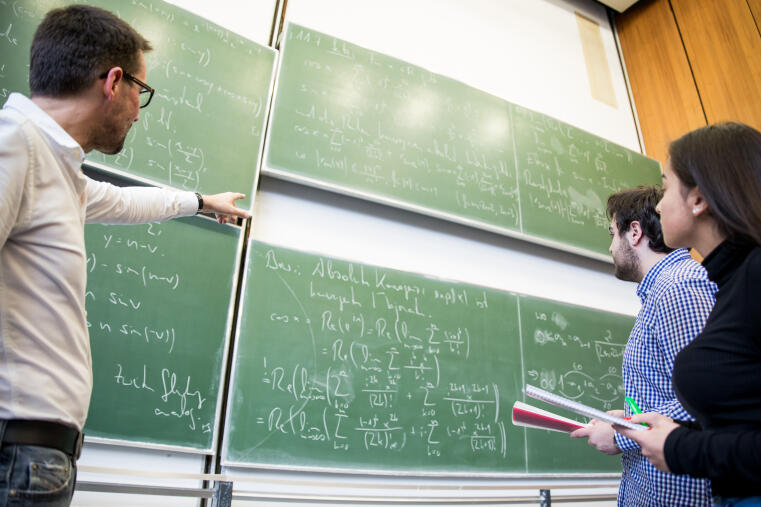
This is a typical challenge for the didactic approach in the Teaching-Learning Lab at the Faculty of Mathematics and Computer Science. Several times a year, talented maths students from various schools grapple with such assignments. The teaching students observe how the pupils go about finding solutions and offer tips – if necessary. ‘First of all, we want to get students excited about the subject by presenting them with especially practical problems,’ explains doctoral student Leander Koll who is interested in how best to train future teaching staff to use artificial intelligence in mathematical modelling. ‘Secondly, the students in these seminars can combine their theoretical knowledge with their pedagogical training.’ This is entirely in character for “FB 10” – the Faculty of Mathematics and Computer Science. In addition to somewhat complex theoretical fundamentals, the department heads in all seven faculty institutes are committed to conveying knowledge that is as practical and relevant to everyday life as possible.
It was exactly 30 years ago that the University of Münster merged mathematics and computer science into one faculty. Its present structure has on one hand enabled both disciplines to fully establish themselves, and on the other, allows a large group of students to enrol in teaching degree programmes, and others to pursue alternative career goals.
In the field of mathematics, the faculty’s six institutes focus e.g. on stochastics, analysis and numerics, logic and foundations, and “fundamental and inclusive mathematics education”. The working groups at the Institute of Computer Science cover all the central areas of their discipline, such as “software development and verification”, “embedded systems” and “data science”. ‘Our degree programmes are distinguished by the close interconnection of theory and practice, in other words, their strong application-based orientation,’ explains Dean of Studies and mathematics didactics scholar Professor Gilbert Greefrath.
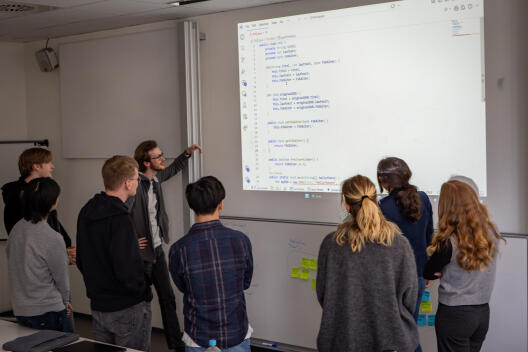
Besides the “Teaching-Learning Labs” at the Institute of Fundamental and Inclusive Mathematics Education, the faculty employs three other central teaching concepts. For instance, “inverted classrooms” primarily aim to increase student activity in the introductory lectures. ‘We give the students four challenging homework exercises each week, for which they can find the solutions online in the “Learnweb”. In this way, we gain valuable time for discussions and collaboration in the lectures,’ points out senior lecturer Dr Christian Serpé, whose didactic specialisation includes the development and use of (teaching) videos.
The project “MiRA” is also devoted to exploring “mathematics in real-world applications”. Mathematics, as faculty experts contend, is not only an integral part in many areas of everyday life, it is also ‘of elementary importance to the natural sciences and technology.’ Alternating with the traditional Teaching-Learning Labs, “MiRA digital” presents students with a digital variant which intensively examines how artificial intelligence can be effectively used, for example with “GeoGebra” software that combines geometry and algebra skills.
The tutorial training in computer science aims to convince students to adopt tutorials that are as interactive as possible. How and when do I give hints, and in what detail? The training is not only about helping tutors continually learn but also encouraging them to teach. All these ideas and projects are well received. The number of students in the faculty has steadily increased in recent years and currently tops 5,100, many of whom are just 17 years old.
The reason for its popularity may well lie in the fact that the faculty and especially the mathematics department have established a reputation that far exceeds Münster’s outstanding position in academia. Indeed, four Leibniz Prize laureates teach and conduct research at the faculty, and the collaborative research centre “Geometry: Deformations and Rigidity” is supported by the German Research Foundation (DFG) with millions in funding. The achievements of the Cluster of Excellence “Mathematics Münster” have proven lucrative as well. For example, since 2018 six researchers in the Cluster succeeded in securing one of the highly sought-after European grants, and with the establishment of the “Centre for Mathematics Münster”, a new research facility will be completed by 2027. Students are certain to benefit from the faculty’s top-notch infrastructure and first-class instructors.
The same applies to the Institute of Computer Science, which also intensively engages in collaboration with other facilities. For instance, it works closely with the Department of Information Systems and the Faculty of Geosciences. And students in almost all mathematics programmes and many other courses of study can minor in computer science.
Last but not least, the faculty has a very international character. Students have access to an extensive support network, ranging from full scholarships for talented international scholars to short-term grants for research stays, as well as specific study abroad programmes and Erasmus+ partnerships. ‘It is this diversity that makes studying in Münster so future-oriented,’ says Gilbert Greefrath. ‘Aside from gaining subject-specific expertise, students learn to systematically analyse complex problems and solve them in international teams – a core skill for the modern working world.’
Text: Norbert Robers