Encouraging critical thinking and assuming responsibility
Our teaching activities focus on working with the “Book of Books” – the Bible. In addition to studying classical disciplines, there are many possibilities to specialise and engage in international collaboration. Upon completion, graduates can look forward to exceptional career opportunities.
It has been more than 500 years since Martin Luther refused to recant his treatises and theses at the Diet of Worms. Addressing Emperor Charles V, he insisted it would be ‘difficult, unredemptive and dangerous’ were he to act against his conscience, especially against the Holy Scriptures. Centuries later, the pioneering reformer’s position has lost none of its relevance. On the contrary, Luther’s view remains an essential component of Protestant doctrine and an integral part of the Protestant DNA. For Martin Luther, the Bible – as the word of God – was a road that led to life. He believed that God spoke to us in the Bible as a ‘fellow man to his friends’. He concluded that ‘the Bible is not ancient, nor is it modern – it is eternal.’
Therefore, it is no surprise that the “Book of Books” remains the core focus of every Protestant theology degree programme – as it is in Münster, home to one of the largest training facilities for Protestant theology in Europe. While the Catholic Church regards both the Holy Scriptures and papal and episcopal doctrine as equally important source material, Protestant theologians regard the Bible as the sole foundation of all action and thought: “sola scriptura” (by Scripture alone). As Dr Sarah Riegert, the faculty’s managing director, explains, ‘we work intensively with the texts, that is our distinctive basis.’
The course offerings span the five main traditional disciplines: Old Testament including Biblical archaeology,
New Testament, church history, systematic theology (dogmatics and ethics), and practical theology including religious education. For the 19 degree programmes, students must substantiate a certain level of proficiency in various languages. For example, those who pursue a “Magister Theologiae” or an ecclesiastical final examination are required to pass the Advanced Latin language certificate (großes Latinum), the Ancient Greek language certificate (Graecum) and the Hebrew language certificate (Hebraicum) before the intermediate examination. For those studying to become a teacher, one must pass either the Graecum, the Hebraicum or the Basic Latin language certificate (kleines Latinum).
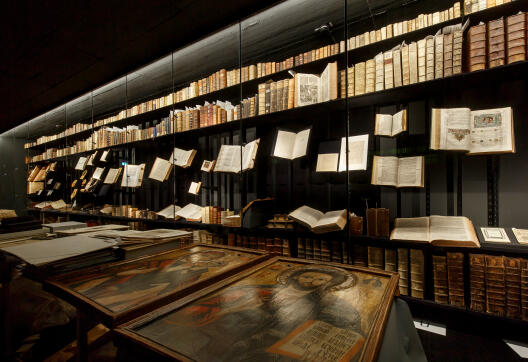
In addition to this indispensable “foundation”, there are multiple ways for students in Münster to gain expertise in an area of specialisation. With the Institute for New Testament Textual Research, the Bible Museum, the Institute for Ethics and Associated Social Sciences, the Institutum Judaicum Delitzschianum, the Institute of Ecumenical Theology, the Department of Reformed Theology and the Department of Religious Studies and Intercultural Theology, ‘one can choose numerous focal areas of specialisation within one’s degree programme,’ says Dean of Studies Professor Christophe Nihan. Another interesting course of study in past years has been the master’s programme in “Spiritual Care” which introduces graduates to ‘new approaches in holistic guidance and counselling for people coping with illness, crisis and suffering.’
There are three “key aspects” that are integral for all teaching and non-teaching degree programmes at the Faculty of Protestant Theology. First: critical skills in pluralistic thinking. Students should be able to form their own, informed judgement while also remaining open to varying perspectives. ‘For us, the individual lies front and centre,’ says Christophe Nihan. ‘We want to encourage critical thinking while also closely intertwine theory and practice with respect to our social responsibility.’
Second: collaboration with other disciplines, knowledge transfer in society and the promotion of “soft skills”. Theological training covers a broad historical and systematic range – from antiquity to the present day. Consequently, it encourages exchange with other disciplines and subjects and helps students develop basic but important skills, such as academic writing, public speaking and substantiated argumentation.
The third key aspect: “the methodology of materiality of religions”. To this end, students acquire skills that enable them to interact with the material forms of religious expression, such as manuscripts and rituals. The important thing is a willingness to “learn from outsiders”. As Sarah Riegert points out, ‘in a globalised working world and in culturally mixed teams, this is absolutely essential.’
The degree programme in theology offers a ‘very sound basis’ for entering a variety of occupational fields – even outside the rectory. Students benefit from various possibilities that allow them to spend part of their programme studying abroad. The Faculty of Protestant Theology has concluded numerous cooperation agreements with international universities and Erasmus programme partners, e.g. in Zimbabwe, Jerusalem, Rome, Vienna and Hong Kong. In close coordination with the Careers Service of the University of Münster, the faculty also offers a broad range of advisory services and seminars on personal career orientation and profile-building. Other seminars teach participants self-management, building professional networks, professional communication and application training. Based on the faculty’s observations, students have close to a 100 % chance of practising a profession after graduation.
The University of Münster has a long tradition – indeed since its founding – of strongly focusing on theological study. In the coming years, this tradition stands to greatly benefit from the new “Campus of Theology and Religious Studies”. The Faculties of Catholic and Protestant Theology will be situated at a single location together with the Faculty of Islamic Theology. Centralising the faculties will result in the creation of the largest theological library in Europe. According to the Rectorate, ‘by bringing together old and new institutional structures, the University of Münster will not only strengthen interdisciplinary partnerships but also send a signal for navigating religious diversity and equal treatment.’ This could well be of great interest and value to all future theology students.
Text: Norbert Robers