Specialist training with a human touch
In the Faculty of Medicine, students quickly learn to take responsibility – in a practice-oriented, scientifically informed and human-centric way.
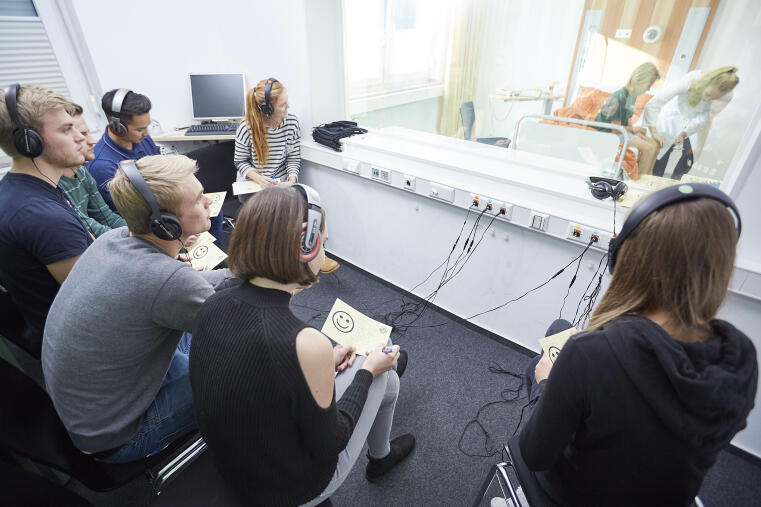
This morning when Sophia enters the treatment room in the “Study Hospital Münster”, a certain “Rafael Mendes” is already waiting for her. Fingers tapping restlessly on the armrests, he looks nervous and is seeking eye contact. She’s here to discuss an upcoming operation he’ll be having. Gently, clearly, professionally. Rafael Mendes is the name of today’s patient, who is being played by a trained amateur actor. Nonetheless, the situation seems real – and that’s exactly the point. The students are taught to embrace closeness, while also keeping a certain professional distance. The roleplay is meant to build up students’ confidence, not only in terms of their medical knowledge but also their future role as a doctor.
This experience is typical for degree programmes in human medicine, dentistry and midwifery studies at the University of Münster. The objective is to train scientifically informed and practically competent doctors and midwives who are capable of acting independently, gaining advanced qualification and conducting research on their own. In addition to learning about bodily functions and illnesses, they acquire competence in diagnostic, therapeutic and preventive methods, ethical orientation, communication skills and a cross-disciplinary understanding of medicine. The Faculty of Medicine regards its medical training as central in developing one’s identity, otherwise known as “professional identity formation”. ‘The goal isn’t to make our graduates think, feel and act like doctors, but rather to be doctors,’ says Dean of Studies Professor Bernhard Marschall.
The faculty has implemented a clearly structured and practice-oriented path to achieving just that. The full medical degree programme takes at least six and a half years to complete and is divided into a four-semester preclinical and an eight-semester clinical period of study. The latter includes the “practical year”. The curriculum is supplemented by a first-aid training course, a stint of nursing service, mandatory work placements – called “Famulaturen” (clinical traineeships) – and a three-part medical examination. This nationally standardised framework offers students orientation and allows them to specialise in areas of personal interest. The medical programme in Münster is unique in that courses are not held independently of one another, but are rather embedded in thematically related modules, such as the “Cardio-vascular system” or “Musculoskeletal system”. This allows students to better apply any prior knowledge they have and integrate newly learned information, which in turn facilitates lifelong learning.
For students like Sophia, this structure is filled with life at the Study Hospital. Under simulated traffic noise, they learn how to carry out onsite emergency examinations, conduct patient consultations and stitch up wounds on synthetic skin in the “SkillsLab”. They begin practising their skills with healthy people, and later with actual patients. Making mistakes is expressly allowed, for learning is all about trying, failing and improving. The various teaching formats – such as class instruction at a patient’s sickbed, seminars in small groups, problem-oriented learning in tutorials and practical courses and block internships – are all interconnected.
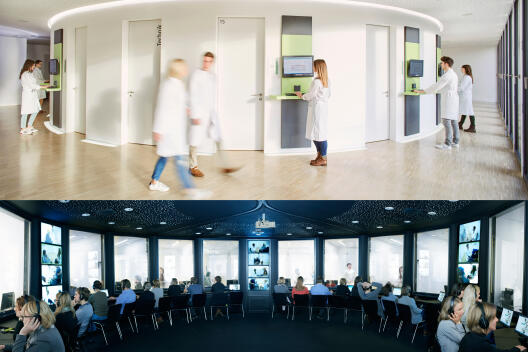
The combination of practice and theory continues in the scientific component of the programme. In addition to realistic training environments, such as the Study Hospital and the “LIMETTE” learning centre, a new, cutting-edge Study Lab will be added to the faculty in 2026. This new facility, unlike any other in Germany, will offer far greater scientific depth to the medical programme where academic life will be influenced by numerous research projects, research schools and doctoral programmes. In this way, up-and-coming medical professionals will be introduced to current research topics at an early stage – from molecular mechanisms to innovative imaging techniques to the latest clinical studies. This goes to show that research is not regarded as an afterthought, but rather as an integral part of medical practice. Especially accomplished students have the opportunity to augment their studies by participating in parallel doctoral courses in the “MedK” medical college, dedicated to systemically connecting experimental research with a clinical context.
This clinical context is supported by a broad medical infrastructure. The University Hospital Münster (UKM) with its numerous specialised clinics and centres represents almost the entire spectrum of modern medicine. The clinical range is directly reflected in the training programme, which is further strengthened by close partnerships with other disciplines, e.g. biology, chemistry, pharmacy, physics, mathematics, computer science and psychology. In other words, medical training at the University of Münster takes place in a scientific environment that combines basic research, clinical application and technological innovation.
The use of digital tools is part and parcel of this strategy. They complement patient-oriented training by facilitating in-depth learning and promoting considered action. The lectures are offered in hybrid form, i.e. in-person classroom instruction can be viewed simultaneously online. Students can access their documents, e.g. timetables and course certificates, via an app specifically developed for this purpose by the faculty. Artificial intelligence helps students practise consultations and simulations, while virtual-reality applications allow them to respond to scenarios that are difficult to train for in advance, for instance, diagnosing brain death.
Another factor that distinguishes Münster’s medical programme is its personal character. The University of Münster is one of the few higher education institutions in Germany that allows students to enrol in both summer and winter semesters. The result is relatively small cohorts which is conducive to more personalised supervision, greater professor-student interaction in class, and room for scientific curiosity – also with respect to one’s future career path.
At the end of the practical day, Sophia reports on her conversation with “Rafael Mendes” in her seminar. She describes several situations which she would have liked to have resolved differently. Her instructor listens carefully, asks questions and encourages her. Knowledge is the basis, but only by consciously applying it can students learn to assume responsibility. And what applies to patient treatment also applies to science in general. Which is exactly what students learn in Münster – step by step, conversation by conversation, experience by experience.
Text: Dr. Kathrin Kottke