Perfect balance of theory and practice
To understand what makes chemical-pharmaceutical instruction at the University of Münster so exceptional, you need only visit the PharmaCampus and put on a lab coat. The analytics practical course in the master’s programme “Chemistry” is a perfect example of the cutting-edge, practice-relevant training that students receive at the Faculty of Chemistry and Pharmacy.
Theory and practical application in harmony
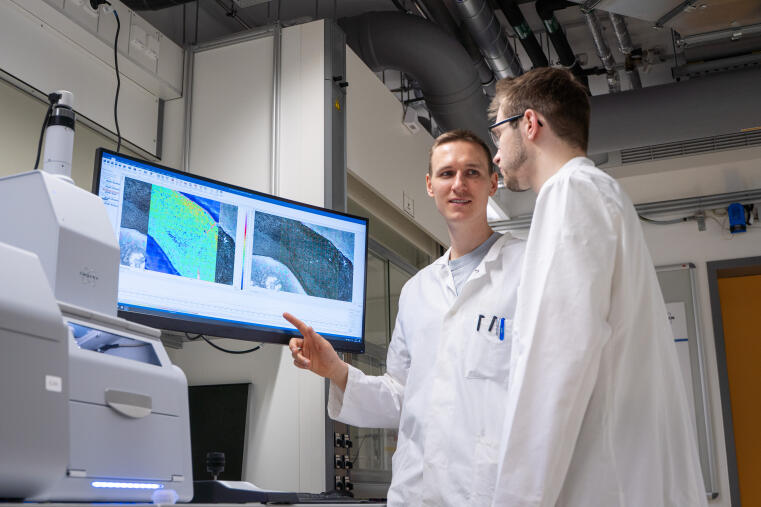
In the basement of the PharmaCampus, an infrared microscope scans the cross-section of a mouse aorta at 10,000 pixels per second. This powerful device produces high-resolution images at a scale so small that a human hair appears the size of a bridge pier. The sharpness in detail is important to doctoral candidate David and the group of four master’s students that he supervises. In the practical course “Analytical chemistry”, the group is investigating aortic aneurysms, i.e. abnormal dilation of the main artery, by analysing the molecular composition of the tissue.
The analytical work conducted by this group is typical of the practical approach offered at the faculty. ‘Whether it’s chemistry, food chemistry or pharmacy – we offer students a broad selection of degree programmes where theoretical training is closely tied to practice-related elements,’ explains Dean of Studies Professor Klaus Langer. Concretely, this means that about half of all the modules contain practical components, for which students are required to conduct experiments in the laboratory.
This is what 64 students are busy doing for six weeks in the analytics practical course, each seeking answers to research questions of their own. The topics are largely relevant to everyday life, for example, analysing tattoo dyes, examining the properties of batteries or investigating water samples after treatment with contrast agents used in medicine. To this end, students require a theoretical foundation which they mainly acquire in the early phase of their programmes, e.g. in the “Introduction to inorganic chemistry” (chemistry), in the “Fundamentals of medical and pharmaceutical chemistry” (pharmacy) or in “The microbiology of food” (food chemistry). During the analytics practical course, students attend one of four rotating lectures every day which provide a theoretical foundation for their activities in the lab.
Thanks to this combination of theoretical study and practical application, the faculty teaches students fundamental knowledge while allowing them to assume greater personal responsibility and closer proximity to research. This strategy is not only evident in the analytics practical course, but also at the “PharMSchool”. During their four-semester main study phase, pharmacy students intensively devote themselves to research matters. In group projects, they creatively and independently explore the pharmaceutical aspects of various illnesses and disorders, such as depression, respiratory infections and obesity. This strong connection between research and teaching culminates in the eighth semester with a public symposium, at which the students present their projects. The quality of the concluding presentation is reflected by the fact that it is recognised as a continuing education course for certified pharmacists and is targeted at the academic community of pharmaceutical professionals.
Research and practice play a central role in the area of food chemistry instruction, as well. For example, in a beer brewing module, bachelor students are introduced to food-chemical theory and practice as it relates to brewing beer. After receiving extensive theoretical instruction, the groups craft four to five different types of beer per year. In addition to teaching students the relevant chemical-analytical skills, the offered courses facilitate a greater identification with their subject of study and promote a strong sense of belonging among the students.
Cross-disciplinary teamwork
This sense of belonging is not an accidental side effect of instruction, but rather an essential component. ‘Research always happens in teams – and that’s what we teach students every day,’ explains Klaus Langer. Cooperation plays an especially important role in the later stages of one’s studies. For while the introductory practical courses take place during one’s degree programme, students increasingly collaborate with other disciplines in research projects later on.
And the same goes for the analytics practical course. The group investigating the mouse aortas received their tissue samples through the mail from a nuclear medical researcher who works at the Berlin Charité. In consultation with the researcher, the students hope to find out how the metal ion concentration in the sample influences the formation of aneurysms. This experiment alone results in more cross-disciplinary contacts than appear in the faculty’s name: biology, materials sciences, physics, computer science and medicine. The latter is particularly relevant to pharmaceutical instruction, as the collaborative project “SPHERE” demonstrates. In this project, medical and pharmaceutical students work together in a year-long practical course to plan therapies and practise treating patients. Economics is another discipline that maintains close ties to the faculty, for example, in the English-language master’s programme “Business Chemistry” which offers a combination of management, technology and chemistry modules. While the analytics practical course maintains contact with Berlin, other teaching formats have a far more extensive scope when it comes to joint partnerships. ‘Interdisciplinary collaboration extends even beyond national borders,’ says pharmacy professor Klaus Langer. This is due to the high degree of internationalisation in research. ‘Our instructors cultivate an outstanding network of global contacts – and our student researchers benefit from this. One example: around half of all our master’s students in chemistry gain experience abroad by way of research internships in industry or at universities – in Japan, China, Italy, Sweden and many other countries.’
Career training and perspectives
Whether one decides to work in Germany or abroad, the experience and contacts gained in the programme serve as an excellent basis for pursuing a doctorate or entering the job market – in the pharmaceutical or chemical industry, in pharmacy or research institutes, in schools or government agencies. ‘The opportunities are wide-ranging and the prospects of finding a job are very good,’ points out Klaus Langer. The faculty is committed to ensuring that students receive an outstanding education. At the same time, it strives to enable them to work independently in a responsible and cooperative manner, to continue honing their skills and meet their social responsibilities. ‘Chemistry and pharmacy are often criticised – and unjustly so. We train students so that they can inform the public about their work and contribute to solving the challenges facing society – for example, as teachers in schools, in battery research or in fighting diseases,’ explains Klaus Langer. The analytics practical course at the PharmaCampus perfectly embodies this aim. The students analyse the infrared images of the aorta, determine the molecular distribution and thereby contribute important data for group leader David’s doctoral project. In this way, they may be bringing us one step closer to curing cardio-vascular diseases someday.
Text: André Bednarz