Where theory and practice go hand in hand
From individual molecules to entire organisms, from lab work to field studies – students in the Faculty of Biology learn how evolution shapes life on earth.
Justus sits at a group of tables with three other teaching degree students in a bright, modern seminar room. He wears a nose clip to prevent air from passing through his nose. The master’s student breathes in and out through a tube. The others observe a laptop, which graphically depicts the curve of Justus’s breaths. In today’s class in the tandem module “Teaching human biology with digital tools”, the students are learning about breathing – an important topic in biology, the study of living organisms.
What can school-leavers expect if they choose to study life sciences? They become acquainted with the broad range of the discipline, from biochemistry to cellular, neuro- and behavioural biology to biotechnology. The course material primarily introduces students to the fundamental questions of biology. How has evolution spawned today’s life forms, and how does it work? How do animals, plants and other organisms react to changing environmental conditions? Biology explores these questions from the macro- to the micro- level, from populations in their ecosystems to individual organisms and cells, all the way to single molecules. The methodological spectrum ranges from field studies to computer-aided simulations to molecular-biological lab work. Students investigate genes, proteins and other biomolecules as single entities and in their entirety in the form of massive datasets. The faculty provides equipment that is essential for many working groups, such as mass spectrometers used for analysing molecules, and high-resolution microscopes which can peer into the depths of cells.
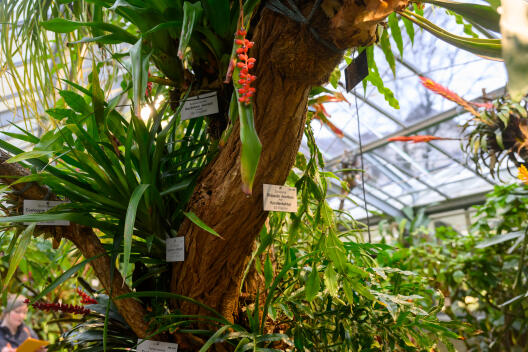
Around 50 percent of students in the Faculty of Biology are enrolled in teaching degree programmes, while the other half study biosciences/life sciences. Following their bachelor’s degree, they can choose to specialise in one of four master’s degree programmes – Biosciences/Life Sciences, Biotechnology, Molecular Biomedicine or Water Sciences – which prepares them for potential careers in science, industry or public agencies. Didactics and technical disciplines are closely interwoven. ‘What specialist knowledge do teaching degree students need, and what should they later teach their students? And with regard to didactics – how should they go about it? Both aspects go hand in hand,’ explains Professor Bettina Zeis, Vice-Dean for Teaching and Student Affairs. In tandem modules, for example, a digitally rendered three-dimensional model of cardiac contraction helps students understand the biological processes and shows how they might integrate them into classroom instruction. This is augmented by observing under a microscope the heartbeat of a water flea – a real, living specimen. ‘This is how the faculty implements its teaching strategy of closely interweaving theoretical knowledge with practical elements. Alongside lectures and seminars, laboratory experiments convey knowledge of modern methods.’ The students also use learning venues, such as the Botanical Garden and the faculty-operated Marine Biology Tidal Flat Station in Carolinensiel, and they benefit from the faculty’s international partnerships which offer opportunities for studying abroad.
Back to Justus and the tandem module. The methodological focus of today’s class is spirometry, a procedure for measuring lung volume. Students are initially introduced to the fundamentals of human anatomy and physiology. Later in the semester, they will develop a school lesson plan. ‘I’m glad we’ll be holding the lesson with a class in the Teaching-Learning Lab,’ Justus says. ‘I feel that having contact with pupils during our studies is extremely important.’ Fellow student Hanna adds, ‘Throughout the course, we’re constantly considering what skills we want to teach and are given free rein to try out what can be feasibly carried out in school. This didactic orientation is a big help to me.’ The practical day in the Teaching-Learning Lab is filmed with omnidirectional cameras and later analysed to provide the students with detailed feedback. Throughout the module, the instruction strongly focuses on the subject-specific didactical use of digital media and tools. These enable prospective teachers, for example, to let their pupils observe respiratory movement with a 3D simulation of the lung via virtual-reality glasses.
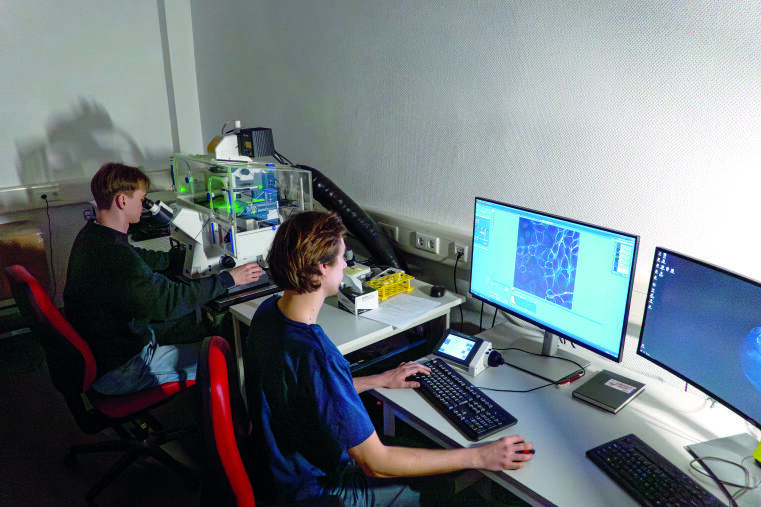
Another student, Tim, is pursuing his master’s degree in Biosciences/Life Sciences. He is working in the microscopy room. He fixes a cell sample on the stage and warms up the fluorescence microscope’s argon laser. He has just come from the sterile laboratory to check whether the cells are actually building the proteins he hopes to investigate. With the microscope, he wants to see how cells form specialised contacts between themselves, and so doing, create stable and organised cellular structures. He is working with an epithelial cell line derived from kidney tissue. Epithelial cell structures cover the exterior surfaces of the body and line internal cavities and organs. Consequently, they play an important function as a protective layer and barrier. ‘When the cell-cell contacts are disrupted, it can result in illness,’ Tim explains. He uses genetically engineered cells. The proteins that are so important for his research become visible in the living cells through fluorescence. They can also be temporarily and individually influenced with brief light impulses. In this way, Tim can observe in real time how their dynamics change and how it directly affects the stability of cell-cell contacts. This allows him to draw conclusions about the function of the proteins.
Tim is busy working on his master’s thesis and is fully involved in researching with “his” working group. ‘During my bachelor’s programme, I completed an advanced module on cell biology with the same group,’ he recalls. After that initial contact, he was thrilled. He subsequently wrote his bachelor’s thesis, completed a research module and eventually started his master’s thesis in the same group. ‘I had already become familiar with and applied a number of molecular biological techniques during my bachelor’s programme. I also learned how to operate the fluorescence microscope. Over time, I was given more and more responsibility to do my work on my own.’
That is exactly the intention, explains Bettina Zeis. Every science major must complete two eight-week research modules. ‘Usually, students use them to determine which research groups and themes would be suitable for their final theses, and they learn how to conduct research independently. This has enabled us to establish “learning through research” as a standard teaching method in our faculty.’
In the meantime, Tim envisions what his experiments should look like, he plans his trials on his own and carries them out by himself. ‘I’m the one responsible and free to research the way I want. That’s what I like best,’ he says.
Text: Dr Christina Hoppenbrock