Experts with all-round competence
Without physics there would be no technological progress. The Faculty of Physics teaches students these advanced technologies and how to use them responsibly. Students also acquire fundamental skills that are in high demand in many jobs.
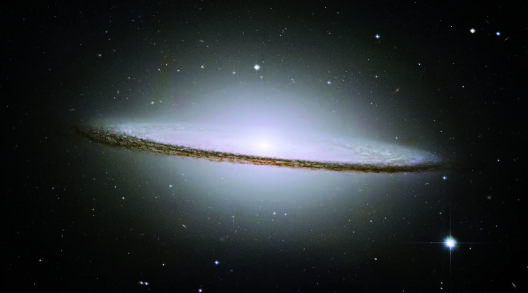
Students majoring in physics or geophysics at the University of Münster can expect a programme of superlatives. Whether you’re interested in the endless expanses of the universe, want to delve into the innermost depths of the Earth, or wish to work with the thinnest materials in the world, it’s all possible in the Faculty of Physics. And that’s just the start.
‘We have distinguished experts on all topics of study listed in the curriculum,’ says Professor Hubert Krenner, Vice-Dean for Teaching and Student Affairs. ‘That’s a strength that extends beyond textbook knowledge.’ Consequently, the curriculum has a strong research-oriented focus. While writing their bachelor’s theses, students can participate in current non-teaching and didactic research projects on a trial basis. To this end, they can join one of around 45 active working groups in the faculty. These groups conduct research in nano- and particle physics, the physics of complex systems, geophysics and subject-related didactics that ties in aspects of the natural sciences, technology and education. Some of these groups are part of interdisciplinary institutes with which the faculty collaborates, including the Center for Nanotechnology and the Center for Soft Nanoscience.
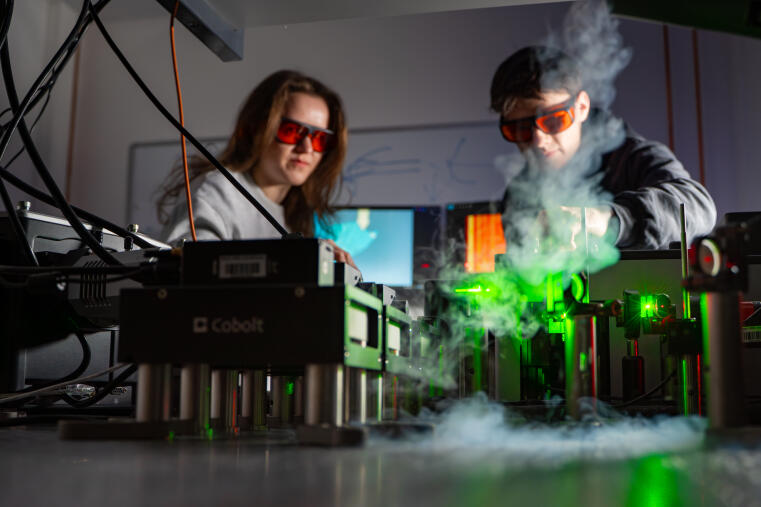
Such collaboration offers students numerous opportunities, e.g. to work in the laser laboratory or in the nanofabrication cleanroom, help develop high-precision equipment or technologies at infinitesimal scales or conduct theoretical physics on a supercomputer. Teaching degree students can develop programming series for learning robots for use in the classroom or devise inexpensive experiments that can be carried out on 3D printers. Regardless of what topic fascinates them, the students all work by the same rules of the descriptive discipline of physics whose researchers conduct experiments and develop models and theories based on their results. These help inform new predictions which can be tested anew in further trials.
In addition to theoretical training, practical courses are equally important as they form the foundation of experimental training. ‘We’ve developed a new introductory practical course,’ reports Hubert Krenner. ‘Students can carry out initial experiments without any prior knowledge, followed by further experiments that become increasingly complex.’ This enables students to optimally prepare for their final projects.
Aside from the skills that are required for certain occupations, e.g. working at a school as a teacher or for a career in research or industry, “all-round competence” is of particular importance. What distinguishes the professional profile of physicists is the ability to quickly familiarise oneself with complex, technical topics and develop structured strategies and solutions, explains Hubert Krenner. ‘From the very start, we train students to acquire these skills by offering them insights into all areas of physics – from theory to experimentation – and enabling them to solve a wide variety of problems.’
Social responsibility also plays an important role. In the area of artificial intelligence, for example, students are confronted with such issues as transparency, fairness, data protection and potential misuses. Not only are they expected to gain technical skills but also learn how to apply these in a responsible manner. Socially relevant topics are also a recurring theme in the degree programmes, e.g. developing environmentally sustainable materials or resource-friendly technologies.
Speaking of technologies, many areas of physics are seeing rapid advances. Photonic quantum networks, for instance, promise fast and secure next-generation communication, while computer hardware is becoming ever smaller, and measuring techniques ever more precise. Physicists are significantly involved in these developments. Physics teachers, on the other hand, have to respond to these dynamics in class. As a result, the faculty is currently redesigning its course of study for prospective teachers. For example, a new theoretical physics lecture is expected to begin in the winter semester 2027/28. It is specifically targeted at students in two-subject bachelor’s teaching programmes and will focus more strongly on the needs of school-based instruction.
In the non-teaching degree programmes, the areas of computational physics and artificial intelligence will be afforded greater attention. After all, modern physics wouldn’t exist without model- and data-based methods. They allow us to understand and simulate complex systems and make corresponding predictions, e.g. on the movement of magma oceans in the Earth’s mantle, climate events, the characteristics of biological systems and the phenomena of particle physics. Numerical simulations and data analyses serve as a bridge between theory, experiments and applications.
That is why students acquire competence in mathematical modelling, numerical simulation, programming, statistical data analysis and machine learning – skills that are required in numerous occupations, e.g. in industry and research, the finance sector, energy management and technology companies. The Faculty of Physics is also heavily involved in developing the new cross-faculty master’s degree programme “Interdisciplinary Data Science”. The programme offers physics students the opportunity to combine their analytical and mathematical strengths with modern data science methods.
And finally, one for the record books: At the Faculty of Physics, one can also conduct research at the South Pole – though this privilege is reserved for only a select handful of students. The measurement data of the large-scale experiment “IceCube”, situated below the surface of the ice near the geographic South Pole thanks to researchers from Münster, is delivering insights into the secrets of cosmic neutrinos. Researchers here in Münster are responsible for analysing data produced by these “ghost particles” – 15,785 km away from the southernmost point of the Earth.
Text: Dr. Christina Hoppenbrock