Law for the common good
There is possibly no other course of study as steeped in history as the law programme. The Faculty of Law draws strength from its more than 100 years of teaching experience, while proving that innovation in jurisprudence is possible.
The mandatory requirements
The state examination degree programme comprises at the core of the law curriculum. It is based on the “Act on Legal Examinations and Legal Preparatory Service (Legal Education Act of North Rhine-Westphalia – JAG NRW)”. Those who successfully complete the examination programme and legal preparatory service (practice-oriented legal clerkship (Referendariat)) may call themselves a fully trained attorney (Volljurist) and, depending on their aptitude, can work as a judge, state attorney or lawyer.
More than 600 young people begin their academic journey at the Faculty of Law every year, usually starting in the winter semester, but also quite a few in the summer semester. The students’ high success rate is due in no small part to the faculty’s expertise in teaching. The professors and dozens of other instructors begin by conveying the fundamentals of their discipline in lectures, e.g. in the areas of civil, criminal and public law. At the same time, students are introduced to the history and philosophy of law, as well as various process and procedural regulations. ‘The large lectures are an important tool; they allow us, together with the students, to efficiently lay the necessary foundation for the further course of their studies. This frees up capacities to provide more intensive supervision to students working in small groups in later semesters, which is so valuable,’ explains Dean of Studies Professor Gernot Sydow.
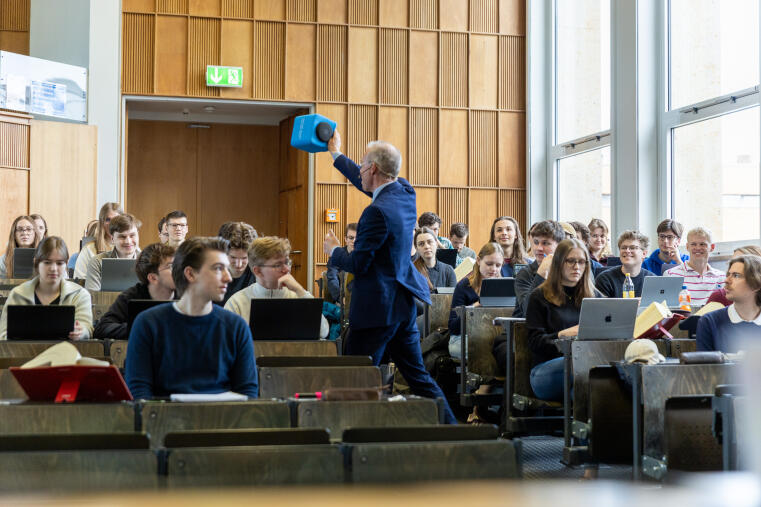
Lectures and study groups are central to the first two semesters in the two-year foundational study phase. Gernot Sydow offers the course “German and European Constitutional Law”. Some 350 first-semester students sit together in tightly packed rows in auditorium F 1. Law is one of the few disciplines at the University of Münster that boasts such a high attendance rate – and that without a mandatory attendance rule and with students far beyond their first semester.
When he addresses the topic “Republic and Secularity” in his lecture, Gernot Sydow demonstrates that – contrary to what many assume – the Faculty of Law does not focus on teaching students to memorise legal statutes by heart. It’s more about transnational comparative law, historical bases and processes and, above all, mindsets and working methods. Students learn the processes and principles of legal work. This provides them with the argumentative and methodical skills to solve practice-oriented test cases – the ideal prerequisites for a future career in law.
On their way there, they are required to pass an interim examination in the fourth semester. The fifth and sixth semesters are devoted to areas of specialisation. This is when students specialise in one of ten focal areas of law, e.g. “Business and Corporations”, “Criminology” and “Labour and Social Matters”. The style of instruction also changes at this point. The lectures are usually much smaller and specialised and can be selected by students based on their personal interests.
For an impression of the intensity and student-centred focus of teaching at the Faculty of Law (FB 03), one need only visit the faculty’s own final examination review course “unirep”. During the seventh and eighth semester, students review the content and especially the methods taught in the prior semesters in preparation for the first state examination. The review course “unirep” is widely known throughout Germany and attracts a number of transfer students. The faculty invests a great deal of time, money and staffing in this structured and free review course in lectures, working groups and courses, supplemented by extensive services online. This is where students can download practice examinations and their solutions, handouts, recorded lectures and podcasts. In this way, the faculty lives up to its mission to provide students with optimal preparation for these important final examinations. ‘There are regulations in place that precisely define the structure of the state examination degree programme. ‘But at the same time, we want to be flexible and show initiative so that we can cater to the needs of our students as best we can,’ says Gernot Sydow.
A plenitude of options
Even if the state examination programme is often equated with the study of law, the teaching activities at the faculty are heterogenous, international and interdisciplinary thanks to several bachelor’s and master’s programmes. ‘There are very few faculties of law in Germany that offer students such a broad selection of programmes,’ asserts Gernot Sydow. These include the dual degree programmes “Economics and Law” and “Political Science and Law” and such internationally oriented programmes as “German and French Law” and “International and Comparative Law.”
To underscore how much it values the diversity of legal instruction, the faculty has meanwhile established three internationally oriented chairs. One of them is held by Professor Elsemieke Daalder, who discusses property rights in comparison with other European countries in one of her lectures. Like Gernot Sydow, she too avoids teaching at students from the front. Instead, she gets students to review older materials while taking new content into consideration. She speaks freely, offers numerous anecdotes and is approachable. In this respect, she and Gernot Sydow exemplify the dynamic and collaborative teaching methods employed at the Faculty of Law. ‘High standards are important to us, as is offering students degree programmes and career prospects that are as individualised as possible,’ explains Gernot Sydow.
Balancing achievement and care
‘Studying at university can and should be the most wonderful time of your life,’ says Dean of Studies Gernot Sydow to the first-semester students in auditorium F 1. However, high expectations, psychological illnesses and loneliness can make studying difficult. ‘Most of you will have no problems, but for those who do, let me assure you: you are not alone.’ Gernot Sydow hopes this important digression about what really matters can offer students some clarity and relief. ‘You can’t put yourself under pressure to perform during your whole programme and entire life.’ He knows that the study of law requires hard work, discipline and perseverance, and that the curriculum is demanding. Therefore, he is committed to establishing a disciplinary culture that also celebrates average performance, i.e. a “satisfactory” grade. ‘Take care of yourself and others,’ he urges his listeners, proving that the Faculty of Law is there to support its students. They show their instructor their gratitude with a rousing round of applause.
Text: André Bednarz