Safeguarding access to our cultural heritage
Were it not for the subjects of history and philosophy, we could lose access to our cultural heritage. This is why the range of programmes at the Faculty of History and Philosophy is especially broad. Its teaching activities are supported by four pillars: interdisciplinary networking, research- and practice-oriented diversity, digital course offerings and internationalisation.
Do we really need to look back to the past? Or is history yesterday’s news? The American historian and two-time Pulitzer Prize winner David McCullough had a strong opinion on this. ‘History is a guide to navigation in perilous times,’ he wrote to his students at Wesleyan University in their graduate year-book in 1984. ‘History is who we are and why we are the way we are.’ By raising central questions about the human existence, history has always been, and continues to be, relevant to society.
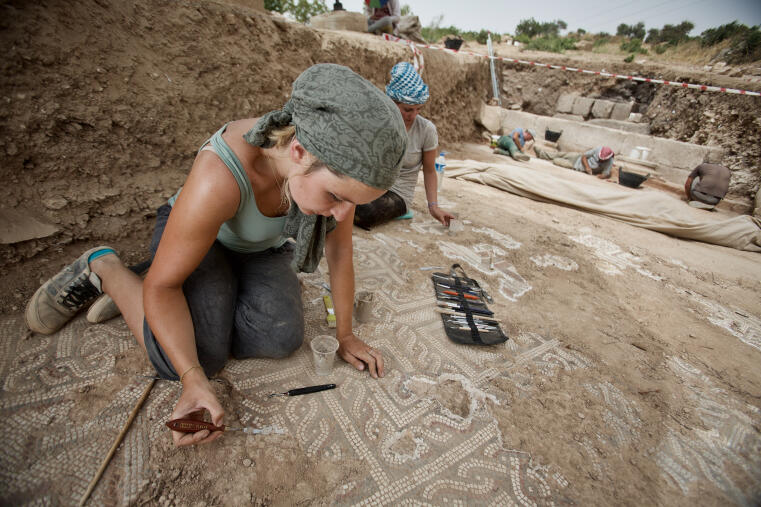
The same spirit is alive and well in research and teaching at the Faculty of History and Philosophy. Its teaching activities are comprised much like a mosaic – especially in terms of interdisciplinary networking, research- and practice-oriented diversity, digital course offerings and internationalisation. ‘We are devoted to studying and preserving history and culture,’ says Dr Susanne Pinkernell-Kreidt, Vice-Dean for Finances and Academic Organisation in the faculty. ‘Without subjects like history and philosophy, we would lose access to our cultural heritage. That’s why these subjects and their content are so important.’
Whether as a teacher at school, an employee in the cultural sector or a researcher at a university, knowledge transfer into society is a fundamental principle embedded in humanities courses. ‘We believe that students should not retreat inside an ivory tower,’ says Head of Faculty Professor Eva-Bettina Krems. Just the opposite. For instance, the faculty is one of the largest teacher training facilities for all types of schools in the state of North Rhine-Westphalia in the subjects of History, Greek, Latin and Philosophy.
The degree programmes cover a broad spectrum, ranging from classical studies and history to ancient languages, art history and musicology to cultural and social anthropology and philosophy. During the introductory phase, students learn the fundamentals of their subject of study, such as applying scientific methods and discussing current political and social issues. The lectures, seminars, practical courses and excursions also teach students how to work with humanities-related texts, objects, sources, historical documents and material estates. The goal is to allow them to apply theoretical knowledge in practice, assess the relevance of information, recognise contexts and relationships and express these appropriately in written form. Regardless of their desired field of specialisation, students have the possibility to attend courses in related subjects and combine, for instance, modules in Greek philosophy and ancient history. ‘Such a diverse range of options – even outside of one’s faculty – is quite extraordinary and something very few universities in Germany offer,’ explains Susanne Pinkernell-Kreidt.
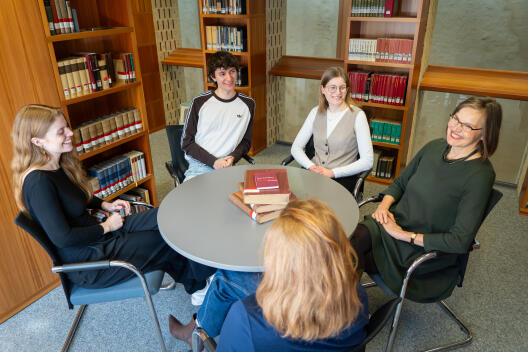
Those who love critically weighing the persuasive power of complex arguments and theses by Immanuel Kant and Karl Marx, among others, should feel right at home with the philosophers. Through the study of philosophy, students acquire the skills to analyse complex relationships, think logically and reflect on human behaviour. In seminars they learn how to systematically present their lines of argumentation.
For more than 20 years, the faculty has defined its role as that of providing research- and practice-oriented academic instruction. The principle of “research-based learning” is integrated in numerous practical modules where students independently carry out their own research projects. This offers them insights into professional practice. To ensure that theory finds its way into practical application, one needs suitable locations. That’s why courses are not only held at the Fürstenberghaus or the Philosophikum. The Archaeological Museum and the Institute for Comparative Urban History, with their extensive collections also serve as alternative learning venues within the University. Archives, commemorative sites and municipal museums form a bridge to society and career-oriented learning. To familiarise graduates with other occupational fields besides teaching at schools, the faculty offers the format “History & Career”. In this practical course, guest speakers employed at museums, archives, publishing houses or in municipal politics discuss where their career paths led them after completing their degrees in history. The Department of Philosophy also has a career consultant speak with students and answer any questions they have about their career choices. These examples underscore how much the faculty values interaction in teaching. ‘The students can count on their instructors to engage in intensive and personal dialogue with them,’ says Eva-Bettina Krems.
Digital instruction and digital competence have long become an established component in the humanities. The Faculty of History and Philosophy emphasises the growing importance of digitality through various webinars and digital examinations. Students also benefit from collaboration with the Center for Digital Humanities. Its experts use computer-based processes to solve research questions in the humanities and social sciences. They turn to digital sources and digitalised research materials in order to employ them in the digital sphere. Students carry out digital analyses of images, texts and audio-visual material. For example, they analyse clay fragments with scratched inscriptions or annotate the correspondence left behind by a Jewish couple that managed to escape to the United States during the Nazi regime. With the corresponding IT competence, students can obtain the “Digital Humanities” certificate which can give them a step up in an academic career or help them find a job in the non-academic labour market.
Teaching activities at the Faculty of History and Philosophy are not limited to Münster and the surrounding region. Aside from the European Erasmus programme, there are numerous cooperation agreements with international partner universities, for example in Chile, India, Japan, Mexico, South Africa and Thailand. And those who yearn for more internationality are free to attend practical courses and seminars taught in English each semester at the faculty’s departments and institutes
Returning to what David McCullough so aptly expressed, history and philosophy are not just a dusty collection of facts. At the Faculty of History and Philosophy, students learn to orientate themselves in our world by sharing the knowledge they gain for the benefit of society.
Text: Kathrin Nolte