Understanding the Earth, shaping the future
Whether it’s attending lectures, doing field work or experimenting in a lab – students in the Faculty of Geosciences learn about the complex interactions between Earth, society and the environment.
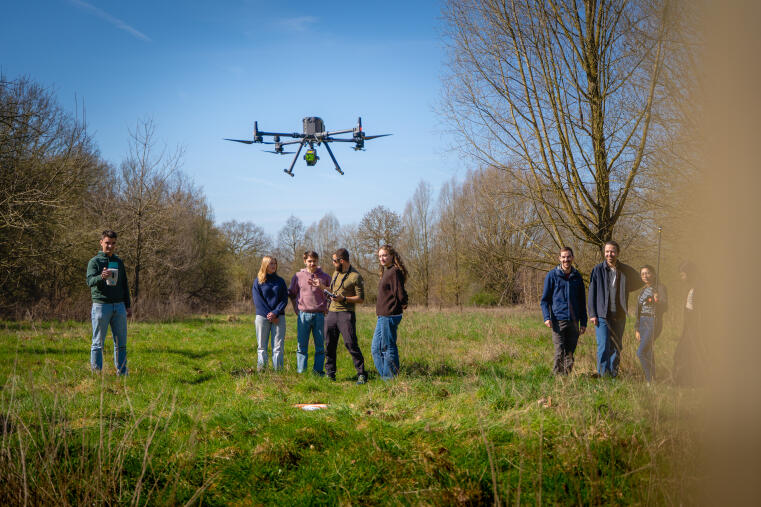
One early summer morning, students investigate the birds that inhabit the former wastewater fields north of Münster. Others cartograph the rock strata in the Alps, analyse environmental patterns in Argentina between the Patagonian steppe and the foothills of the Andes, and experiment with ice particles in the lab for insights into the creation of our solar system. Others are doing research on kiosks in metropolitan cities, investigate compost as social and ecological nodes, or collect environmental data in cooperation with citizen science groups, using self-developed sensor stations. Whether it’s just outside the front door or on a different continent – study and teaching at the Faculty of Geosciences are closely connected to the world outside the lecture hall.
Observing, measuring, questioning and analysing – practical field work plays a key role in all geoscience subjects and promotes curiosity, perseverance and, to a certain degree, enthusiasm for adventure. The degree programmes explore the Earth system, for it is imperative to gain a deep understanding of the basics of geological, planetary, environmental and human-geo-graphical sciences so that we can rise to the challenges facing us today and shape the future. Students investigate, for example, geological processes and human-environment relationships, and then develop sustainable scenarios in actual laboratories. They examine everything from primordial epochs of geological history up to the present day, from the microscopic level to large-scale biotopes, cities, landscapes, continents, the Earth’s atmosphere and onward to outer space. Digital media plays a central role; satellite images, drone and sensor data are used to calculate the risk of flooding or propose climate scenarios. This broad thematic scope distinguishes the degree programmes and allows students to pursue their own interests at an early stage – in the lab, field, seminar room or at the computer.
The faculty’s seven institutes connect planetary, geo- and environmental sciences with ecology, human geography, planning sciences and geoinformatics. Natural and social scientific perspectives, as well as analogue and digital methods are intertwined throughout. ‘This combination is relatively unusual for Germany and is one of the distinguishing characteristics of our profile in Münster,’ explains Vice-Dean for Teaching and Student Affairs, senior lecturer Dr Patricia Göbel. This strength is evident in everyday academic life. For example, the fundamentals are taught in a lecture, data is collected in a field practical course and statistically analysed, then later combined with socio-economic information. This enables students to better understand usage conflicts or environmental repercussions.
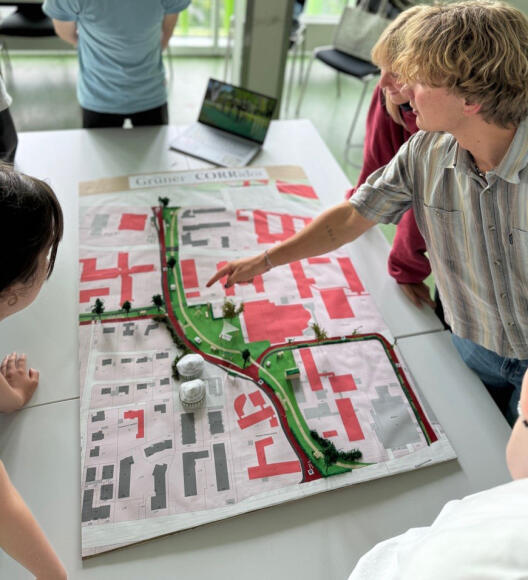
The Faculty of Geosciences offers non-teaching bachelor’s and master’s degree programmes, as well as teaching degree programmes. As a rule, all students begin their studies with an introduction to the common fundamentals of their discipline, which is gradually supplemented by specialised modules. Field work placements, lab practical courses, excursions and project-oriented teaching formats are established components of the curricula and are increasingly augmented by data- and model-based working methods. For example, the students analyse urban structures on location as part of a one-week excursion. ‘In Genoa we examined how the historic port city transformed from an industrial harbour to a cruise ship port of call,’ explains geography student Maj-Britt Wilbrand. ‘We spoke with local groups, examined social differences between the city districts and noticed how important it was to take various perspectives into consideration.’ Such experiences are typical of everyday academic life and demonstrate how theoretical concepts of urban and social geography can be applied on site. For those interested in studying abroad, students have the opportunity to participate in the Erasmus Mundus Masters Course “Geospatial Technologies” or study at one of the many partner universities via the Erasmus+ programme.
The faculty is strongly committed to qualifying the teachers of tomorrow. The core disciplines and subject-specific didactics are closely interwoven and address current social issues. ‘In my school internship, I realised that topics like globalisation and climate change were good stepping stones for rousing student interest,’ remembers teaching degree student Oskar Ehmann. ‘It’s because these are issues that directly affect the world they live in and offer many jumping-off points.’ The goal is to prepare future teachers to give practice-oriented instruction by conveying socially relevant geoscientific content.
The professional perspective plays an important role early on in one’s studies. Practical phases, work placements and research-oriented courses help students gain professional orientation. In addition to subject-specific qualifications, they acquire competence in teamwork, communication and employing digital tools. In professional work placements, e.g. at environmental agencies, students are involved in drafting reports on construction projects, through which they learn how important precise analysis, clearly prepared content and coordination with various stakeholders can be. The degree programmes offer a path to a variety of career opportunities, e.g. at environmental and spatial planning agencies, administrative authorities, R&D, consulting and education providers.
Sustainability is a central and cross-sectional topic in all degree programmes. Patricia Göbel points out that the faculty’s programmes are characterised throughout by “education for sustainable development” (ESD) and that the subjects are regarded as future-oriented sciences. Thanks to multifaceted partnerships with organisations, e.g. the Center of Interdisciplinary Sustainability Research (ZIN), intensive exchange exists between research and teaching, which allows sustainability-related topics to be directly incorporated into seminars and projects.
The students also benefit from this proximity to research, a high-performance infrastructure with state-of-the-art laboratories and facilities with cutting-edge equipment, and insights into current national and international research projects. This is supplemented by partnerships with external organisations, such as agricultural and forestry management agencies, NGOs and aerospace companies, e.g. in cooperation with the European Space Agency (ESA).
Study and teaching at the Faculty of Geosciences are characterised by their “down-to-earth” focus – in both the figurative and literal sense of the word. They react to the changing circumstances on Earth and address issues that are of central importance to the future of our environment and society. Those who study here will find themselves moving freely between the lecture hall, the field and the lab, as well as between the natural and social sciences. And their horizons will expand accordingly – from local observations to a fully global perspective.
Text: Dr Kathrin Kottke