More than musical scales and dulcet tones
Dynamic, international and rich with music – the Münster University of Music (MHS) was originally part of the Detmold University of Music. In 2004 it became an independent faculty of the University of Münster and has since developed its own distinctive profile. For those who dream of making music their profession, MHS offers numerous opportunities ranging from the Youth Academy for talented young musicians to concert examinations and teaching degrees for general schools to artistic doctoral programmes.
Near the traffic circle at Ludgeriplatz, architects have installed a glass pyramid in front of an old three-storey building that once housed a bank branch. To reach the stairs that lead to the building’s main foyer, visitors must first pass between two oversized, white ears that frame the main entrance. The artwork outside the building hints at what visitors can expect inside. The corridors of the University hum and buzz like a beehive – musical scales and etudes float from the fully booked practice rooms, in the upstairs auditorium there are rehearsals and concerts, and in the seminar rooms, one can hear chamber music ensembles and bands practising. Young people toting instrument cases on their backs or sheet music pockets under their arms hurry down corridors, talk with one another or wait in the foyer for the concert hall to be free for the next rehearsal.
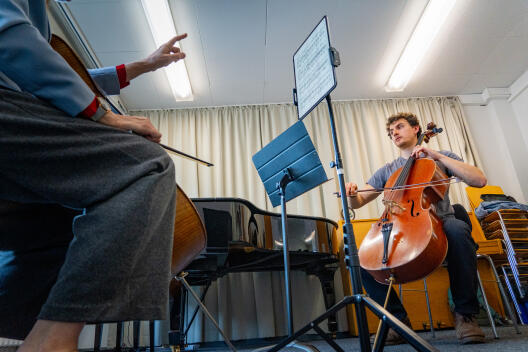
Despite all the rehearsing, classroom instruction comprises the core of artistic training. What makes the instruction so unique is the optimal supervision that students receive. In what other subject of study can one expect one-on-one instruction between a professor and their student? No wonder talented young musicians review the credentials of the teaching staff before applying for admission to MHS. Master courses taught by renowned, professional musicians of classical music enrich the artistic curriculum. All of this has proven extremely popular, as the number of applicants from around the world far exceeds the number of available study places. ‘Unfortunately, we have to turn down many good people due to a lack of capacity,’ admits Professor Peter von Wienhardt, who teaches piano.
But before that happens, applicants must first pass an aptitude test. Everyone who gets invited has already achieved a high level of mastery in an instrument that they plan to major in, e.g. violin, piano or singing. Many of them have taken instrumental lessons since they were young children and have won top prizes in competitions like “Jugend musiziert”. In the competition for admission to MHS, they are required to submit a video clip, demonstrating their musical proficiency. Most applicants are aware that other qualities also play a role in determining whether a successful career in music is in their future. For example, knowing how to deal with stage fright and the pressure to succeed, and understanding that self-discipline and persistence are vital for achieving one’s goals. ‘Our students are further along in this respect than other students their age,’ says Dean of Studies Barbara Plenge.
Whether in the classroom, in formats like the Opera Studio or in orchestral and chamber music projects, the MHS curriculum not only promotes and enhances the students’ artistic abilities, but also their personal skills. ‘Our students are trained to listen intently and learn teamworking, language skills, creativity and communication,’ explains Barbara Plenge. Taken together, these qualities lend themselves to “employability” in the labour market, which – in the area of music – has improved over the past two decades. According to a recent study by the German Music Information Centre, there will only be enough qualified teachers in ten years to fill just one-quarter of all vacant positions at music schools nationwide.
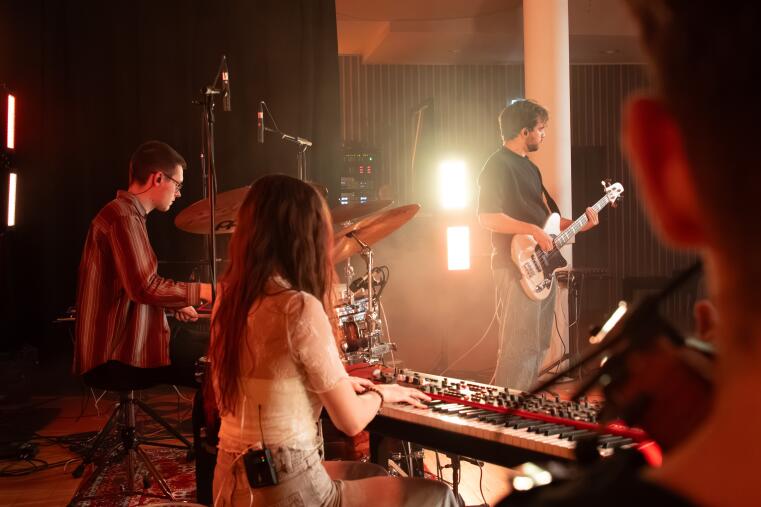
Professor Alex Grube confirms that the prospects are highly promising in the field of pop music. He immensely enjoys working with students to hone their strengths. Classical and pop music graduates have often diversified to pursue a combination of career options. ‘Some work in advertising, in film music or as influencers. In the end, almost all of them went freelance,’ he says. They give concerts as soloists or perform in ensembles, they teach privately or at music schools, or are hired for their extraordinary abilities that they acquire during their studies. They work as coaches, teaching students about resilience techniques and musician health. In the area of cultural management, they organise concert series and festivals. ‘We take such varied occupational backgrounds into account in our teaching activities,’ says Barbara Plenge. Seminars and workshops on career-building, concert formats and mental health prepare students for the many possible career paths ahead of them.
One of these career goals is to teach music at a school of general education. All the teacher training activities for the subject Music are bundled at the Institute of Music Education in Philippistrasse, which joined the faculty in 2017. Like the artistic programmes, the teaching degree programmes also focus on practical instrumental and vocal training. Students learn how to conduct ensembles based on modern management standards and gain initial practical experience teaching at schools. In addition to choirs, big bands and a large symphony orchestra, there are also many musically oriented cultural groups at the University that are open to students of all disciplines.
Near the end of the semester, students and the public can experience the broad spectrum of musical performance in concerts of classical music, band performances in clubs around town, and open-stage events on summer evenings on a mobile stage, organised by the departmental student body. The pop music department of the University of Music regularly invites the public to “aasee sessions” at the “Baracke”, a student cultural centre. In the main building, public recitals and concerts take place almost every day. Students rack up stage experience in well over 100 courses per semester. As Barbara Plenge confirms‚ ‘the audience benefits from the richly varied programmes and enjoys the lively, artistic atmosphere of our institution.’
Text: Brigitte Heeke