


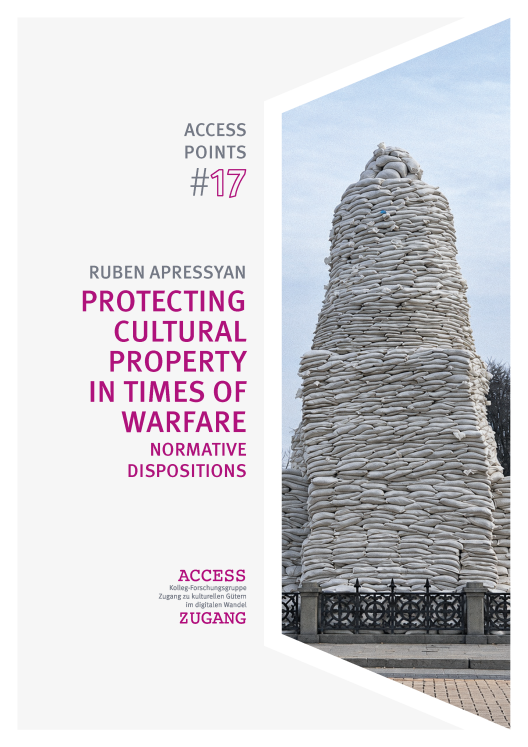
Ruben Apressyan:
Protecting Cultural Property in Times of Warfare: Normative Dispositions
ISBN: 978-3-69012-017-3
ISBN of the print edition: 978-3-69012-517-8
DOI: 10.17879/04908721535
URN: urn:nbn:de:hbz:6-04908722599
ISSN: 3054-4092
Abstract (English)
UNESCOʼs international legal instruments concerning the protection of cultural property during armed conflict rest not only on generally affirmed commitments to the norms of public international law but also on shared ethical commitments. Their normative foundations assume particular significance in light of the enduring tension between the protection of cultural heritage and the requirements of military necessity. An analysis of UNESCO conventions, declarations, and recommendations demonstrates that legal regulation alone cannot ensure effective protection. Rather, the principle of respect for cultural property, enshrined in the 1954 Hague Convention, provides the essential ethical foundation for military decision-making beyond formal legal obligations. Effective protection therefore depends on embedding respect for cultural property more firmly within the humanitarian education, professional ethos, and ethical training of armed forces personnel.
Abstract (German)
Die internationalen Rechtsinstrumente der UNESCO zum Schutz von Kulturgut in bewaffneten Konflikten beruhen nicht allein auf völkerrechtlichen Normen, sondern ebenso auf gemeinsamen ethischen Grundüberzeugungen. Angesichts des anhaltenden Spannungsverhältnisses zwischen dem Schutz des kulturellen Erbes und dem Prinzip der militärischen Notwendigkeit kommt diesen normativen Grundlagen besondere Bedeutung zu. Die Analyse der UNESCO-Konventionen, Erklärungen und Empfehlungen zeigt, dass rechtliche Regelungen allein keinen wirksamen Schutz gewährleisten können. Vielmehr bildet das in der Haager Konvention von 1954 verankerte Prinzip des Respekts vor Kulturgut die entscheidende ethische Grundlage für militärische Entscheidungen, die über bloße Rechtspflichten hinausweist. Ein wirksamer Schutz kulturellen Erbes setzt daher voraus, dass der Respekt vor Kulturgut dauerhaft in der humanitären Ausbildung, dem berufsethischen Selbstverständnis und der ethischen Schulung von Angehörigen der Streitkräfte verankert wird.