

updated 03.07.2026
|

Ralf Schindler and Katrin Tent to speak at the International Congress of Mathematicians 2026
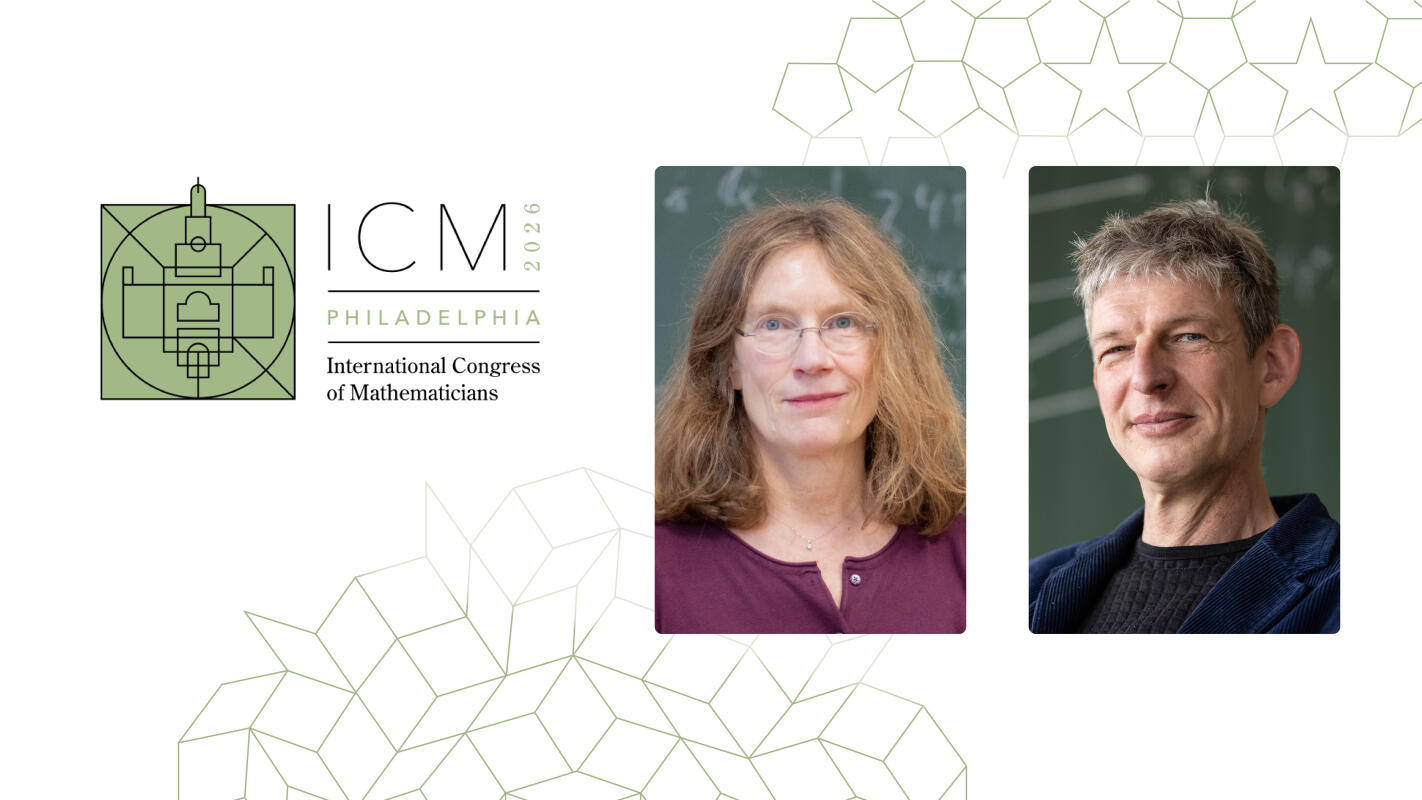
© MM, ICM 2026

Prof. Dr. Ralf Schindler and Prof. Dr. Dr. Katrin Tent, both investigators at our Cluster of Excellence Mathematics Münster, have independently been invited to present their research at the International Congress of Mathematicians (ICM) being held in in Philadelphia, USA, from 22 to 30 July 2026. The ICM takes place every four years and is the longest running and largest event in the field of mathematics.

Both lectures will be in "Section 1 Logic", which covers the areas of model theory, proof theory and computability, set theory and applications.


24 July 2026, 3:00 pm - 3:45 pm
Ralf Schindler and David Asperó:
Forcing Axioms and The Continuum Problem: Hilbert's First Problem Revisited

Georg Cantor famously proved in the 1870’s that there are more real numbers than natural numbers. A question is then "Exactly how many real numbers are there? $\aleph_1$? $\aleph_2$? Maybe more?" This is known as the Continuum Problem. It has been one of the most important guiding problems throughout the history of set theory. By work of Kurt Godel in the 1930’s and of Paul Cohen in the 1960’s we know that the standard axiomatic system for set theory, namely ZFC, does not solve this problem. On the other hand, and notwithstanding the independence results of Godel and Cohen, there are good reasons not to take the Continuum Problem as a pseudo-problem. In our talk we will start by hinting at some of the reasons not to take the independence results as the last word in this story. We will then introduce and motivate forcing axioms and will present some older and also some quite recent results using these axioms in order to argue that the Continuum Problem may have a solution after all. We will also mention some competing views and open questions in the area.

Interview with Ralf Schindler
Hilbert’s 23 Problems at ICM 2026: Where Are We Now? (Article Simons Foundation, 06/2026)


26 July 2026, 3:00 pm -3:45 pm
Katrin Tent:
From the Cherlin-Zilber Conjecture via Sharply 2-Transitive Groups to the Burnside Problem

We review the current state of the Cherlin-Zilber Algebraicity Conjecture on simple groups of finite Morley rank, which states that every such group is the group of K-rational points of an algebraic group for some algebraically closed field K. We will explain the relevance of sharply 2-transitive groups as a potential source of counterexamples and how the Burnside problem necessarily comes into the picture.

Interview with Katrin Tent


Throughout the ICM, Mathematics Münster will be present in the exhibition hall. At the booth "Wunderbar. Mathematics without Boundaries in Germany", representatives of several German mathematical research institutions will provide information about research and career opportunities for mathematicians. The booth programme will also feature a panel discussion.

25 July 2026, 1:30 pm -2:30 pm
Panel on Collaborative Research in Mathematics in Germany: Opportunities and Challenges
with Alexandra Carpentier (Potsdam), Dominik Maeder (DFG), Katharina Proksch (DFG), Katrin Tent (Münster) and Ulrike Tillmann (Oxford)

  • Interview with Katrin Tent

    Katrin Tent
    Katrin Tent
    © MM/vl

    Katrin Tent's research is in the intersection of model theory and group theory, using aspects from a broad range of areas. The overall question her research has been addressing over the last decades can be summarized under the title 'work on the Cherlin-Zilber conjecture'. 

    What does the invitation to the ICM mean to you?
    It is a wonderful recognition of my work and I am super excited about it!

    Which aspects of the ICM are you looking forward to?
    I have never been to an ICM and I am looking forward to experiencing the spirit of this very special conference. The fact that the next ICM takes place in Philadelphia gives me some concern about how it will be run given the situation of the scientific community in the US and the funding cuts that are taking place under the current government.

    Could you please briefly introduce your field of research in general?
    My research is in the intersection of model theory and group theory, using aspects from a broad range of areas. The overall question my research has been addressing over the last decades can be summarized under the title 'work on the Cherlin-Zilber conjecture' i.e. find criteria to identify an abstractly given group as an algebraic group under suitable extra conditions like BN-pairs or finite Morley rank.
    Sometimes, this quest has taken me quite far from the algebraic groups at the center of my attention, e.g. in the context of the Burnside problem, asking whether a finitely generated group of bounded exponent is necessarily finite. The answer is "no" and the corresponding infinite Burnside groups are very different from algebraic groups. Nevertheless, they come up in this context when constructing new groups with BN-pairs of rank 1. Then, from the Burnside groups, it is but a small step to C*-simple groups, which shows how interwoven all these questions are.

    What will be the topic of your talk at the ICM?
    I will try to present exactly this program towards the Cherlin-Zilber conjecture sketched above, to show how the pieces of my work fit together.

    Which questions are you currently working on?
    I continue working on this picture, understanding groups, geometries and model theory from all these perspectives.

  • Interview with Ralf Schindler

    Ralf Schindler
    Ralf Schindler
    © MM/Peter Leßmann

    Ralf Schindler works in set theory, specifically in the area of inner model theory and the theory of forcing axioms. Together with David Asperó (University of East Anglia), he has answered a long-standing question: in 2019, they showed that Martin's Maximum$^{++}$ implies Woodin's $\mathbb{P}_{\max}$ axiom $(*)$. 

    What does the invitation to the ICM mean to you?
    I'm flattered to have been invited to the most significant math conference in the world. Hilbert's speech at the ICM 1900 in Paris has shaped my field, and the First Problem which he proposed there, namely the Continuum Problem, a problem that was originally isolated by G.
    Cantor, is what inspired a lot of set theoretical work over the last century including my work with Asperó. Our key result is directly connected with the Continuum Problem.

    Which aspects of the ICM are you looking forward to as a speaker? And which as a participant?
    Recent years have seen a whole bunch of dramatic results in set theory, I was lucky enough to play a role in this stunning enterprise, and I will be very happy trying to pass this excitement to a wider audience. Symmetrically, I'm enthusiastic about getting inspired by meeting and listening to some of the most clever people on this planet.

    Could you please briefly introduce your field of research in general?
    I work in set theory, specifically in the area of inner model theory and the theory of forcing axioms. Set theory may be thought of as the theory of infinite cardinalities, but key notions from descriptive set theory or from the theory of stationary sets produce a lot of complicated structure in the realm of sets and infinite cardinalities.
    Ultimately, we want to understand the local and global structure of the universe of all sets (which is where all of mathematics takes place), and we do so by studying consequences of strong axioms, their interrelation, and ways, how models of such axioms may be produced.

    What will be the topic of your talk at the ICM?
    Answering a long-standing question, Asperó and me showed in 2019 that Martin's Maximum$^{++}$ implies Woodin's $\mathbb{P}_{\max}$ axiom $(*)$. Our proof method has since then been applied in many other situations, e.g. by Lietz to force that the non-stationary ideal on $\omega_1$ be $\omega_1$ dense, or by Sun and myself to show that under MM, $NS_{\omega_1}$ is not $\Pi_1$ definable. Further developments were produced by De Bondt, Kasum, Velickovic, Viale, and others. My joint ICM talk with D. Asperó will put our original result in context, present its key significance and new proof idea, and discuss how it transformed our way to think of the dichotomy of forcing over $ZFC$ models and forcing over determinacy models.

    Which questions are you currently working on?
     In the wake of my result with Asperó, Woodin proposed an even harder question, namely if $(*)^+$ is compatible with MM. The key issue here is the question of the possible cofinalities of the Wadge hierarchy of universally Baire sets of reals under MM, a problem I study with my doctoral researcher Yasuda. Our result might also open the door to attack the $\Omega$ conjecture. With my doctoral researcher Sorouri, I work on generalizations of the theory of Varsovian models which we originally developed with Sargsyan and Schlutzenberg. Jointly with Asperó, I try to settle the long-standing open problem that had been posed by Prikry, if large cardinals imply the existence of a precipitous ideal on $\omega_1$, which - if true - would have dramatic consequences for the theory of inner models.