Arbeitskreis Plotin

‘What Comes after the First’
A Workshop on Ennead 5.4 of the Plotinus Reading Group at the University of Münster

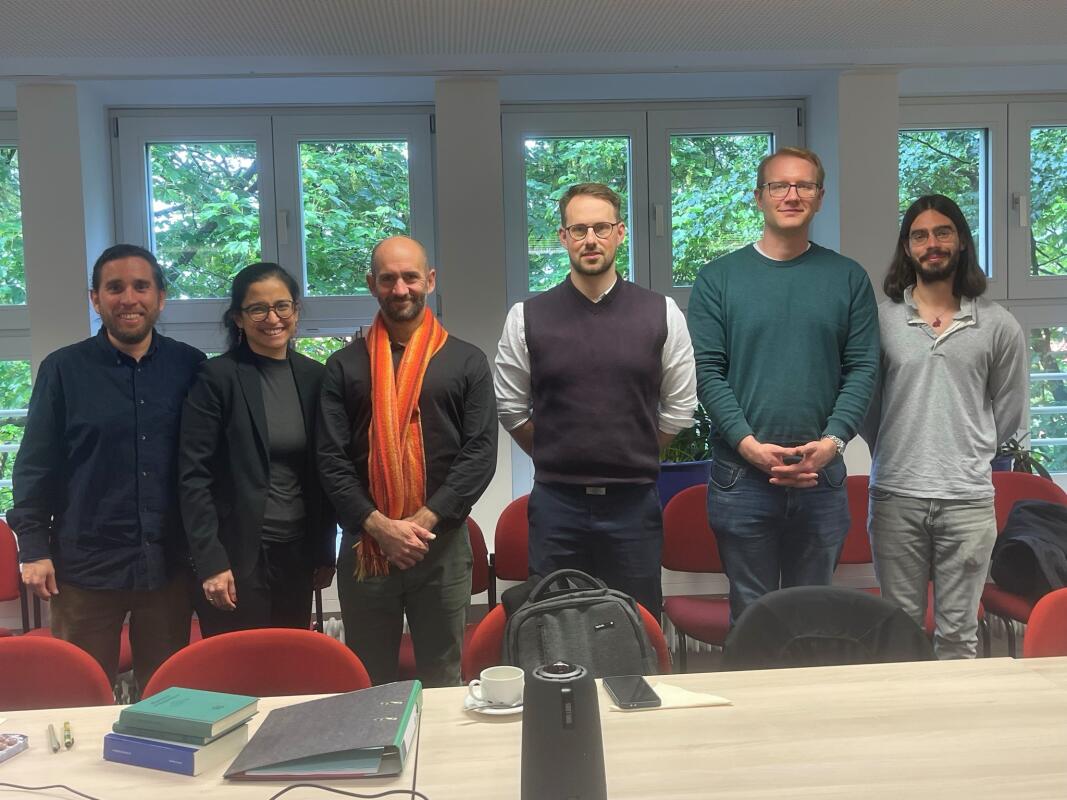
Guest: Dr. Gabriel Martino (CONICET / Universidad de Buenos Aires / Universidad del Salvador)

Wednesday, 13 May 2026 | 10:00 – 18:00
Philosophisches Seminar, Domplatz 23, 48143 Münster, R. 315
Zoom (please contact alexandra.alvanleon@uni-muenster.de)

The AK Plotin is pleased to announce the organisation of its workshop ‘What Comes after the First’: A Workshop on Ennead 5.4., scheduled to take place in Münster on 13 May 2026, on the occasion of the visit of the Argentinian Plotinus scholar, Dr. Gabriel Martino.

Dr. Martino specializes in the philosophy of the Enneads, engaging in comparative work with Indian philosophy, particularly on conceptions of the self, action, and mysticism. In addition to his doctoral dissertation, La mística eneádica: Genealogía, análisis y comparación (2020), he has published extensively on Greek, Indian, and comparative philosophy. He is currently an Associate Researcher at the Argentinian National Scientific and Technological Research Council (CONICET) and a Visiting Research Associate at the Institute of Philosophy and Technology in Athens, Greece. He is also an Associate Professor of Ancient Greek and Sanskrit at the Universidad del Salvador and an Associate Professor of Sanskrit at the University of Buenos Aires (UBA).

The workshop will be conducted in a hybrid format, in English, through the close reading of Ennead 5.4 (7), “How That Which Is after the First Comes from the First, and on the One”. Our aim is to translate, interpret, and discuss this concise treatise. Some of the central themes we will address include the problem of how the many can be derived from the simple One, the power of the One to produce all things, and the double energeia theory.

The workshop is open to anyone interested in participating in the discussion. If you want to join us in person or online, please email alexandra.alvanleon@uni-muenster.de

Der antike Philosoph Plotin gilt als Begründer und bekannteste Vertreter des Neuplatonismus. Diese philosophische Bewegung der Spätantike versteht sich als eine Exegese der platonischen Philosophie, sie ist aber in der Tat eine originelle Weiterführung und Systematisierung dieser Philosophie und anderer wichtigen philosophischen Schulen der Antike (bzw. des Aristotelismus und der Lehre der Stoa u.a.). Den Einfluss der Philosophie Plotins, die uns in 6 Bücher —den Enneaden— überliefert wurde, kann man durch die Geschichte der abendländischen Philosophie beobachten, von der Spätantike —sowohl unter Philosophen als auch Theologen— bis zum deutschen Idealismus. In den Enneaden werden Probleme der klassischen griechischen Philosophie —Ethik, Epistemologie, Kosmologie, Ontologie, Seelenlehre, Nuslehre und Henologie— umgearbeitet und thematisch organisiert.

Der AK Plotin trifft sich im SoSe 26 regelmäßig montags um 16:30 Uhr (s.t.) online über Zoom. Der Arbeitskreis befasst sich mit den gesamten Enneaden und besteht bereits seit mehreren Semestern. Wir beschäftigen uns nun mit der siebten Abhandlung der sechsten Enneade: VI.7 „Wie kam die Vielheit der Ideen zustande? Das Gute”, in der Plotin die Entstehung der intelligiblen Vielheit aus dem Einen diskutiert. Die Texte lesen wir in jeder Sitzung gemeinsam auf Deutsch (Meiner Ausgabe–Harder Übersetzung bzw. Reclam Ausgabe-Tornau Übersetzung). Kenntnisse der altgriechischen Sprache sind hilfreich, aber nicht erforderlich. Alle Interessierten (auch ohne Vorkenntnisse!) sind herzlich willkommen.

Kontakt: Alexandra Alvan