
Geoscientific Preparation Technician
Your job
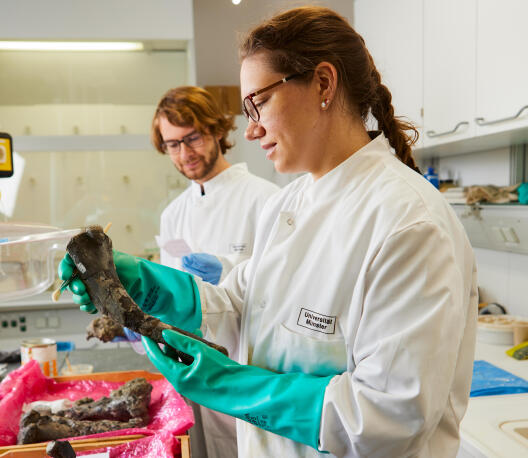
Geoscientific Preparation Technicians should be proficient in various aspects after completing their training, particularly in the standard methods of rock processing for scientific investigations. For the production of rock sections and thin sections, acetate peels or lacquer film replicas and soil lacquer profiles, a steady hand and a keen eye are required. Preparing fossils, which requires a lot of patience and a good knowledge of the structure of extinct animals and plants, is also a central part of the training, whether mechanically with sandblasting equipment and chisels or chemically with acids, lyes and other chemicals. Microfossils are isolated from the rock using special methods.
In addition to the demands of scientific processors, geoscientific preparators should be able to prepare fossils for presentation in museums or build models of the associated extinct organisms. Here, a artistic flair is particularly important, as the creation of shapes and the colouring of casts are essential elements of the public visibility of preparatory work. Designing and decorating exhibition cases of the Geological-Palaeontological Museum is also part of the training programme.
YouTube video on the training of geoscientific preparator [de]
Perspectives
Münster is renowned for the high quality of its preparation graduates, even without official recognition by the chamber. However, nationwide, only fewer than five positions are available each year; therefore, unlimited spatial mobility after the end of training is essential. Potential employers include the geological institutes of universities and large museums, possibly also freelance preparators.
Application profile
- Good natural science knowledge, especially in biology and chemistry
- Craftsmanship and artistic talent
- Completion of the 18th year of life
- Good spatial imagination
- Willingness to learn
- Initiative
- Communication skills
- Enjoyment of meticulous work
- Patience and care
Training institution
You will complete your practical training at the Institute of Geology and Palaeontology (GP) and at the Geomuseum of the University of Münster.
In addition, you will participate in a scientific excavation in the field lasting at least four weeks. During your training, several two- to four-week internships are planned, including one in the micropalaeontology laboratory of the Institute of Geology and Palaeontology. At least four weeks of the internships will be spent in a preparation workshop outside Münster (if desired, also abroad).
Training focus and theoretical training
During your training at the university, you will get to know many interesting areas of work. The training focuses are in the following areas:
- Sawing, grinding and polishing of rocks
- Producing thin sections of rocks
- Releasing fossils using chemical (acids, lyes) and mechanical (engraver, sandblasting, etc.) aids
- Producing and colouring casts of fossils using single- and multi-part moulds
- Conserving fossils
- Building fossil reconstructions as models
- Exhibition technique
In addition to the practical training, you will also acquire theoretical knowledge by attending the regular introductory lectures of the university, including practical classes. As well as an internal seminar in which the trainees report monthly on a subtopic.
Attendance of the following lectures and practical classes is mandatory: "The Earth" and "Introduction to Palaeontology"; further events as desired. Attendance at vocational school is not planned, therefore, no school-age applicants are considered.
Duration of training/possibility of shortening
The training usually lasts 3 years. There is the possibility of shortening it if very good performance is evident.
Examination
The final examination takes place before a committee of the Faculty of Geosciences of the University of Münster. It includes a theoretical part and the assessment of an extensive presentation of practical work samples from all areas of training and completed internships.
Particularities
The training is, strictly speaking, merely an apprenticeship, i.e. not a state-recognised degree. Nationwide, the only other place offering this path is Bochum, but there it is very theoretical and at the expense of practical experience. Nowhere else in Germany is something comparable to what is offered at the University of Münster possible. In addition to the activities in the in-house and external workshops, it is expected or recommended to be active for a time in other university-internal laboratories and workshops: at least two weeks in micropalaeontology and at least six weeks in palaeobotany, where photographic techniques are also learned. Glassblowing, carpentry, precision engineering and zoological preparation may also be added.
On average, about one trainee is taken on per year in the Geological-Palaeontological Preparation Workshop. Applications can be submitted at any time.
Chances on the job market
There are no opportunities for employment at the University of Münster for geological preparators. Compared to usual training occupations, the job prospects are very low - nationwide, about two positions become available each year.
Due to the high practical relevance of our training, the University of Münster has a very good reputation, so the prospects are relatively good; so far, all trainees have found employment, albeit not always within the first 2-3 years...
What our trainees say
- "What I particularly like about the training is the proximity to the university, the high level of practical relevance and the very individual support!"
- "What I particularly like about the training is that there is also the opportunity to learn a lot through external internships and to establish contacts with other institutes or museums!"
- "I like to learn in Münster because this form of training is only available here in Germany!"
Translated with AI assistance.