
Precision engineer, precision engineering
Your profession
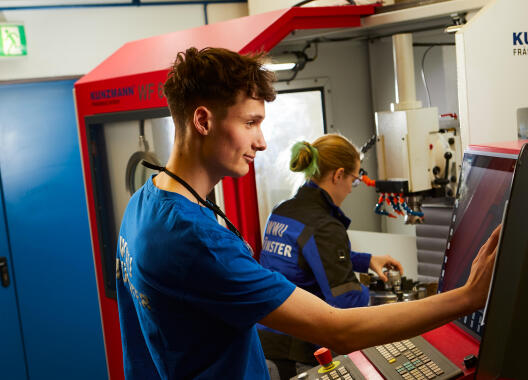
You work in the precision engineering workshops of various faculties of the University of Münster, such as the Institute of Physics or the Institute of Organic Chemistry. Here, you will be responsible for the production of highly precise components through turning, milling, drilling or grinding and, after a training period, you will also take on the independent use of computer-controlled machine tools.
Stations and contents of your training
During your three-and-a-half-year training, our skilled workshop staff will take the time to provide you with comprehensive practical instruction in various manual and machine-based work techniques, while also imparting the necessary specialist knowledge. Here, you can not only further develop your craft skills but also gain valuable experience in the testing, assembly and repair of various components or precision instruments used in science, medicine or electrical engineering. Step by step, you will learn about different materials such as brass, aluminium, steel, plastic or titanium and independently take on their processing.
Make use of the wide variety of tasks and orders from our various institutes: from the production of high-temperature furnaces, optical devices, teaching materials for lectures and low-temperature systems, to devices for chemical experiments, pressure vessels or measuring instruments for geophysical investigations. With us, you will get to know all these different areas of work and also have the opportunity to further expand your specialist knowledge within the framework of pneumatics and CNC courses.
YouTube video about training as a precision mechanic [de]
What you should bring
- In addition to a good secondary school certificate, your grades in mathematics and the natural sciences should indicate a recognisable interest in the training profession.
- Your technical understanding and manual skills will support you in processing a wide variety of materials and producing complex components that ultimately form a large whole.
- Analytical and logical thinking skills will help you independently take on various work steps.
- Your structured, conscientious and goal-oriented approach, combined with your high level of commitment, will help you achieve the best possible results in our research workshops.
- Your spatial imagination will make it easier for you to deal with various drawings on a daily basis, which you can also discuss with your team at any time with your open and communicative nature.
Training institutions & theoretical training
The practical training is completed in the precision engineering workshops of the faculties of the University:
- Institute of Physics
- Institute of Organic Chemistry
- Institute for Nuclear Physics [de]
- Institute of Inorganic and Analytical Chemistry
- Institute of Pharmaceutical and Medicinal Chemistry
- Institute of Physical Chemistry
- Institute of Materials Physics
- Institute of Geophysics
- Institute of Applied Physics
The theoretical training takes place for 1.5 days a week at the Hans-Böckler-Berufskolleg [de] in Münster.
Duration of training/possibility of shortening
The training lasts 3 1/2 years. A reduction to 3 years is possible for trainees with a technical college entrance qualification or particularly good performance during the training and at vocational school.
What our trainees say
- "I really enjoy making things out of various metals and plastics!"
- "This is exactly how I imagined the profession of a precision mechanic!"
- "Working with many machines and measuring instruments is fun!"
Apply now!
Translated with AI assistance.