

Exchange with Minister Melanie Walter regarding the Parkinson's Vibrating Socks project
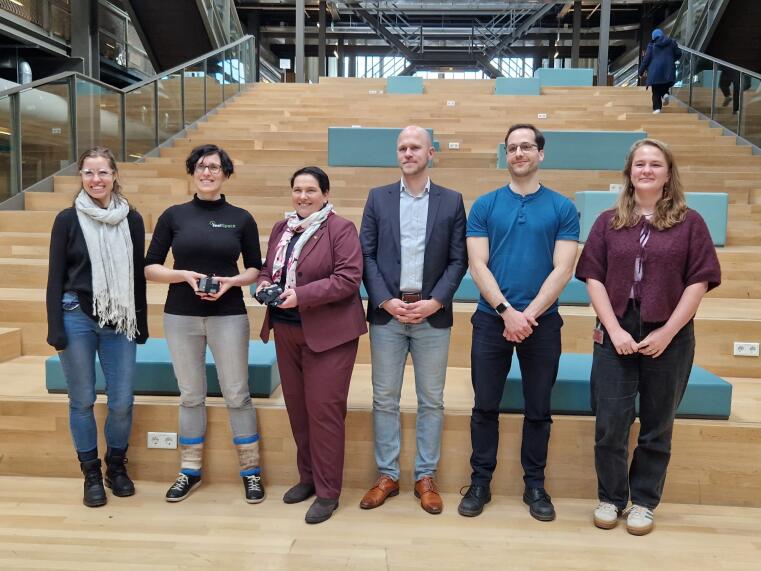
On Friday, 27 March 2026, Melanie Walter, Lower Saxony’s Minister for European Affairs and Regional Development, visited the campus of the University of Twente to learn more about the Interreg project Parkinson Vibrating Socks.
Among her responsibilities are European structural policy and cross-border cooperation in Lower Saxony, shaping the framework conditions under which projects like this can emerge.
The visit focused on a technological approach that can provide tangible support for people living with Parkinson's disease in everyday life. Many people affected by Parkinson’s experience so-called freezing of gait — sudden movement blocks in which the feet seem stuck to the ground and the next step cannot be initiated. In addition to reduced mobility, this also increases the risk of falls and insecurity in daily life.
The project addresses exactly this challenge: a wearable system in the form of a sock is being developed that delivers targeted vibration impulses as soon as a movement block is detected. This sensory feedback helps the brain resume movement — drug-free, discreet, and suitable for everyday use. Behind this seemingly simple idea lies intensive research and close involvement of future users. The project consortium is currently working on optimising the second prototype. Initial test phases show strong user acceptance as well as first indications that the number of movement blocks can be reduced. The insights gained are directly feeding into further development.
Minister Walter expressed her enthusiasm for the project’s innovative potential: “This is a truly great initiative that can noticeably improve people’s everyday lives!”
The project is funded through Interreg Deutschland-Nederland. For around 35 years, the programme has strengthened cooperation between Germany and Netherlands, creating room for innovations that would hardly be possible without cross-border collaboration.
The visit highlights how important European cooperation is in addressing societal challenges.
Topics such as demographic change and neurodegenerative diseases require joint action by research institutions, companies, and public funding structures. Projects such as Parkinson Vibrating Socks demonstrate how concrete solutions for everyday life can emerge from such collaboration.