
Electronics technician for devices and systems
Your job
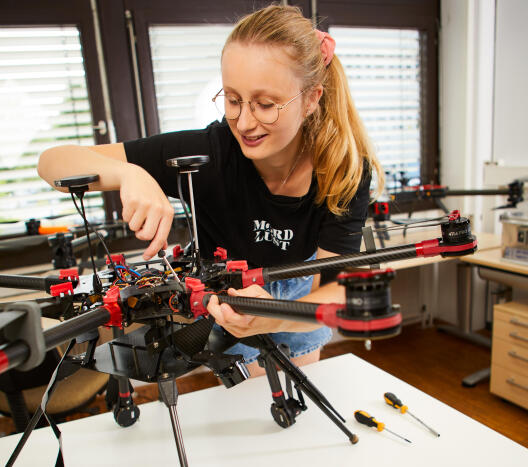
You will work in teams with our specialists in the electronics workshops and laboratories of various faculties. Here you will get to know various electrical and electronic components and, after a settling-in period, will independently take on the commissioning and maintenance of electrical systems.
Stations and contents of your training
At the beginning of your three-and-a-half-year training period, you will undergo an extensive induction phase in the field of precision engineering, where you will learn mechanical basics such as filing, turning, drilling, or milling and can further develop your craftsmanship. Soon you will independently handle the repair of devices from the teaching area as well as the various experimental laboratories and be familiar with the assembly of electronic components or the construction of device housings. The preparation of special cables for use in the laboratory also poses no difficulty for you.
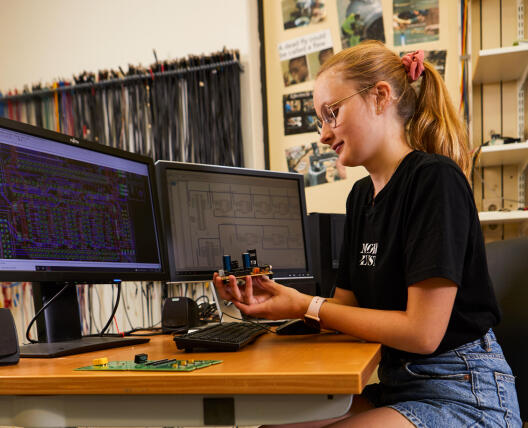
Within the framework of various project works, you can gradually acquire specialist knowledge in the fields of analogue and digital technology, measurement, control and regulation technology, as well as hardware technology. This way, you will have the opportunity, among other things, to create various circuit diagrams and circuit board layouts using computer-aided design and to automate systems using so-called programmable logic controllers (PLCs). Take your chance and acquire first foundations of IT, for example in the areas of installation, repair or software.
What you should bring
- In addition to a good secondary school leaving certificate, your grades in maths, physics and English should indicate a recognisable interest in the apprenticeship.
- Your analytical and logical thinking skills, as well as your technical understanding, will support you in troubleshooting upcoming repairs and in handling electronic components.
- Accuracy and a conscientious approach will support you not only in the production of technical devices but will always have the highest priority in your daily dealings with them.
- Your team spirit and well-developed communication skills will enrich teamwork and interactions with our customers.
- Spatial awareness, creativity, and the willingness to engage with new, complex problems will help you to advance the project work.
Training institutions & theoretical training
The practical training at the university is completed in the electronics workshops and laboratories of the faculties:
- Faculty of Geosciences
- Institute of Mineralogy
- Institute for Nuclear Physics
- Institute of Physical Chemistry
- Institute of Botany
- Centre for Information Processing
- Institute of Physics
The theoretical training takes place two days a week at the Hans-Böckler-Berufskolleg [de] in Münster.
Duration of training/possibility of shortening
The training lasts three and a half years. A reduction to three years is possible for apprentices with a technical college entrance qualification or particularly good performance during the training and at vocational school.
Apply now!
Translated with AI assistance.