Cerebral blood flow changes in Post-Covid patients
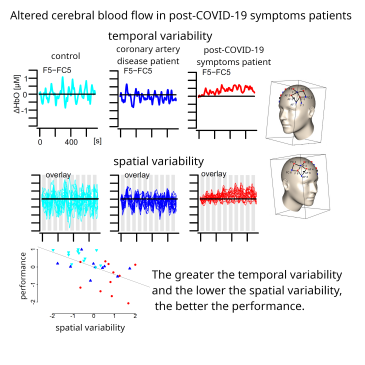
The study by Kutz et al. (2026) examines cerebral blood flow regulation in patients with Post-COVID Syndrome (PCS) during cognitive stress. Using functional near-infrared spectroscopy (fNIRS), cerebral blood flow in PCS patients was analysed in comparison to patients with coronary heart disease and healthy control subjects. The results show that PCS patients exhibit decreased temporal but increased spatial variability of blood flow, indicating a more rigid regulation. This altered haemodynamics correlates with poorer performance in cognitive tests (longer reaction times, lower accuracy) as well as a marked increase in sleepiness and fatigue. The authors conclude that impaired microvascular adaptations are a significant cause of cognitive deficits in PCS and that fNIRS is a valuable diagnostic tool for documenting these changes.