The magnitude of dual-task costs may be moderated by the modality-compatibility effect
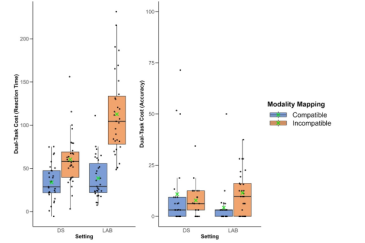
A recent study conducted by the Department of Neuromotor Behavior and Exercise demonstrated that when the sensory modality of task input (e.g., auditory or visual) differs from the sensory modality of the task response (e.g., auditory or visual), dual-task costs increase. However, this effect is more pronounced in a classical laboratory environment than in a more naturalistic driving simulator environment. These findings indicate that interference arising from modality incompatible mappings is attenuated in more naturalistic settings compared with classical laboratory conditions. This suggests that while the modality-compatibility effect may also be present in real-world contexts, it does not manifest in the same way as in traditional laboratory environments. You’ll find the original publication here