

Interactions between operator algebras, K-theory and homotopy theory
The aim of the conference is to foster interactions between researchers working in areas such as classification of C*-algebras and Steinberg algebras, topological and algebraic K-theory, the Baum-Connes and Farrell-Jones conjectures, as well as KK-theory and noncommutative motives. Research talks will be complemented by introductory minicourses, designed to give experts in one field the necessary foundation in the other.
Speakers
- Ko Aoki (Bonn)
- Guido Arnone (Buenos Aires)
- Sara Azzali (Bari)
- Emma Brink (Bonn)
- Ulrich Bunke (Regensburg)
- Guillermo Cortinas (Buenos Aires)
- Anupam Datta (Bonn)
- Ivo Dell'Ambrogio (Lille)
- Eugenia Ellis (Montevideo)
- James Gabe (Odense)
- Georg Lehner (Münster)
- Xin Li (Glasgow)
- Alistair Miller (Leuven)
- Shintaro Nishikawa (Southampton)
- Ulrich Pennig (Cardiff)
- Sanaz Pooya (Potsdam)
- Valerio Proietti (Oslo)
- Maxime Ramzi (Münster)
- Rhiannon Savage (London)
- Christopher Schafhauser (Lincoln)
Organisers
- Julian Kranz (University of Münster)
- Devarshi Mukherjee (University of Oxford)
Mini-Courses
Schedule
| Time | Monday 7.9. | Tuesday 8.9. | Wednesday 9.9. | Thursday 10.9. | Friday 11.9. |
| 8:30 | registration (SRZ) | ||||
| 9:00 - 10:00 | Bunke (M3) | Li (M3) | Ramzi (M3) | Azzali (M3) | |
| 10:10 - 10:30 | coffee (SRZ) | coffee (SRZ) | coffee (SRZ) | coffee (SRZ) | coffee (SRZ) |
| 10:40 - 11:10 | Dell'Ambrogio (M3) | Cortiñas (M3) | Ellis (M3) | Proietti (M3) | Savage (M3) |
| 11:20 - 11:40 | Pennig (M3) | ||||
| 11:50 - 12:20 | Miller (M3) | Arnone (M3) | Datta (M3) | Lehner (M3) | |
| 12:20 - 13:40 | lunch break | lunch break | lunch break | lunch break | lunch break |
| 13:40 - 14:40 | Nishikawa (M3) | Schafhauser (M3) | Bunke (M3) | Schafhauser (M3) | |
| 14:50 - 15:20 | coffee (SRZ) | coffee (SRZ) | poster session (SRZ) | coffee (SRZ) | |
| 15:20 - 15:50 | Pooya (M3) | Brink (M3) | Aoki (M3) | ||
| 16:00 - 16:20 | Ramzi (M3) | Gabe (M3) | |||
| 16:20 - 17:00 | |||||
| 18:00 - 19:00 | reception (SRZ) | ||||
| 19:00 - ? | dinner (Buddha palace) |
Disclaimer: Participants are expected to provide their own lunch.
Titles and Abstracts
Ko Aoki: On algebraic $K$-theory of operator algebras
Algebraic $K$-theory of topological algebras has long been studied, particularly for its relationship with topological $K$-theory. I will explain how Clausen–Scholze’s condensed mathematics provides a new perspective on this subject. I will present the first general progress on Rosenberg’s 1990s conjecture on negative $K$-theory that applies to arbitrary $C^*$-algebras.
Guido Arnone: $K$-theory of equivariant sheaves
For a finite group $G$, we compute the algebraic $K$-theory of the category of equivariant sheaves on a locally compact Hausdorff $G$-space, generalizing a result of Efimov. Our description is naturally framed in terms of a new equivariant cohomology theory, which we call Bredon sheaf cohomology. One of our main results is a strong uniqueness theorem: any functor from the category of locally compact Hausdorff $G$-spaces to a dualizable category satisfying equivariant open descent and cofiltered compact codescent is equivalent to Bredon sheaf cohomology, generalizing a result of Clausen.
This is joint work with Devarshi Mukherjee and Thomas Nikolaus.
Sara Azzali: Traces and the Godbillon–Vey invariant in KK-theory with real coefficients
Traces on C*-algebras play an important role in index theory: they allow one to extract numerical invariants from classes in K-theory. When real coefficients are introduced in Kasparov's bivariant K-theory, traces — including unbounded ones — naturally give rise to classes in KK-theory with real coefficients. In this talk we explain these constructions and some of their applications. In particular, for a codimension-one foliation we present a natural class that represents the Godbillon–Vey invariant and pairs with the index. This is joint work with Paolo Antonini (Università del Salento) and Georges Skandalis (Université Paris Cité).
Emma Brink: Condensed Group Cohomology
Condensed mathematics as developed by Clausen and Scholze provides a convenient framework for studying algebraic objects that carry a topology, and in particular yields a version of derived functors over the category of continuous $G$-modules for a Hausdorff topological group $G$.
I will compare the resulting notion of condensed group cohomology with continuous group cohomology (defined in terms of continuous cochains) and the condensed/sheaf/singular cohomology of classifying spaces. For locally profinite groups and solid (e.g., locally profinite) continuous $G$-modules, condensed group cohomology recovers continuous group cohomology. The same holds for locally compact, paracompact topological groups and finite-dimensional vector spaces as coefficients. In general, however, condensed group cohomology is a much more refined invariant than continuous group cohomology. I will explain how, despite this, continuous group cohomology with solid coefficients can be realized as a derived functor in the condensed setting for a broad class of topological groups.
Ulrich Bunke: Introduction to KK and E-theory via homotopy theory (lecture notes)
tba
Guillermo Cortiñas: Discretization invariants of ample groupoids
In the talk I will discuss joint work with Xin Li concerning homological invariants of topological groupoids and of their algebras. A groupoid G is étale if the domain and codomain maps d and c are local homeomorphisms, and ample if it is étale and in addition its unit space X is Hausdorff, locally compact and totally disconnected. For example any discrete groupoid is ample. If G is ample and k is a commutative unital ring, then the k-module k[G] of locally constant, compactly supported functions G-->k form a k-algebra under the convolution product, called the Steinberg k-algebra of G. If for example G is discrete, then k[G] is Morita equivalent to a direct sum \bigoplus_x k[G_x] of group algebras of isotropy groups of G. Thus H(k[G])=\bigoplus_xH(k[G_x]) for any Morita invariant homology H, such as K-theory and its variants.
There is a strategy for computing homological invariants of Steinberg algebras of general (non-discrete) ample groupoids in terms of those of group algebras. A first step is to resolve our given groupoid G by a sequence (G_n)_{n\ge 0} of discretizable groupoids. This reduces the problem to computing H(k[G_n]) for each n. Each of the G_n has a discrete groupoid (G_n)_d canonically associated to it, and there is a canonical algebra homomorphism from k[(G_n)_d] to a ring Morita equivalent to k[G_n]. The second step of the strategy is to show that the induced map H(k[(G_n)_d])\to H(k[G_n]) is an equivalence.
We shall discuss how this works in several examples.
Anupam Datta: Higher categorical approach to graded bivariant K-theories
I will begin by describing an infinity categorical framework to graded KK- and E-theory for C* -algebras. Unlike the ungraded variants, this category is not a Dwyer-Kan localization of graded C* -algebras, and instead will be defined as certain comodule categories. I will then discuss its applications in classical K-theories, and also discuss possibilities to generalize this perspective to other contexts, such as in KK-theory for bornological algebras. The latter is ongoing joint work with Devarshi Mukherjee.
Ivo Dell'Ambrogio: Tensor idempotents in the equivariant bootstrap category
For a compact group G, there is a quite satisfactory and useful definition of the G-equivariant bootstrap class which generalizes the classical Rosenberg-Schochet bootstrap class of separable C*-algebra. When viewed as a tensor triangulated category, just as in the non-equivariant case, this class enjoys better structural properties than its full ambient Kasparov category. In this talk I will survey such structural results on the G-equivariant bootstrap category, focussing on their relation with a classification of strongly self-absorbing G-C*-algebras recently proposed by Izumi and Ohara -- and which, for most groups, is still conjectural.
Eugenia Ellis: Homotopy structures realizing algebraic $kk$-theory.
Algebraic $kk$-theory, introduced by Cortiñas and Thom, is a bivariant $K$-theory defined on the category of algebras over a commutative unital ring. It consists of a triangulated category $kk$ endowed with a functor $j\colon\mathrm{Alg} \to kk$ that is the universal excisive, homotopy invariant, and matrix-stable homology theory. Moreover, we can recover Weibel's homotopy $K$-theory from $kk$ since $kk(\ell, A) = KH(A)$ for any algebra $A$. We view the category of algebras with fibrations as split surjections and weak equivalences as $kk$-equivalences as a stable category of fibrant objects, whose homotopy category is kk. Using this, we prove that $kk_\infty$, the Dwyer-Kan localization of the $\infty$-category of algebras at $kk$-equivalences, is a stable $\infty$-category with a homotopy category equivalent to $kk$.
We will discuss the dictionary relating algebraic $kk$-theory and Kasparov $KK$-theory, including their connections to isomorphism conjectures. (Joint
work with Emanuel Rodriguez-Cirone)
James Gabe: $K$-theory for $\Gamma$-$C^\ast$-algebras and 2-extensions
Let $\Gamma$ be a discrete group. For every $\Gamma$-$C^\ast$-algebra the $K$-theory is naturally a $\Gamma$-module. I will explain how every $\Gamma$-$C^\ast$-algebra $A$ gives rise to an element in $\mathrm{Ext}^2_\Gamma(K_\ast(A), K_{1-\ast}(A))$ which in nice cases can be used to classify the $\Gamma$-$C^\ast$-algebras up to $KK^\Gamma$-equivalence. In particular, using the dynamical Kirchberg-Philips theorem by myself and Szabó, I will show that nice classes of $\Gamma$-actions on UCT Kirchberg algebras are classified by $K$-theory (as a $\Gamma$-module) together with these $\mathrm{Ext}^2$-classes.
Georg Lehner: The analogy between $C^*$-algebras and dualizable $\infty$-categories
Analogies between operator theory and homotopy theory have existed for a long time, appearing, for instance, in the closely related Baum--Connes and Farrell--Jones conjectures. More recently, Efimov's framework of continuous $K$-theory has made this analogy considerably more concrete. On the homotopical side, the notion of a dualizable stable $\infty$-category behaves much like the operator-theoretic notion of a $C^*$-algebra. For a locally compact Hausdorff space $X$, the role of the algebra of continuous functions vanishing at infinity is played by the stable $\infty$-category of sheaves of spectra on $X$. Infinite-dimensional Hilbert spaces are replaced by stable $\infty$-categories with countable coproducts, while the Calkin algebra has its counterpart in the Calkin category. $K$-theory exists on both sides, and algebraic $K$-theory admits a description eerily reminiscent of equivalence classes of Fredholm operators. In this talk, we will sketch and explain these analogies.
Xin Li: Isomorphism conjectures and discretisation for ample groupoids
The main goal of my talk is to report on ongoing joint work with Cortiñas, in which we formulate a version of the Farrell-Jones conjecture for ample groupoids and show that it implies discretisation. My plan is to explain what discretisation means in the context of ample groupoids and their Steinberg algebras, how we formulate the Farrell-Jones conjecture in this setting, and why the two are related. Along the way, I will also point out some subtle differences between the group case and the groupoid setting.
Alistair Miller: Homology for self-similar group actions
Self-similar groups are groups of automorphisms of infinite rooted trees obeying a simple but productive rule. The topological dynamics of a self-similar group action can be encoded on the one hand by an ample groupoid, and on the other by a discrete group known as a Röver-Nekrashevych group. I will present work with Benjamin Steinberg in which we compute the homology of this ample groupoid, including the case of Grigorchuk's famous self-similar group. We apply our findings to the homology of the corresponding Röver-Nekrashevych group, via a theorem of Xin Li which constructs a spectrum connecting the two homology theories.
Shintaro Nishikawa: Finite wreath products, analytic power operations, and Baum–Connes permanence.
Stability under finite wreath products is a natural strengthening of an isomorphism conjecture. It is familiar in the Farrell–Jones setting, but has been less systematically incorporated into the Baum–Connes framework. I will explain how, and under what hypotheses, this strengthened form of the Baum–Connes conjecture with coefficients can be established by constructing finite power operations directly at the level of Kasparov cycles. From a homotopical viewpoint, these operations should behave like symmetric-monoidal tensor powers. This formal perspective, however, is not available for free—especially in Lafforgue’s length-controlled $KK$-theory, where the necessary categorical or universal-property framework is not currently available. I will therefore describe the cycle-level construction, its interaction with gamma elements and the passage to finite wreath products, and the resulting Baum–Connes permanence theorem. I will conclude with applications to relatively hyperbolic groups obtained via Dehn filling.
This is joint work with Nansen Petrosyan.
Ulrich Pennig: Units of K-theory and Their Applications in Operator Algebras
Complex topological $K$-theory arises from a commutative symmetric ring spectrum $KU$, which in turn has an associated spectrum of units $gl_1(KU)$. The first group of the resulting cohomology theory classifies twists of $K$-theory. In a similar way, any strongly self-absorbing $C^*$-algebra $D$ gives rise to an analogous ring spectrum $KU^D$ with its own spectrum of units $gl_1(KU^D)$. In several joint papers with Bianchi, Dadarlat, Evans, Giron-Pacheco and Izumi we have shown how this spectrum and its variants are closely intertwined with twisted K-theory, as well as with the lifting obstructions for cocycle actions and $G$-kernels on strongly self-absorbing $C^*$-algebras. In this talk, I will highlight the most recent developments in this project.
Sanaz Pooya: K-theory classes of higher Kazhdan projections and delocalised $\ell^2$ Betti numbers
Higher Kazhdan projections are generalisations of the classical Kazhdan projection, constructed from the reduced cohomology of a discrete group with coefficients in unitary representations. When such a representation has spectral gap, these projections lie in the associated group $C^*$-algebra and give rise to $K$-theory classes. In this talk, I will introduce their construction and explain how the associated $K$-theory class can be used to study delocalised $\ell^2$-Betti numbers. I will focus on virtually free groups, including $\mathrm{SL}(2,\mathbb Z)$, where these $K$-theory classes can be computed explicitly. This leads to new vanishing and non-vanishing results for delocalised $\ell^2$-Betti numbers.
Valerio Proietti: Operator K-theory and higher sheaves.
I will discuss a strategy to reframe and possibly compute the Elliott invariant of $C^*$-algebras by using $G$-sheaves of spectra, where $G$ is the underlying étale groupoid associated to a (stably finite) classifiable $C^*$-algebra with a Cartan subalgebra. The Baum-Connes conjecture (for torsion-free étale groupoids) and its formulation in the stable $\infty$-categorical enhancement of $KK$-theory play a major role.
Maxime Ramzi: An introduction to localizing motives
In these two lectures, I will give an introduction to the notion of localizing invariant and localizing motive. I will explain, via the example of the Farrell-Jones conjecture, how localizing motives can be used to encode certain K-theoretic conjectures. Time permitting, I will also discuss the notion of $A^1$-invariant localizing motives.
Rhiannon Savage: $C^\infty$-bornological rings
In this talk, I will outline the development of a new model for derived differential geometry using an extension of $C^\infty$-rings that I call $C^\infty$-bornological rings. This new theory embeds into the theory of derived bornological geometry recently proposed by Ben-Bassat, Kelly, and Kremnizer. I will also discuss how we can use an Artin-Lurie style representability theorem to show that the derived moduli stack of solutions to non-linear elliptic PDEs is representable by a derived $C^\infty$-bornological affine scheme.
Christopher Schafhauser: Classification of simple, nuclear C*-algebras
A conjecture of Elliott from the early 1990s predicted that unital separable simple nuclear C*-algebras are determined up to isomorphism by K-theoretic invariants. By the combined effort of many researchers over three decades, the conjecture has now been verified under two additional hypotheses: Z-stability and the Universal Coefficient Theorem (UCT). In the years following the proof of the classification conjecture, in my joint work with Carrion, Gabe, Tikuisis, and White, we provided a more conceptual proof of this result. I will discuss some aspects of the classification theory for C*-algebras, with a focus on the role of KK-theory and the UCT.
Poster Session:
David Aretz: Super K-theory and group completion
Janou Glaeser: The spherical Steinberg algebra
Georg Jakob: Categorified simplicial chain complexes and the Farrell-Jones conjecture
Lars-Lennert Kerti: Coarse K-homology of Warped Cones
Aaron Kettner: K-theory of the Cuntz--Pimsner algebras associated to twisted homeomorphisms
Yimu Mao: The Picard Homotopy Type of a Derived Smooth Manifold
Valentin Nico: Algebraic kk-theory for ample groupoids
Guglielmo Nocera: A categorification of the assembly map in L-theory
Luca de Paulis: Trace methods for motivic categories
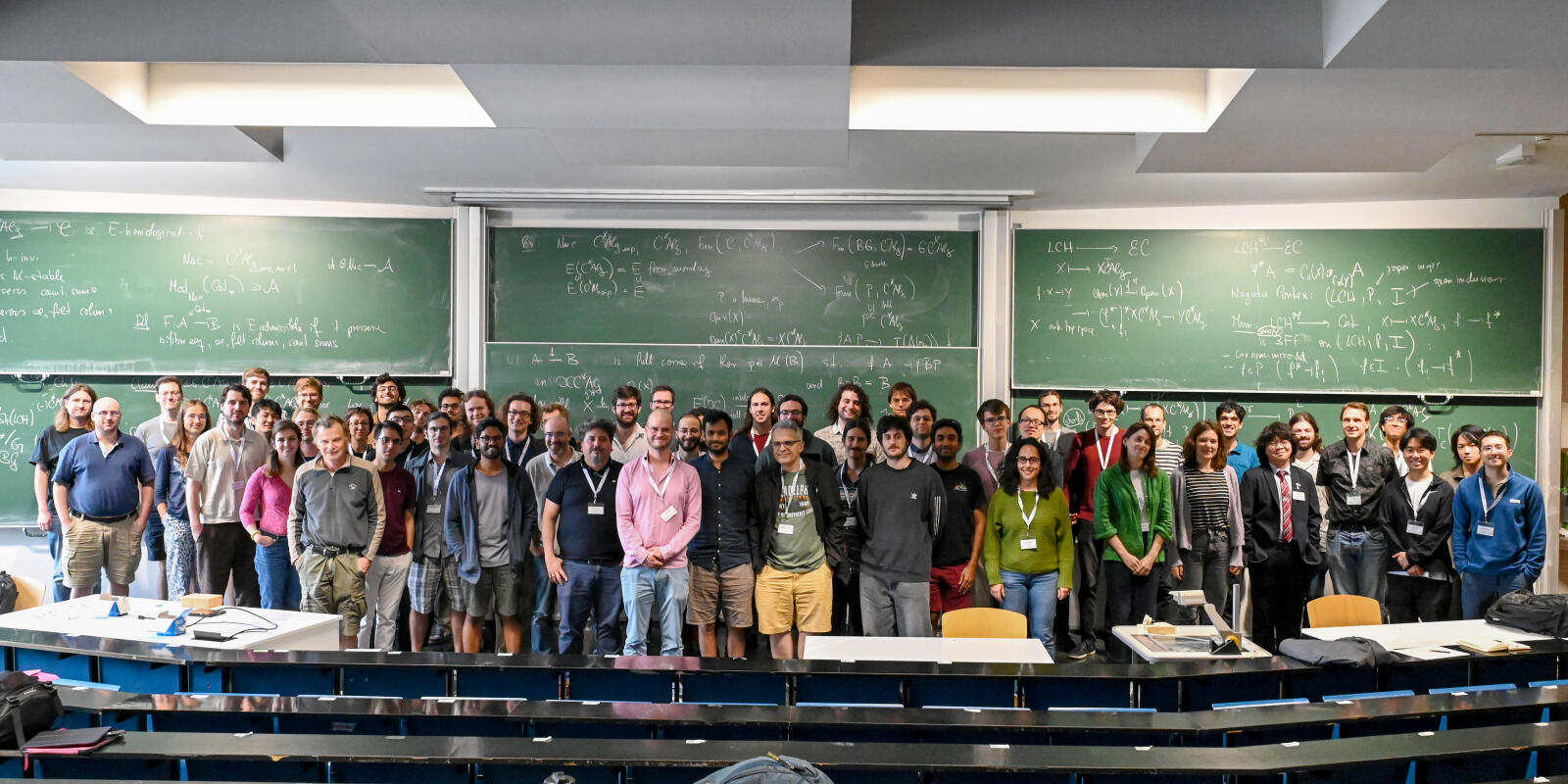
Conference Photo
Registration
All speakers and participants have to register using the following link until August 8th: https://indico.uni-muenster.de/event/3933/
We have limited funding available for early career researchers. If you want to apply for funding, please register through the above link and send an email including your CV to Julian Kranz or to Devarshi Mukherjee until July 15th.
Support and child care
Childcare is available free of charge for all conference participants. If you need childcare, please indicate the details in the registration form.
Venue and Travel information
Registration, coffee breaks and the poster session take place in room SRZ 216/217 on the second floor of the seminar building (Seminarraumzentrum, SRZ, Orléans-Ring 12) next to the Faculty of Mathematics and Computer Science and the Cluster of Excellence Mathematics Münster.
All talks take place in lecture hall M3 on the ground floor of the lecture hall building (Hörsaalgebäude Mathematik und Informatik, Einsteinstraße 64).
The dinner on Wednesday evening takes place at Buddha palace, Von-Esmarch-Straße 18.
Directions can be found on openstreetmap, on the University of Münster campus map and on the MM websites.
We have also collected practical information in a leaflet: Information for conference guests / Informationsblatt für Tagungsteilnehmer:innen [enIde]
Warning: We are aware of a convincing scam targeting participants in mathematical research events. These scammers may telephone or email you and tell you that they are organising accommodation in Münster for you. If you are approached by a third party (eg Travel Tripora or travellerpoint.org) asking for booking or payment details, please ignore. We will never ask you for credit/debit card information. If we are booking accommodation for you, the email will come from Elke Enning, never a third party. We are not the only institute to be targeted. These scammers were prolific before the pandemic and would now appear to be back in business.
Poster
You are welcome to download the poster from this page and display it at your institution.
Sponsors
The conference is supported by the Cluster of Excellence Mathematics Münster and by the CRC 1442 Geometry: Deformations and Rigidity