
Geometry, HOlonomy and Structures with Torsion (GHOST)
The goal of this workshop is to bring together young European-based researchers under the broad umbrella of geometric structures. We aim to provide a place for interaction and sharing of research ideas across a range of disciplines: these include Spin geometry, special holonomy, almost Hermitian geometry, hypercomplex geometry, or Kähler and complex algebraic geometry and related topics.
Speakers
Giuseppe Barbaro (Aarhus University, Denmark)
Beatrice Brienza (University of Turin, Italy)
Longteng Chen (Paris-Saclay University, France)
Udhav Fowdar (University of Warsaw, Poland)
Elia Fusi (University of Turin, Italy)
Giovanni Gentili (Paris-Saclay University, France)
Partha Ghosh (IMJ-PRG Paris, France)
Tathagata Ghosh (National Center for Theoretical Sciences (NCTS), Taiwan)
Dominik Gutwein (University of Hamburg, Germany)
Asia Mainenti (IMAR, Romania)
Lucía Martín-Merchán (Humboldt University of Berlin, Germany)
Romy Merkel (University of Münster, Germany)
Pietro Piccione (Gothenburg University, Sweden)
Andries Salm (Université Libre de Bruxelles, Belgium)
Lothar Schiemanowski (Christian-Albrechts-University of Kiel, Germany)
Tommaso Sferruzza (INdAM - University of Turin, Italy)
Enric Solé-Farré (BIMSA, China)
Ivan Solonenko (University of Stuttgart, Germany)
Leander Stecker (University of Leipzig, Germany)
Dennis Wulle (University of Münster, Germany)
Schedule and abstracts
The talks will take place in room SRZ 216/217, on the second floor of the seminar building (Seminarraumzentrum, SRZ). Coffee breaks will be in the lounge of the second floor of the SRZ building.
If you need some place to work, we have arranged some tables in the lounge outside SRZ 216/217. The lounge also has some blackboards.
Here is a schedule of the talks
| Monday | Tuesday | Wednesday | Thursday | Friday |
|---|---|---|---|---|
|
8:30 - 09:15 Registration |
||||
|
09:15 - 10:05 Andries Salm |
09:15 - 10:05 Romy Merkel |
09:15 - 10:05 Enric Solé-Farré |
09:15 - 10:05 Elia Fusi |
09:15 - 10:05 Asia Mainenti |
|
10:10 - 11:00 Pietro Piccione Non-Archimedean approach for the Yau-Tian-Donaldson conjecture |
10:10 - 11:00 Dennis Wulle On the Geometry and Topology of positively curved Eschenburg Orbifolds |
10:10 - 11:00 Partha Ghosh |
10:10 - 11:00 Giuseppe Barbaro |
10:10 - 11:00 Tommaso Sferruzza |
|
Coffee break Registration |
Coffee break | Coffee break | Coffee break | Coffee break |
|
11:35 - 12:25 Beatrice Brienza |
11:35 - 12:25 Ivan Solonenko Index and nullity of boundary components in symmetric spaces of compact type |
11:35 - 12:25 Lothar Schiemanowski |
11:35 - 12:25 Udhav Fowdar |
11:35 - 12:25 Dominik Gutwein |
| lunch | lunch |
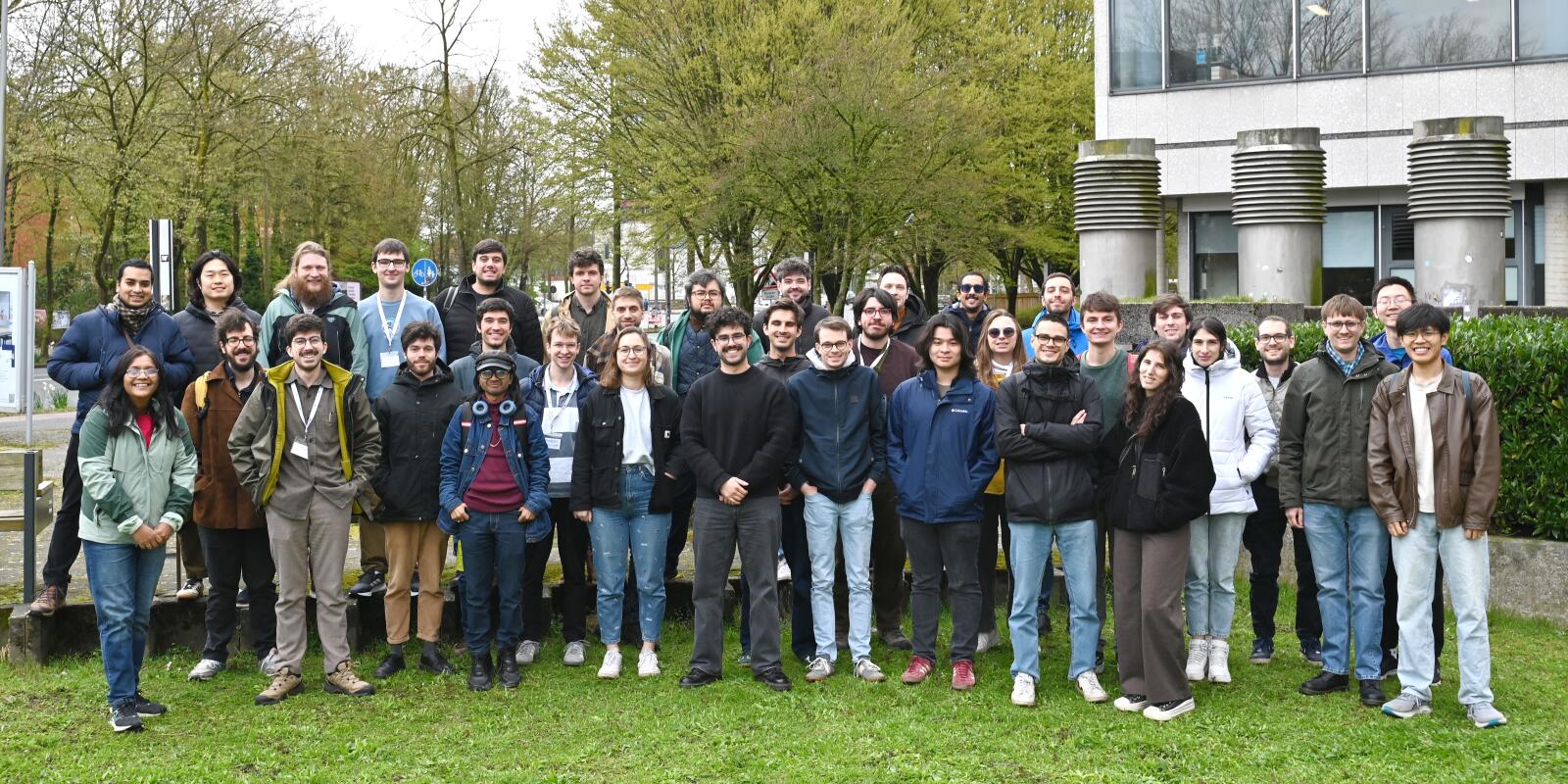
Conference photo + lunch |
lunch |
lunch |
|
14:30 - 15:20 Giovanni Gentili The holonomy of the Obata connection on Joyce hyper-complex manifolds |
14:30 - 15:20 Leander Stecker |
14:30 - 15:20 Longteng Chen |
14:30 - 15:20 Lucía Martín-Merchán Closed G 2 manifolds satisfying the known topological obstructions to holonomy G 2 metrics |
14:30 - 15:20 Tathagata Ghosh Moduli Spaces of Instantons on Asymptotically Conical Spin (7)-Manifolds |
|
Collaboration Time |
Collaboration Time | Collaboration Time | ||
|
7:00 PM Conference Dinner |
Abstracts (in alphabetical order)
Giuseppe Barbaro: Toric Generalized Kähler–Ricci Solitons
We study generalized Kähler–Ricci solitons (GKRS). We show that in four dimensions, all GKRS are either described by the generalized Kähler Gibbons–Hawking approach, or have split tangent bundle, or are A-type toric. This further motivates the study of toric GKRS. In this setting, we establish a local equivalence between toric steady Kähler–Ricci solitons and A-type toric GKRS. Under natural global conditions we show this equivalence extends to complete GKRS, yielding a general construction of new examples in all dimensions.
Beatrice Brienza: The geometry of strong HKT manifolds in dimension 8
A manifold (M, J 1 , J 2 , J 3 ) is called hypercomplex if each J i is a complex structure and { J 1 , J 2 , J 3 } satisfy the quaternionic relations. A quaternionic Hermitian metric g is called HKT (hyper-Kähler with torsion) if ∇ B 1 =∇ B 2 =∇ B 3 =: ∇ B , where ∇ B i denotes the Bismut connection associated with (J i , g) . If, in addition, the bismuth torsion of ∇ B is closed, the metric is called strong HKT. Whenever we have a strong HKT metric, the three Hermitian structures (J i , g) are Bismut Hermitian Einstein, namely, they are pluriclosed and their Bismut Ricci curvature disappears. In this talk, we discuss some properties of compact strong HKT manifolds and, more generally, of Bismuth Hermitian Einstein manifolds. In particular, we describe the geometry of compact simply connected strong HKT manifolds of real dimension 8. This is joint work with A. Fino, G. Grantcharov, and M. Verbitsky.
Longteng Chen: Uniqueness of asymptotically conical Kähler-Ricci flow
Let (M, g, X) be a complete gradient Kähler–Ricci expander with quadratic curvature decay (including all derivatives). Its geometry at infinity is modeled by a unique asymptotic cone, which takes the form of a Kähler cone (C 0 , g 0 ) . In this talk, we will show that if there exists a solution to the Kähler–Ricci flow on M that desingularizes this cone, then it necessarily coincides with the self-similar solution determined by the soliton metric g.
Udhav Fowdar: Strong G 2 -structures with torsion
Strong G 2 -structures with torsion are the natural analogue of Bismut Hermitian Einstein manifolds (ie SKT manifolds with vanishing Bismut Ricci form) in dimension 7. In this talk, I will present some new results about this class of manifolds and how these can be viewed as analogous to known results in the (non-)Hermitian setting. I will also discuss possible geometric flow approaches in this context. This is based on a joint work with Anna Fino.
Elia Fusi: Homogeneous generalized Ricci flows
The Generalized Ricci flow is the natural analogue of the Ricci flow in the setting of Generalized Geometry. In this talk, we will firstly discuss motivations for the study of the Generalized Ricci flow and its connection with the pluriclosed flow. Afterwards, we will focus on the homogeneous case, describing how the Generalized Ricci curvature can be seen as the moment map for a suitable action. Furthermore, we will give an interpretation of the generalized Ricci flow as a ”bracket flow”, in the sense introduced by Lauret, and discuss long-time existence on solvmanifolds and the convergence to generalized Ricci solitons in the nilpotent case. We will finally show that Bismut flat metrics on compact semisimple Lie groups are dynamically stable. These are joint works with Ramiro Lafuente and James Stanfield.
Giovanni Gentili: The holonomy of the Obata connection on Joyce hyper-complex manifolds
The Obata connection on a hypercomplex manifold is the unique torsion-free connection that preserves the hypercomplex structure. Up to taking the product with a torus, Joyce constructed left-invariant hypercomplex structures on compact semisimple Lie groups and certain related homogeneous spaces. Soldatenkov showed in 2011 that every Joyce hypercomplex structure on SU (3) has Obata holonomy equal to the quaternionic general linear group and it was expected that the same should hold for all Joyce hypercomplex manifolds. For all such group manifolds except for direct products with all factors of the form SU (2n+1), we will show that the holonomy group is strictly contained in the quaternionic general linear group. The case of SU (2n+1) is more subtle, however for every n > 1, there still exist infinitely many Joyce hypercomplex structures with Obata holonomy strictly contained in the quaternionic general linear group. This talk is based on a joint work with Beatrice Brienza, Udhav Fowdar, and Luigi Vezzoni.
Partha Ghosh: Mass and rigidity in almost Kähler geometry
In this talk, I present an explicit formula for the ADM mass of asymptotically locally Euclidean (ALE) almost Kähler manifolds. The formula expresses the mass in terms of the total Hermitian scalar curvature and topological data associated with the underlying almost complex structure, extending a result of Hein and LeBrun in the Kähler ALE case. The proof is based on a Spin C adaptation of Witten's proof of the positive mass conjecture in the spin case and is therefore distinct from previous complex-geometric methods. In dimension 4, I show that one can prove a positive mass theorem and a Penrose-type inequality for asymptotically Euclidean (AE) almost Kähler manifolds using this formula. I also explain rigidity phenomena of almost Kähler ALE manifolds. In particular, I show that any four dimensional Ricci-flat almost Kähler ALE manifold of order 4 is Kähler, yielding new evidence towards the Bando–Kasue–Nakajima conjecture. I also discuss analogous rigidity results for asymptotically locally flat (ALF) manifolds.
Tathagata Ghosh: Moduli Spaces of Instantons on Asymptotically Conical Spin (7)-Manifolds
In this talk we discuss instantons on asymptotically conical Spin (7)-manifolds where the instanton is asymptotic to a fixed nearly G 2 -instanton at infinity. After recalling the introductory notions of G 2 & Spin (7)-manifolds, asymptotically conical manifolds, and Yang–Mills equations & Instantons, we briefly discuss the deformation theory of AC Spin (7)-instantons.
As examples, we consider two important Spin (7) manifolds: R 8 , where R 8 is considered to be an asymptotically conical manifold asymptotic to the cone over the round sphere S 7 , and Bryant–Salamon manifold - the negative spinor bundle over 4-sphere, asymptotic to the cone over the squashed 7-sphere.
We apply the deformation theory to describe deformations of Fairlie–Nuyts–Fubini–Nicolai (FNFN) Spin (7)-instantons on R 8 , and Clarke–Oliveira's instanton on the negative spinor bundle over 4-sphere. We also calculate the virtual dimensions of the moduli spaces using Atiyah–Patodi–Singer index theorem and the spectrum of the twisted Dirac operators.
Finally, if time permits, we discuss the current ongoing project with D. Harland on proving the unobstructedness and uniqueness of the FNFN instantons
Dominik Gutwein: The moduli space of conically singular SU (3)-instantons
Instantons over manifolds with special holonomy are a distinguished class of connections on principal bundles. In their seminal paper from 1998 Donaldson and Thomas envisioned invariants of special holonomy manifolds based on the moduli space of such instantons (ie the space of all instantons modulo gauge equivalence). However, a rigorous construction of these invariants faces formidable challenges arising from the possible non-compactness of this moduli space. One source of non-compactness comes from the formation of non-removable singularities, that is, a sequence of instantons might converge to an instanton that is singular along a subset of the underlying manifold. In this talk, I will focus on instantons over 6-manifolds with SU (3)-structures that have isolated singularities of conical type. In particular, I will discuss their moduli space, its structure, and its virtual dimension. This talk is based on ongoing work with Yuanqi Wang.
Asia Mainenti: p-Kähler structures on fibrations and Lie groups
A p -Kähler structure on a complex manifold is a closed, transverse ( p,p )-form. For the extremal values of p , we get the well known Kähler and balanced manifolds. Further motivation to consider such structures comes from non-abelian Hodge theory. The aim of the talk is to discuss open problems in this setting, and to present some recent results on the existence of p -Kähler structures, with a focus on fibrations, Lie groups and their compact quotients. This is based on joint work with A. Fino and G. Grantcharov.
Lucía Martín-Merchán: Closed G 2 manifolds satisfying the known topological obstructions to holonomy G 2 metrics
Within Berger's classification of holonomy groups, G 2 is the exceptional case in dimension seven, and a G 2 -holonomy metric determines a parallel 3-form ϕ. As in other special geometries, the existence of such metrics imposes topological constraints on compact manifolds, including finite fundamental group and non-vanishing first Pontryagin class.
Admitting a closed G 2 structure is a weaker condition, but it is important for the construction of holonomy G 2 metrics on compact manifolds: all known examples are constructed by perturbing closed G 2 structures with small torsion. Until recently, all known simply connected compact manifolds admitting closed G 2 structures were precisely those that also admit holonomy G 2 metrics.
In this talk we discuss the results in arXiv:2508.12658 , where we use orbifold resolution techniques to construct new compact manifolds with closed G 2 structures that satisfy the topological conditions for G 2 holonomy. In these cases, the torsion is not small, and determining whether holonomy G 2 metrics exist on them seems to be a challenging open problem.
Romy Merkel: Twisted bundle constructions in calibrated geometry
The notion of calibrations and calibrated submanifolds was introduced by Harvey and Lawson in 1982 and has since attracted considerable interest through its rich theory and its connections with gauge theory. Motivated by the Harvey–Lawson bundle construction of special Lagrangian submanifolds in C n , one approach to constructing calibrated submanifolds is to view the ambient manifold as the total space of a vector bundle over some manifold X , restrict it to an oriented immersed submanifold L of X and then consider the total spaces of appropriate subbundles. As shown by Karigiannis–Leung, twisting such calibrated subbundles by special sections of the complementary bundles can lead to further examples. After an introduction to calibrated geometry and an overview of previous results, I will explain how these twisted bundle constructions yield special Lagrangian submanifolds in the Calabi–Yau manifold T ∗ S n with the Stenzel metric, as well as calibrated submanifolds in the G 2 -manifold Λ - 2 ( T ∗ X ) ( X 4 =S 4 , C P 2 ) and the Spin (7)-manifold $ - (S 4 ), both equipped with the Bryant–Salamon metrics. I will compare the results to the Euclidean case, outline the main ideas of the proofs, and conclude with some explicit examples.
Pietro Piccione: Non-Archimedean approach for the Yau-Tian-Donaldson conjecture.
In Kähler Geometry, the Yau–Tian–Donaldson conjecture relates the differential geometry of compact Kähler manifold with an algebro-geometric notion called K-stability. I will start with a brief overview of the topic, and then I will discuss a possible non-Archimedean approach to solve this conjecture, generalizing a result of Chi Li to the transcendental setting.
Andries Salm: Metric perturbations of degenerate Z/2-harmonic 1-forms
Z/2 harmonic 1-forms are generalizations of harmonic 1-forms that allow topological twisting around a subspace of codimension 2. These objects were introduced by Taubes to compactify the moduli spaces of solutions to generalized Seiberg-Witten equations, and they show up in many other gauge theoretical problems.
Donaldson showed there is a deformation theory for so-called non-degenerate Z/2-harmonic 1-forms. In this presentation metric we study the perturbations of the remaining degenerate solutions. For a natural class of degenerate examples, we prove that after a suitable perturbation of the ambient Riemannian metric, the form can be deformed to a nearby non-degenerate Z/2-harmonic 1-form.
Lothar Schiemanowski: New exotic sections of the Deligne—Hitchin moduli space
The Higgs moduli spaces provide a rich class of examples of hyperkähler manifolds. The Deligne—Hitchin moduli space is the twistor space of the Higgs moduli space. It turns out that in its space of holomorphic sections other hyperkähler manifolds are hidden. I will explain these concepts and then describe a class of exotic holomorphic sections of the Deligne—Hitchin moduli space and a construction of such sections.
Tommaso Sferruzza: Geometrically formal Hermitian manifolds
Geometrically formal metrics, introduced by Kotschick in '01, are Riemannian metrics on closed oriented smooth manifolds for which the product of harmonic forms is still harmonic. This notion implies the rational formality of the manifold and, at least up to real dimension four, it forces the cohomology ring of a closed oriented manifold to be the one of a compact global symmetric space. In the last ten years, authors adapted the notion of geometric formality to Hermitian metrics on compact complex manifolds and their spaces of harmonic forms with respect to the Dolbeault, Bott-Chern, and Aeppli Laplacians. This has introduced new metric structures which control the multiplicative structure of the complex and pluripotential homotopy theory of compact complex manifolds. In this talk, I will present a broad survey on the most recent results. This presentation is based on a joint work with Adriano Tomassini.
Enric Solé-Farré: From Fueter sections to connections on spheres and back
In his PhD, Walpuski constructed examples of Spin (7)-instantons via a gluing procedure, where the gluing data involves nowhere-vanishing Fueter sections. A natural question is then what happens when the Fueter section is allowed to disappear. In this talk, I will describe what is conjectured to occur in the presence of (non-degenerate) isolated zeros and explain how it connects to the study of connections on S 7 . I will then revisit and extend Waldron's work on connections on S 7 , showing how it naturally leads to considering some "new" Fueter operators. I will conclude by discussing some ongoing work and open questions related to these constructions.
Ivan Solonenko: Index and nullity of boundary components in symmetric spaces of compact type
Let S be a compact minimal submanifold in a Riemannian manifold M. Using the eigenvalues of the Jacobi operator associated with S , one can define what is known as the index and nullity of S . Loosely speaking, these are the dimensions of the spaces of (infinistesimal) normal deformations of S along which its volume decreases or is preserved, respectively. The submanifold is called stable if its index is zero. In his seminal paper from 1987, Ohnita derived a formula that allows one to calculate the index and nullity of a totally geodesic submanifold S = G/K in a compact symmetric space M by comparing the eigenvalues of the Casimir operator of G in certain representations arising from S . In general, that formula is rather unwieldy, but in certain cases it looks simpler. For instance, in that same paper, Ohnita applied his formula to certain totally geodesic spheres, called Helgason spheres, computing their indices and nullities and showing that they are always stable.
Helgason spheres are a special case of a much wider family of totally geodesic submanifolds that one can associate to every symmetric space M of compact type by considering root subsystems of the root system associated with M . Under the duality between symmetric spaces of compact and noncompact type, the submanifolds in that family are known as boundary components. It turns out that the Casimir operators in Ohnita's formula look much nicer for boundary components and their eigenvalues can be rewritten in terms of the root data—which is a lot simpler and combinatorial in nature. Using this approach, we have been able to calculate the index for a variety of boundary components of higher rank. In this talk, I am going to explain this approach and mention the following two results: (a) the submanifold SU(k)/SO(k) in SU (n)/SO(n) is stable if and only if k is even (here k = 2 corresponds to the Helgason sphere); (b) a simple necessary condition for the index to be positive, which allows to easily rule out a lot of boundary components as unstable. This is a joint work in progress with Niklas Rauchberger.
Leander Stecker: Reducible Holonomy in Closed Torsion Geometry
The classical de Rham theorem states that reducible holonomy yields a product geometry. In the case of connections with skew torsion this does not remain true. We adapt a submersion theorem from parallel torsion geometries to the closed torsion case and investigate occurrences in SKT geometry. In particular, we derive the holonomy decomposition of SKT structures on compact semi-simple Lie groups.
Dennis Wulle: On the Geometry and Topology of positively curved Eschenburg Orbifolds
Studying the topology of Riemannian manifolds under curvature constraints is a central topic in Riemannian geometry. Lower curvature bounds, such as non-negative or positive sectional curvature, are of particular importance. While numerous examples with non-negative curvature are known, positively curved Riemannian manifolds rarely appear, creating a sharp contrast with the few known topological obstructions separating these two classes. Extending the study to more singular spaces, like orbifolds, offers the potential to handle both the shortage of examples and the lack of obstructions even in the smooth category. In this topic, we study the geometric and topological properties of Eschenburg orbifolds, which provide an infinite family of non-negatively and positively curved spaces in dimension six. In fact, we present restrictions of the singular set imposed by positive sectional curvature and calculate the cohomology rings of the entire family. By merging these two perspectives, we observe a distinct behavior of the cohomology rings of special positively curved subfamilies compared to their non-negatively curved counterparts.