

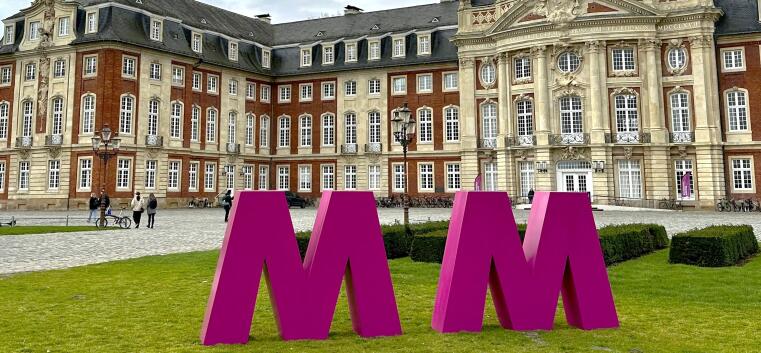
Opening Conference: 2nd Funding Period of Mathematics Münster
In Honor of Bernhard Riemann’s 200th birthday
The Cluster of Excellence 'Mathematics Münster: Dynamics - Geometry - Structure' has recently obtained continued funding for its second term, and the upcoming conference will serve as a celebration of this achievement. Much like the Cluster bridges the full spectrum of mathematics at Münster – from pure to applied – the conference aims to unite prominent international mathematicians, Cluster researchers, and early career scholars. This dynamic event will offer a platform for lively exchange across diverse areas of mathematics. We look forward to inspiring interdisciplinary dialogue and collaboration, showcasing both external expertise and the innovation emerging from within our Cluster.
We would be delighted to welcome you in Münster on this event.
Speakers (confirmed)
Rima Alaifari (RWTH Aachen)
Christian Bär (University of Potsdam)
Robert Burklund (University of Copenhagen)
Steffen Dereich (University of Münster)
Cristiana De Filippis (University of Parma)
Allen Fang (University of Münster)
Christophe Garban (Université Lyon)
Ursula Hamenstädt (University of Bonn)
David Kerr (University of Münster)
Julian Kranz (University of Münster)
Luzie Kupffer (University of Münster)
Jonathan Luk (Stanford University)
Lucas Mann (University of Münster)
Sophie Mildenberger (University of Münster)
Volodymyr Nekrashevych (Texas A&M University)
Vincent Pilloni (Université Paris-Saclay)
Maxim Ramzi (University of Münster)
Dima Sinapova (Rutgers University)
Katrin Tent (University of Münster)
Bálint Virág (University of Toronto)
Scientific Committee
Shirly Geffen
Gustav Holzegel
Franziska Jahnke
Chiranjib Mukherjee
Thomas Nikolaus
Mario Ohlberger
Eva Viehmann
Hendrik Weber
Burkhard Wilking
Caterina Zeppieri
Preliminary Schedule
| Wednesday | Thursday | Friday | |||
|---|---|---|---|---|---|
| 08:30 | Registration | 08:30 | Women's Breakfast | ||
| 09:00 | Opening (Aula) |
09:00 | Nekrashevych (S8) |
||
| 09:45 | De Filippis (Aula) |
10:00 | Hamenstädt (Aula) |
09:45 | Virág (S8) |
| 10:30 | Coffee Break | 10:45 | Coffee Break | 10:30 | Coffee Break |
| 11:00 | Pilloni (S8) |
11:15 | Garban (Aula) |
11:00 | Burklund (S8) |
| 11:45 | Luk (S8) |
12:00 | Alaifari (Aula) |
11:45 | Sinapova (S8) |
| 12:30 | Lunch | 12:45 | Lunch | 12:30 | Lunch |
| 14:30 | Tent (S8) |
15:15 | Dereich (Aula) |
14:30 | Kerr (Aula) |
| 15:15 | Ramzi (S8) |
16:00 | Coffee Break | 15:15 | Mann (Aula) |
| 15:40 | Kranz (S8) |
16:30 | Kupffer (Aula) |
15:40 | Mildenberger (Aula) |
| 16:00 | Coffee Break | 16:55 | Fang (Aula) |
16:00 | Coffee Break |
| 16:30 | Poster Blitz (Aula) |
17:30 | Public Lecture: Bär (Aula) |
||
| 17:15 | Poster Session | ||||
| 18:00 | Reception | 19:30 | Dinner | ||
Titles und Abstracts
Christiana De Filippis: Nonuniform Ellipticity and Nonlinear Potentials
The representation formula for the Poisson equation gives an explicit expression of solutions in terms of the data, yielding zeroth- and first-order pointwise bounds via convolution with suitable Riesz potentials. Their mapping properties allow for a sharp regularity transfer from data to solutions, so that nonlinear PDEs can be treated, up to the $C^{1}$-level as they were linear. I will then discuss a novel potential-theoretic approach to the (ir)regularity of solutions to certain nonuniformly elliptic PDEs arising in geometric and physical models.
Vincent Pilloni: Zeta functions of curves
Zeta functions of algebraic varieties provide a vast generalization of Riemann's zeta functions. We will report on some conjectures and progress concerning zeta functions of genus 2 curves.
Jonathan Winghong Luk: Shock formation in gas dynamics
I will discuss shock formation for partial differential equations governing gas dynamics, beginning with the seminal work of Riemann. I will then survey recent results in multiple spatial dimensions for increasingly complex physical situations, emphasizing the fundamental role of geometric ideas.
Katrin Tent: Universal hyperbolic graphs and spaces and their isometry groups
I will present a construction of a universal homogeneous hyperbolic metric space, i.e. a metric space in
which every finite hyperbolic space with rational distances can be isometrically embedded, in analogy
to the Urysohn space. The isometry group of this space is a totally disconnected polish group and I
will discuss simplicity and primitivity of the group and its action.
Maxime Ramzi: Categorification of rings
Given an additive category $C$, taking its Grothendieck group $K_0$ is a way to extract concrete "numerical information" out of $C$ - for example, it replaces finite dimensional vector spaces over a field with their dimension, a simpler invariant.
Conversely, given an abelian group $A$, one may wonder whether it is $K_0$ of a certain additive category, whether $A$ can be "categorified". In various areas of mathematics, categorifying questions about numerical invariants has turned out to be a powerful method. In the context of knot invariants, Khovanov asked whether $Q$ and $Z[1/n]$ can be categorified as rings, that is, be expressed as $K_0$ of an additive category equipped with a tensor product. This question was partly answered by Levy, who then asked whether all commutative rings can be categorified. In this talk, I will explain the precise question Levy asked, and explain a positive answer to this question.
Julian Kranz: Dynamical comparison for groupoids and applications
Dynamical comparison is a regularity property for étale groupoids with important structural implications for the associated C*-algebras and the homology of the associated topological full groups. I will review recent progress on establishing dynamical comparison for large classes of groupoids and on using it to find unexpected isomorphisms among seemingly different classes of C*-algebras.
Ursula Hamenstädt: A tale about Riemann surfaces and mapping class groups
Riemann surface is a closed surface equipped with a complex structure. If the genus is at least two, then equivalently it is a closed hyperbolic surface. We'll give an overview of some of the properties of the moduli space of such surfaces and their mapping class group, and we connect geometric information to the construction of geometric representations of the mapping class group on suitably chosen $L^p$-spaces and discuss some open questions.
Christophe Garban: Continuous Symmetry and Phase Transitions in Lattice Spin Systems
A central problem in statistical physics is to understand how spins placed on the lattice $Z^d$ interact and collectively organize at different temperatures. When the spins take values in a discrete set — for instance in the celebrated Ising model, where $\sigma_x\in\{−1,+1\}$ — the mechanisms governing phase transitions are by now relatively well understood.
The situation changes dramatically when the spins take values in a continuous space, such as the unit circle $S^1$ in the XY model or the unit sphere $S^2$ in the classical Heisenberg model. In this setting, new phenomena appear, and the behavior depends strongly on whether the underlying symmetry is Abelian or non-Abelian. In particular, the non-Abelian case remains far more mysterious.
In this talk, I will introduce the mathematics of spin systems with continuous symmetry, emphasizing their deep connections with analysis, including harmonic functions, harmonic maps, and geometric analysis. I will also describe some recent results and open problems in the area.
No prior background in statistical physics or probability will be assumed. Based on joint works with J. Aru, D. van Engelenburg, P. Dario, N. de Montgolfier, A. Sepúlveda and T. Spencer.
Steffen Dereich: Mean-Field Decoupling of Neurons in Infinite-Width Neural Network Training
Wide neural networks may be viewed as high-dimensional interacting particle systems: each neuron evolves during training, while interacting with the others through empirical averages determined by the network output and the loss. This perspective naturally suggests a mean-field limit as the width tends to infinity. However, in contrast to classical mean-field models, the relevant scaling for feature learning is delicate. The $\mu P$ parametrisation is designed to produce nontrivial infinite-width training dynamics, avoiding the purely linearised behaviour of the neural tangent kernel regime.
In this talk, I will discuss a new decoupling result for neural network training in the $\mu P$ setting. Starting from Gaussian initialisation, we show that the original interacting neuron system can be explicitly coupled to a completely decoupled system. In this decoupled system, individual neurons evolve independently of each other according to effective one-particle dynamics. They interact with the rest of the network only through deterministic mean-field quantities. The result can be understood as a propagation-of-chaos statement adapted to the $\mu P$ scaling, with an explicit coupling between the true dynamics and the decoupled system.
Luzie Kupffer: Bi-infinite random walk paths and geodesic flow on hyperbolic groups
It is well-established that Patterson-Sullivan measures on the boundary of a hyperbolic space, along with the associated Bowen-Margulis-Sullivan measure, provide valuable insights into the action of a group of isometries on the space's boundary through analysis of the geodesic flow. Given that paths of a random walk on a hyperbolic groups lie close to the group's quasi-geodesics, it is natural to ask whether similar behaviour can also be seen in the flow along bi-infinite random walk paths.
In this talk, I will show how studying bi-infinite random walks on a discrete hyperbolic group $G$ leads to an analogue of the Patterson-Sullivan measure on $\partial^2G$. This measure can be constructed in multiple measure-equivalent ways, each giving distinct perspectives on its intrinsic structure. Moreover, as in the classical case, the action $G \curvearrowright \partial^2 G$ is ergodic with respect to this measure. Central to the construction of these measures is the almost sure convergence of the random walk to the boundary $\partial G$ and the study of the distribution of the hitting points. This talk is based on joint work with Mahan Mj and Chiranjib Mukherjee.
Allen Juntao Fang: On the uniqueness of Kerr-de Sitter
The uniqueness of the Kerr-de Sitter family of black hole spacetimes as stationary solutions to the Einstein vacuum equations is a crucial ingredient to understanding the final states of positive cosmological constant universes, such as our physical universe. In the asymptotically flat case, Kerr was shown to be the unique analytic stationary solution to the Einstein vacuum equations via a combination of results by Hawking, Carter, and Robinson. Outside of analyticity, Alexakis, Ionescu, and Klainerman showed several conditional rigidity results for Kerr. In this talk, I will discuss some recent work in the spirit of Alexakis, Ionescu, and Klainerman showing the uniqueness of the stationary region of Kerr-de Sitter within the smooth class of stationary solutions to the Einstein vacuum equations with a positive cosmological constant.
Rima Alaifari: How Can We Learn from Paths? Signatures, Kernels and Stochastic Regression
Many data sets arising in stochastic systems, dynamics, and time series are naturally represented by paths rather than by points in a finite-dimensional space. The signature transform, which associates to a path a hierarchy of iterated integrals, provides a powerful way of encoding such objects while retaining rich algebraic and analytic structure. In this talk, I will introduce the basic ideas behind signatures and explain how they can be used for learning problems on path space. I will focus in particular on stochastic regression and on signature kernels, which allow one to work with the signature representation without computing its infinitely many coordinates explicitly. Along the way, I will highlight connections between rough path theory, kernel methods, partial differential equations, and data-driven learning.
Christian Bär: Bernhard Riemann – Visionär der modernen Mathematik (public lecture)
Am 17. September 2026 jährt sich der Geburtstag Bernhard Riemanns zum 200. Mal. Obwohl
Riemann nur 39 Jahre alt wurde und vergleichsweise wenige Arbeiten veröffentlichte, veränderte er
die Mathematik grundlegend. Seine Ideen prägen bis heute unser Verständnis von Raum, Geometrie,
Zahlen und Naturgesetzen.
Der Vortrag zeichnet einige Stationen seines ungewöhnlichen Lebenswegs nach und stellt zwei
besonders folgenreiche Aspekte seines Werkes vor. Zum einen geht es um die nach ihm benannte
Geometrie gekrümmter Räume, die später zur mathematischen Grundlage von Einsteins Allgemeiner
Relativitätstheorie wurde und heute in zahlreichen Gebieten der Mathematik und Physik eine zentrale
Rolle spielt. Zum anderen wird die Riemannsche Vermutung erläutert, eines der berühmtesten
ungelösten Probleme der Mathematik, das auf überraschende Weise mit der Verteilung der Primzahlen
verbunden ist.
Volodymyr Nekrashevych: New amenable groups
Amenability is a fundamental finiteness condition in group theory introduced almost 100 years ago by J. von Neumann. But even now, the border between the classes of amenable and non-amenable groups is not well understood. Recent years have seen the development of new methods of proving amenability of groups, which expanded the class of "non-elementary" amenable groups. I will give a survey of the results in this area and their applications.
Bálint Virág: Continuum RSK Correspondence: From Brownian Motion to Random Geometry
In the KPZ universality class, random growth and last-passage models in the plane converge to a universal object known as the directed landscape - a random directed metric encoding optimal paths and last-passage times.
In this talk, I will describe a bijection that recovers the full directed landscape from a sequence of independent Brownian motions. This construction is the natural scaling limit of the classical Robinson–Schensted–Knuth (RSK) correspondence and gives a clean dictionary between simple noise and rich random directed geometry.
Joint work with Duncan Dauvergne.
Robert Burklund: Geometry in chromatic characteristic
In this talk I will give an overview of recent developments in spectral algebraic geometry and how they shed light on some of the basic questions of stable homotopy theory.
Dima Sinapova: Cardinal arithmetic
Cardinal arithmetic is about investigating the values of powersets of infinite objects, going back to Hilbert's First Problem: the continuum hypothesis (CH). CH is the statement that the size of the reals (which can be identified as the powerset of the natural numbers) is the least uncountable cardinal. Famously, Cohen proved that CH is independent from the usual axioms of mathematics. Since then, modern set theory has analyzed the properties of the powerset function of infinite cardinals in general. In this talk, we will focus on recent results about the powerset value of singular cardinals and interaction with infinitary combinatorics
David Kerr: From form to content: amenability in dynamics and operator algebras
The concept of amenability, in its most powerful incarnations across groups, dynamics, and operator algebras, can be viewed as an organizing principle for detecting, manipulating, and managing structural data. This plays out at the technical level through tilings (groups), tower decompositions (dynamics), and finite-dimensional approximation (operator algebras). What is remarkable is that amenability can be used as a tool both for the internal analysis of objects that possess it as a property and for the investigation of phenomena that lie beyond its own horizon. The former is a program that operates at the finest scales and typically leads to classification theorems, while the latter serves to illuminate the broader expanses of the theory in question. I will discuss some recent examples of the latter principle in the application of dynamics to operator algebras.
Lucas Mann: The categorical local Langlands correspondence
The Langlands program is a set of far-reaching conjectures that permeate modern number theory and complex analysis. Over the years, different versions of the program have appeared, and a particularly important one for arithmetic is the local Langlands conjecture: It predicts a surprising relation between the representation theory of matrix groups over $p$-adic fields on the one side and Galois theoretic information on the other, with deep applications to number theory. A recent breakthrough was obtained by Fargues-Scholze in their seminal paper on the geometrization of the conjecture, lifting the classical conjectures to a powerful geometric framework and "categorifying" both sides, but leaving the conjectured equivalence still open. In joint work with David Hansen, we provide a strategy for proving Fargues-Scholze's conjectures, which (up to a work-in-progress conjecture on certain compatibilities) gives a full proof in the case of $GL_n$ and many classical groups.
Sophie Mildenberger: Tail estimates for multiplicative heat equations in the subcritical regime
We establish tail estimates for multiplicative stochastic heat equations driven by a wide class of subcritical Gaussian noises. In the classical settings of the one-dimensional multiplicative stochastic heat equation (mSHE), driven by space–time white noise, and the two-dimensional parabolic Anderson model (PAM), driven by spatial white noise, time-dependence of the noise leads to better tail estimates even at lower scaling regularity. Indeed, moments of PAM exist only for small times while mSHE exhibits global moments. Working within the framework of regularity structures, we develop a robust approach that allows us to leverage time-dependence for more general noises. The resulting tail estimates reflect the combined effect of the space-time scaling regularity and the temporal dependence of the driving noise.
Poster Session
Gunnar Birke: An Entropy-Preserving Cut-Cell Stabilization Method for Hyperbolic Conservation Laws
Anna Cascioli: Stationary Boundaries on the Space of Amenable Subgroups and $C^∗$-Simplicity
Felipe Espinosa-Vergara: Thick Points under Gaussian Free Field Dynamics
Benedikt Klein: Adaptive Model Order Reduction for Defect Identification
Catrin Mair: A condensed version of ongoing projects
Raquel Murat: Fibrations over coset spaces and condensed group cohomology
Lukas Obermeyer: Generalized inductive limits and traces of $C^∗$-algebras
Milos Provci: Boundedness, Decay, and Stability on Anti-de Sitter-Type Spacetimes
Phil Pützstück: Double duals and how to fix them
Philipp Schange: Expected hyperbolic volume of random ideal polytopes
Alexander Schell: PinT Meets Block Krylov: Increasing Hardware Efficiency for Time-Dependent Simulations
Philipp Sibbel: Diagonals in Kirchberg Algebras
Robin J. Sroka: Scissors automorphism groups
Adam Thompson: Einstein metrics and Harmonic maps
Edoardo Tolotti: Explicit Minimizers of the Confined Anisotropic Riesz Potential
Nikolas Uesseler: On the Existence of Geodesics in the Space of Closed Curves
Alexander Van Werde: Can one hear the shape of a typical network?
Vincent Wolff: Einstein Metrics on Homogeneous Torus Bundles
Registration
Registration is possible by using the following link.
Support and Child Care
Childcare is available free of charge for all conference participants.
Venue and Travel Information
The conference takes place in the Auditorium ("Aula") and in lecture hall S8 in the "Schloss" in Münster.
Schloss
Schlossplatz 2
48149 Münster
Directions can be found on openstreetmap or on the University of Münster campus map.
To book the hotel rooms reserved for participants, please go here.
We have also collected practical information in a leaflet: Information for conference guests / Informationsblatt für Tagungsteilnehmer*innen [enIde]
Poster
You are welcome to download the poster from this page and display it at your institution.
Sponsor
The conference is supported by the Cluster of Excellence Mathematics Münster.