
MaRDI Annual Meeting 2026
The MaRDI Annual Meeting 2026 brings together members of MaRDI and invited guests from neighbouring scientific and infrastructure communities. The meeting begins around midday on Wednesday and ends around midday on Friday.
The scientific programme addresses current advances in FAIR mathematical research data, ranging from standards for metadata and ontologies to workflows for reproducible simulations. Central topics include research data in numerical analysis and scientific computing, as well as infrastructures such as knowledge graphs and repositories. Concrete use cases and tools developed within MaRDI will illustrate these directions.
Plenary contributions, thematic talks, and internal working sessions will connect these scientific topics with the further development of MaRDI, the scientific and infrastructural orientation of the next project phase, exchange between the Task Areas, future cooperation, and cross-consortium links.
On Thursday, a strategic meeting of the Co-PIs is planned. In parallel, participants will meet in working sessions related to the new MaRDI Task Area structure. The results will be brought back to the full group in a joint closing session on Friday.
Confirmed Speakers
Antony Della Vecchia (TU Berlin)
Floris van Doorn (University of Bonn) (jointly with the Colloquium Wilhelm Killing)
Sebastian Pokutta (ZIB / TU Berlin) (jointly with the Colloquium Wilhelm Killing)
Scientific Committee
Scientific Schedule
Preliminary schedule; programme details may still change. All titles and abstracts are collected in the book of abstracts (PDF).
| Time | Wednesday | Thursday | Friday |
|---|---|---|---|
| 09:00 – 09:45 | Chair: N. N.NFDIxCS Services and ArchitectureNFDIxCS Services and ArchitectureUlrike Lucke (University of Potsdam) Managing research data is inseparably linked to managing research software. The community has several tools and services available for this purpose. This ecosystem is currently extended in two dimensions within NFDIxCS. First, infrastructure is provided to support reuse of software in different environments. Second, interoperability of services is addressed by a technical architecture that balances aspects of comfort and security. At the same time, this enables links to be established between developments that have so far been carried out within the individual consortia. Ulrike Lucke | Chair: N. N.Alexander Kasprzyk | |
| 09:45 – 10:30 | Research Data Infrastructures in the Age of Generative AIResearch Data Infrastructures in the Age of Generative AISonja Schimmler (Fraunhofer FOKUS / TU Berlin) In her talk, Sonja Schimmler will examine how generative AI is reshaping the way researchers create, share, and reuse articles, data, models, and code. As this shift introduces new challenges for transparency and reproducibility, research data infrastructures must adapt. She will explore how these systems are evolving to manage diverse scholarly artifacts and leverage AI themselves. Sonja Schimmler | From FAIR data to FAIR Digital Objects in the MaRDI PortalFrom FAIR data to FAIR Digital Objects in the MaRDI PortalTim Conrad (ZIB) The MaRDI portal already provides FAIR-aligned access to publications, datasets, software, algorithms and workflows. What it does not yet offer is a machine-actionable operations layer: a protocol-level way to discover, retrieve and process portal entities without knowing the Wikibase data model. We present our work on exposing portal entities as FAIR Digital Objects via a DOIP gateway placed in front of the knowledge graph. We walk through the entity-to-FDO mapping, the choice of a gateway over changes to the Wikibase installation, and the open questions in defining FDO profiles for mathematical objects. We close with an outlook on the added value of this approach for the MaRDI ecosystem and invite discussion on which types and operations the community needs most. Tim Conrad | |
| 10:30 – 11:00 | Coffee Break | Coffee Break | |
| 11:00 – 11:45 | Chair: N. N.pHS-Bench: Nachhaltiges Benchmarking für port-Hamiltonsche SystemepHS-Bench: Nachhaltiges Benchmarking für port-Hamiltonsche SystemeBirgit Jacob (University of Wuppertal) and Yannik Wotte (University of Wuppertal) Der Beitrag stellt pHS-Bench vor, ein Benchmark-Projekt des SFB 1701 in Wuppertal für Methoden und Software im Bereich port-Hamiltonscher Systeme. Mit Leaderboard- und Blind-Testing-Funktionalitäten ergeben sich neue Fragestellungen, etwa zur Entwicklung geeigneter Metriken, zur fairen Evaluation und zur Akzeptanz in der Community. Eine Integration in MaRDIMark verspricht zugleich eine höhere Nachhaltigkeit, Reproduzierbarkeit und Sichtbarkeit der Benchmarks und eröffnet damit besondere Synergien zwischen pHS-Bench und MaRDI. Birgit Jacob / Yannik Wotte | Chair: N. N.MaRDI Benchmarking and Workflows Peter Benner | |
| 11:45 – 12:30 | Registration (light snack provided) | MathAlgoDB and MathModDB: Current State, Plans, and LLM-Assisted CurationMathAlgoDB and MathModDB: Current State, Plans, and LLM-Assisted CurationBjörn Schembera (University of Stuttgart) and Frank Wübbeling (University of Münster) MathAlgoDB and MathModDB organize knowledge about numerical algorithms and mathematical models in MaRDI. We report on the current state of both databases and outline our plans for the second funding phase: merging them in content and technology on the MaRDI Portal so that they become part of the MaRDI knowledge graph, and extending the approach to further MaRDI databases and other classes of mathematical objects, such as statistical models. A key challenge is to populate these resources at scale: knowledge may come from experts directly or be extracted from existing scientific literature. We present an LLM-assisted workflow that transforms natural-language input into structured database proposals, using extraction contracts, JSON and SHACL validation, provenance, and human review. It can also analyze current articles to identify algorithms, models, numerical experiments, and their relationships. We discuss how this approach can support the scalable and reliable growth of mathematical knowledge graphs. Björn Schembera / Frank Wübbeling | Workflow material for community submissionsWorkflow material for community submissionsLeopold Mareis (TU Munich) and Antony Della Vecchia (TU Berlin) We sketch our plans for a community-led platform for publishing computational notebooks, in which each notebook is intended to receive a persistent identifier via Zenodo and be linked to the MaRDI Knowledge Graph. We outline the envisioned technical setup and first ideas for FAIR-compliant submission templates. Leopold Mareis / Antony Della Vecchia |
| 12:30 – 13:00 | Lunch and Discussions | Introducing the MaRDI ConfKit™ and the plans for TA-EIntroducing the MaRDI ConfKit™ and the plans for TA-EDominik Göddeke (University of Stuttgart) After a lot of work behind the scenes, MaRDIans as well as NFDI friends and partners now have access to a versatile and customizable Conference Kit. The first half of this session celebrates its official release. In a live demo, its customization options, along the lines of typical use cases, will be explored, interactively gathering feedback. In the second half of the session, the ConfKit will serve as a guiding example and foundation of the envisioned OER self-learning material for outreach and novel (hopefully improved) MaRDI services. This opens up the stage to a brief overview of the outreach strategy for the second funding period as suggested by the newly formed TA-E. Dominik Göddeke | |
| 13:00 – 13:15 | Welcome | ||
| 13:15 – 14:00 | Chair: N. N.Michael Hintermüller | ||
| 14:00 – 14:45 | Empirical evaluation of statistical methods: towards replicability and reliable guidanceEmpirical evaluation of statistical methods: towards replicability and reliable guidanceAnne-Laure Boulesteix (LMU Munich) Often, several statistical methods can address a given research question for a given dataset. In many practical cases, particularly with complex data and sophisticated methods, mathematical theory alone cannot definitively determine which method is most appropriate. In this challenging context, empirical evaluations of method performance are crucial for developing guidance for data analysts. Researchers conducting these evaluations apply candidate methods to simulated or real datasets with varying characteristics relevant to the considered field of application and assess the results produced by these methods, which can be viewed as (statistical) research data. In my talk, I will present work conducted by my group over the past few years on the appropriate design of such empirical evaluations, the identification of potential bias sources threatening replicability, and the use of these evaluations to provide reliable methodological guidance to data analysts. Specifically, I will share insights from the international 'STRengthening Analytical Thinking for Observational Studies' (STRATOS) initiative, which aims to deliver accessible and accurate guidance for the design and analysis of observational studies. Anne-Laure Boulesteix | Co-PI Meeting and Parallel Task Area Sessions | |
| 14:45 – 15:30 | Coffee Break | ||
| 15:30 – 16:15 | Chair: Mario Ohlberger · Lecture Hall M2Formalized mathematics in the age of AIFormalized mathematics in the age of AIFloris van Doorn (University of Bonn) Generative AI is rapidly transforming the landscape of mathematical research by solving many open mathematical problems. I will talk about these advances from the perspective of formalized mathematics. Many of these AI solutions come with an AI-generated formalization in Lean. These might not help to understand the mathematical argument, but do provide some guarantees about the correctness of the proof. I will discuss to what extent we can trust Lean formalizations and what there is left to check and my perspectives on autoformalization. Floris van Doorn (jointly with the Colloquium Wilhelm Killing) | Coffee Break | |
| 16:15 – 17:00 | Agentic AI Workflows in MathematicsAgentic AI Workflows in MathematicsSebastian Pokutta (ZIB / TU Berlin) Turning powerful language models into reliable scientific collaborators takes more than model quality: it demands rigorous verification, mathematical guardrails, and an architecture that lets coding agents run long-horizon experiments autonomously. In this talk, I will present a practical framework for AI-assisted research that aims to compress the research cycle. The framework turns general-purpose coding agents into autonomous research assistants through a five-level taxonomy of human-AI collaboration, a set of methodological commandments encoding scientific rigor, and a sandboxed environment supporting sessions from quick explorations to multi-day, multi-node experiments. I will discuss the possibilities and limitations of agentic AI in research, and briefly illustrate the framework. Sebastian Pokutta (jointly with the Colloquium Wilhelm Killing) | Chair: N. N.Wrap-up Session | |
| 17:00 – 19:00 | Get Together | ||
| 19:00 – 22:00 | Conference Dinner (Vinothek am Theater) |
Registration
Registration for the MaRDI Annual Meeting 2026 is open. Please register via the conference registration page.
Contact
For questions about the MaRDI Annual Meeting 2026, please contact Frank Wübbeling.
Venue and Travel Information
The meeting takes place in the Mathematics Münster Conference Hall in the Seminarraumzentrum (SRZ). The conference hall and lounge are located on the second floor. The SRZ is located next to the Faculty of Mathematics and Computer Science and the Cluster of Excellence Mathematics Münster.
University of Münster
Seminarraumzentrum (SRZ)
Orléans-Ring 12
48149 Münster
Germany
Directions can be found on openstreetmap, on the University of Münster campus map and on the MM websites.
We have also collected practical information in a leaflet: Information for conference guests / Informationsblatt für Tagungsteilnehmer:innen [en|de]
The conference dinner (Thursday, 12 November, 19:00) takes place at the Vinothek am Theater, Neubrückenstraße 16, 48143 Münster. Menu (PDF)
Walking to the dinner. The Vinothek is in the old town. These are not the shortest ways but the scenic ones – both take you past some of Münster's highlights. Map of both walks (PNG)
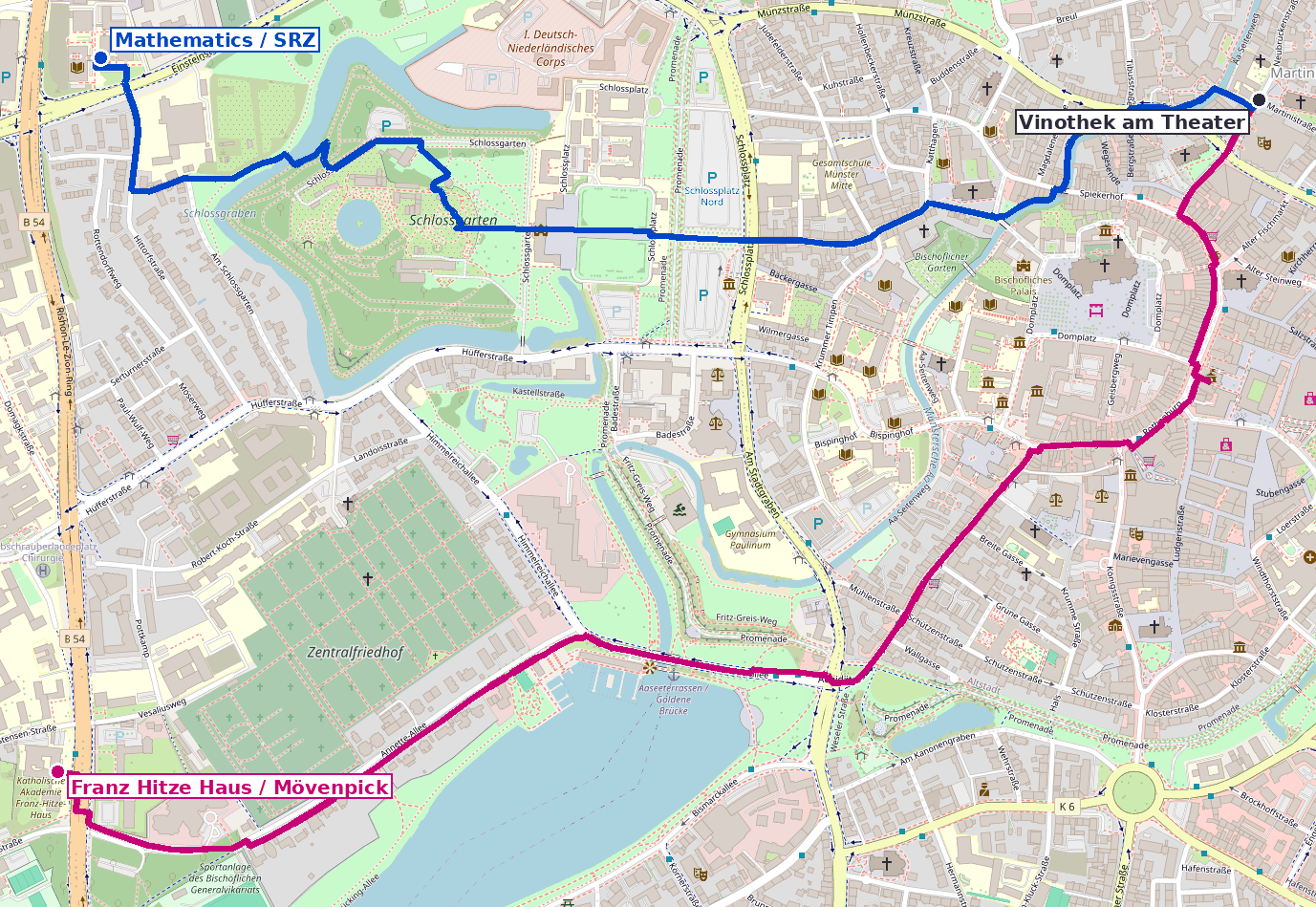
From the Franz Hitze Haus and the Mövenpick Hotel (about 2.8 km, 35–40 minutes): Take the small path past the Mövenpick Hotel to the Annette-Allee and walk along the Aasee lake to its end, past the Aaseeterrassen and Claes Oldenburg's Giant Pool Balls. Continue straight on through the Aegidiitor into Aegidiistraße, past the LWL Museum of Art and Culture, and turn into Rothenburg to reach the Prinzipalmarkt with its gabled houses and arcades. Pass the Historic Town Hall, where the Peace of Münster (part of the Peace of Westphalia) was signed in 1648, and St. Lamberti church with its three cages, and follow Roggenmarkt into Neubrückenstraße.
From the Department of Mathematics and the SRZ (about 2.4 km, 30–35 minutes): Walk through the Schlossgarten, the park behind the Prince-Bishop's Palace (Schloss), today the main building of the university, and enter the Schloss from the garden side. Walk through the building and leave it at the front, then go straight on across the Schlossplatz into Frauenstraße. Pass the Gothic Überwasserkirche, cross the river Aa and continue via Spiekerhof, close to the cathedral, to the Aa and along the river to Neubrückenstraße. If the Schloss is already closed, walk around it.
By bus: From the SRZ, walk 5 minutes to the stop Försterstraße and take bus 1 or 5 (about every 10 minutes) to Tibusstraße (6 minutes); the Vinothek is a 5-minute walk from there. From the Franz Hitze Haus, walk 5 minutes (from the Mövenpick Hotel 8 minutes) to the stop Jungeblodtplatz and take bus 11, 12 or 13 to Aegidiimarkt / LWL-Museum (6 minutes) or bus 22 to Picasso-Museum (8 minutes); together they run about every 5 minutes. From there it is a 10–15-minute walk across the Domplatz to the Vinothek. Back after the dinner: night bus N80 from Domplatz (5–10 minutes from the Vinothek) at :09 and :39 past every hour to Jungeblodtplatz (6 minutes), then a 5-minute walk to the Franz Hitze Haus and the Mövenpick Hotel.
Accommodation
Accommodation will be organised centrally. Hotel rooms for participants will be booked at the Franz Hitze Haus or at the Hotel Jellentrup in Münster, so individual hotel bookings are usually not necessary. The required overnight stays will be collected through the registration process.
Poster
You are welcome to download the poster from this page and display it at your institution.
Sponsor
The conference is supported by MaRDI – Mathematical Research Data Initiative. Funded by the Deutsche Forschungsgemeinschaft (DFG, German Research Foundation) under the National Research Data Infrastructure - NFDI 29/2 - project number 460135501.