
Abel Prize for Gerd Faltings
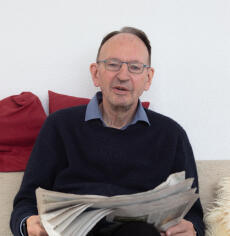
We congratulate Prof. Dr. Gerd Faltings on receiving the Abel Prize 2026!
The Norwegian Academy of Science and Letters honors him for his achievements in arithmetic geometry. His ideas and results have reshaped the field, settling major long-standing conjectures, while also establishing new frameworks that have guided decades of subsequent work.
Gerd Faltings studied in Münster, where he completed his doctorate (1978) and his habilitation (1981). In 2012, he was awarded an honorary doctorate by the Faculty of Mathematics and Computer Science. Until 2022, he was the director of the Max Planck Institute for Mathematics in Bonn. Among his numerous awards is also a Fields Medal, which he received in 1986 for his proofs of the Mordell conjecture and several related conjectures.
Press release of the Norwegian Academy of Science and Letters on the Abel Prize 2026
Webpage on the Abel Prize 2026 with introductions to Faltings' work
In the following, several members of Mathematics Münster offer insights into the role Gerd Faltings’s research plays in their own work and share personal memories of this outstanding mathematician.
Dr. Ferdinand Wagner
"For me, one of the most fascinating ideas of Faltings is his insight that $\mathbb{A}_{inf}$ of the ring of integers in some complete algebraically closed extension of $\mathbb{Q}_p$ should be a "model" for the tensor product of that ring with $\mathbb{Z}_p$ over the non-existent "field with one element". I'm currently trying to understand global analogues of this idea in the context of $q$-de Rham/Habiro cohomology."
Dr. Lucas Mann
"In my research, I have worked extensively with Gerd Faltings' contributions to p-adic Hodge theory and the p-adic Simpson correspondence, two important areas within p-adic geometry. Many of my papers are based on ideas and conjectures that - although now formulated in a more modern language - ultimately go back to Faltings.
Unfortunately, I have not had much personal contact with him so far, but I have always perceived him as a kind and humorous mathematician at conferences and other events."
Prof. Dr. Eva Viehmann
"Gerd Faltings is one of the worldwide leaders in the field of arithmetic geometry. He was also committed to bringing current research to students. Several summer schools and lectures by him were formative experiences during my studies and doctoral education."
Prof. Dr. Urs Hartl
"I know Gerd Faltings from a summer school and various conferences as a very kind and humorous mathematician. He was always helpful when I approached him with my mathematical questions.
Awarding him the Abel Prize is an excellent choice, as he has made decisive contributions to the development of algebraic geometry and arithmetic through his many brilliant results and theories he has pioneered. In one of his big theorems in p-adic Hodge Theory he proved a conjecture that I had posed. I am still very excited and proud that my question was relevant enough for him to work on it."
Prof. Dr. Angela Stevens
A former fellow student of yours, whom I know very well, told me that in your second semester you attended the functional analysis lecture given by Friedrich Tomi in Münster and were by far the best student in the course. Unfortunately, you nevertheless decided not to pursue a career in analysis.
With warmest regards,
Yours Angela Stevens
Prof. Dr. Peter Schneider
"Together with all number theorists of my generation I was extremely impressed when Faltings announced his proof of the Mordell conjecture. It was a fantastic achievement.
For my own work Faltings' fundamental progress in p-adic Hodge theory as well as his paper on the coverings of Drinfeld's p-adic upper half plane were very inspiring."
Prof. Dr. Christopher Deninger
"Around 2003, together with Annette Werner, I was thinking about a p-adic version of the Narasimhan–Seshadri theorem, which relates stable vector bundles on compact Riemann surfaces to unitary representations of the fundamental group. As it turned out during a CRC evaluation in Münster, where Gerd Faltings was a reviewer, he had already been working for some time on the more general problem of a p-adic analogue of the Simpson correspondence. In this setting, the representations need not be unitary, and one instead considers vector bundles together with a Higgs field.
Compared to us, Faltings had the slight advantage of already being a world champion in p-adic Hodge theory. After the discussion during the evaluation, where he criticized our restriction to the case of good reduction, we worked harder than perhaps ever before in our lives. Our goal, of course, was to obtain stronger results in the case of a vanishing Higgs field than the ones of Faltings, even in situations of bad reduction.
I am still proud of some of the ideas in this work, which, compared to its first version, improved tremendously through the exchange with Gerd Faltings. Incidentally, Annette told me later that in his early work on p-adic Hodge theory, Faltings had in fact assumed good reduction. We found that quite amusing.
Faltings’ own short paper on the p-adic Simpson correspondence is extraordinarily ingenious and profound. It initiated a new field that has experienced a renewed surge in recent years, thanks to the perfectoid methods of Peter Scholze and outstanding work by several mathematicians, in particular by Ben Heuer.
My first personal encounter with Gerd Faltings was in Princeton in the 1990s. He was a professor at the university there, while I was a visitor at the Institute for Advanced Study. Gerd was interested in American football and invited me to his home to watch the Super Bowl on television. When a player from the opposing team catches a pass thrown by the quarterback, it is called an interception, and it is a big deal. Gerd’s young daughters were running past him in front of the television, and he would catch them, shouting "Interception! Interception!". They found this very funny, and Gerd soon lost interest in the Super Bowl and just kept playing interception with them.
In later years, I organised the Oberwolfach Arbeitsgemeinschaft together with Gerd for 15 years. He was always extremely efficient, and during a somewhat difficult period for me, he attended the meeting three times in a row without complaint, among other things to lead the program discussions. Normally, we would alternate these responsibilities every six months. I found that very kind of him."