

Quantitative MRI of organspecific vascular permeability and immune cell dynamics by combination with mass spectrometric imaging
Principal investigators: Cornelius Faber, Uwe Karst
Project number: CRC 1450 B02
Project term: 01/2021–12/2028
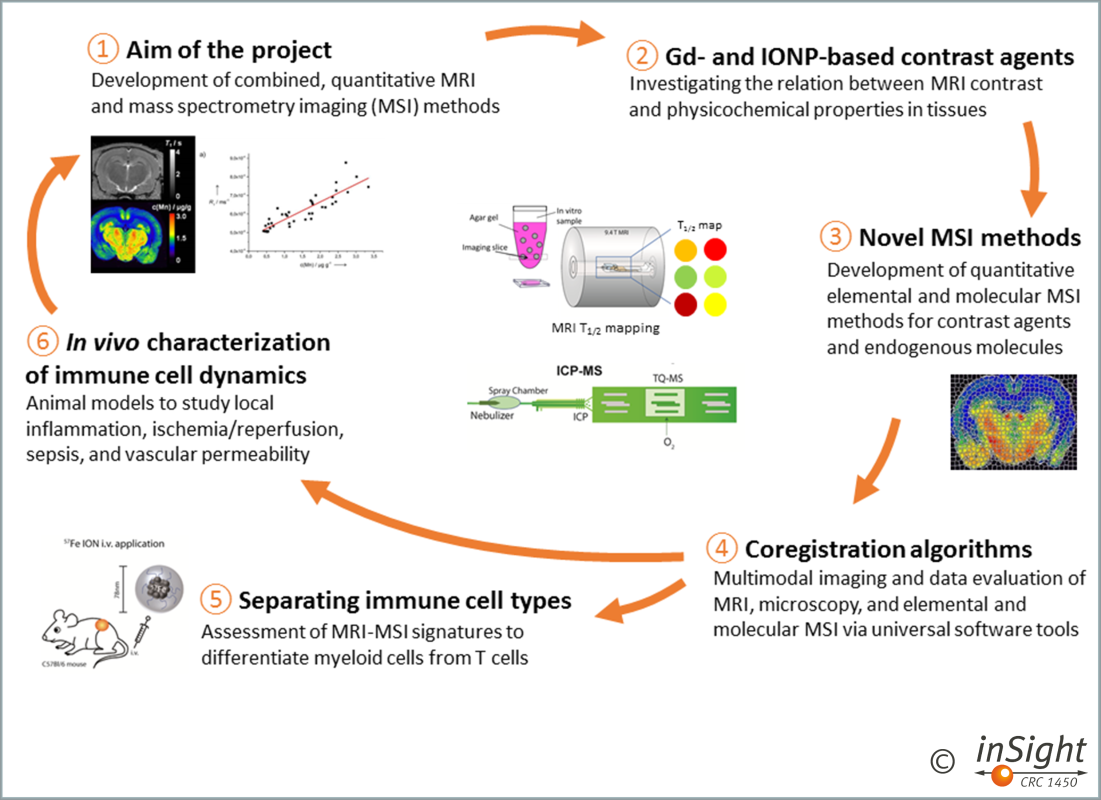
The aim of this project is to develop combined in vivo MRI and ex vivo mass spectrometry imaging (MSI) methods including both, laser ablation-inductively coupled plasma-mass spectrometry imaging (LA-ICP-MSI) and matrix-assisted laser desorption/ionisation mass spectrometry imaging (MALDI-MSI) (1). MSI shall be used to develop fully quantitative MRI methods (2) as part of our comprehensive multiscale imaging strategy (2, 3, 4) to analyse immune responses in disease models and patients in vivo (5).
The overarching question is how quantitative MR parameters depend on elemental and molecular patterns in tissues, and how this dependence evolves during inflammatory responses (6).
Team
Principal investigators
- Faber, Cornelius, Univ.-Prof. Dr. rer. nat.
Department of Radiology - Karst, Uwe, Univ.-Prof. Dr. rer. nat.
Institute of Inorganic and Analytical Chemistry
Project members
- Hiddeßen, Lena
Institute of Inorganic and Analytical Chemistry -
Sivaji, Surya
Department of Radiology
Publications
The names of the principal investigators in our network have been bolded. Publications released prior to 2021, when funding for our network commenced, represent previous project-related work.