

FIRST SUPERVISION
Working title: GELT-Informed Oral Corrective Feedback in Secondary School ELT
Working title: Teachers' Engagement with Global Englishes Language Teaching Materials: An Intervention Study in Vietnamese Lower-secondary Schools
Working title: Fremdsprachliche Hörverstehenskompetenz unterrichten: Eine designbasierte Studie zur Entwicklung von Prinzipien für kompetenzorientiertes Unterrichten von Hörverstehen im Fach Englisch
Working title: Multilingually-sensitive ELT in Primary School
Working title: The Role of Educational Policies in Shaping Learners’ Attitudes towards Global Englishes
SECOND/THIRD SUPERVISION
Working title: Chatbots in the Language Classroom: Providing Individualized Vocabulary for Young Foreign Language Learners
Working title: "What's Happening?" - Developing Aspiring Teachers' Professional Vision with Regards to Fostering Speaking Competences in the Primary EFL Classroom
Working title: The Impact of Captioned Videos on Afghan EFL (English as a Foreign Language) Learners' Vocabulary Learning
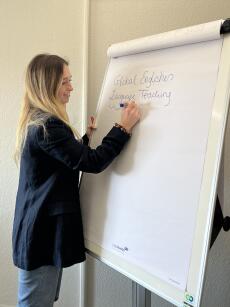
Merle Bergmann
Working title: GELT-Informed Oral Corrective Feedback in Secondary School ELT
Abstract:
The global spread and diversification of English have fundamentally reshaped how English is used, learned, and taught worldwide. In response to this changing sociolinguistic reality, Global Englishes Language Teaching (GELT, Rose & Galloway 2019; Selvi et al. 2023) has emerged as an inclusive pedagogical paradigm that seeks to align English language education with the plurality, diversity, and functional use of English in global contexts. Rather than privileging a single ‘standard’ or ‘native’-speaker norm, GELT foregrounds meaning over accuracy, functional language use, and the development of critical language awareness, including an awareness of English varieties (Rose & Galloway 2019). By doing so, it challenges established language hierarchies and contributes to broader educational debates on multilingual identities, legitimacy, and the social responsibilities of pluricentric language education in a globalized world.
Despite the growing body of research on GELT, one central classroom practice remains largely unexplored from a Global Englishes perspective: oral corrective feedback. As a pedagogically impactful classroom practice (Lyster & Saito 2010; Li 2010), oral corrective feedback constitutes an important part of everyday classroom interaction, in which linguistic norms, ideologies, and assumptions about ‘correct’ language use are enacted and negotiated.
Addressing this research gap, the study reconceptualizes oral corrective feedback as a key element of GELT-informed English language teaching. This study therefore investigates how core GELT principles can inform Global Englishes-oriented oral corrective feedback in English language teaching. In an initial conceptual phase, a framework for GELT-informed oral corrective feedback is developed, followed by an empirical investigation of how these principles are interpreted, negotiated, and implemented by teachers in their classroom practices.
This project is supervised by Prof. Dr. Julia Reckermann.
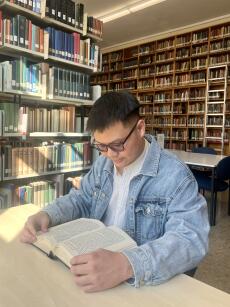
Son Tung Bui
Working title: Teachers' Engagement with Global Englishes Language Teaching Materials: An Intervention Study in Vietnamese Lower-secondary Schools
Abstract:
As English spreads globally as a lingua franca, localized varieties have emerged, challenging the notion that only native English varieties are legitimate and that ownership of the language resides solely with native speakers (Rose & Galloway, 2019). English is also the most common medium of intercultural communication, facilitating exchanges across linguistic and cultural boundaries (Baker, 2017).
To enable English users to navigate the realities of a linguistically and culturally diverse world, the reconceptualization of teaching pedagogy, informed by Global Englishes Language Teaching (GELT), is called for (Rose & Galloway, 2019). In Vietnam, however, native-speaker standards for language teaching and assessment are endorsed by policymakers and classroom practitioners (Le, 2024), potentially making English classrooms fall short in preparing learners for global communication.
This underscores the importance of teacher education in equipping teachers to supplement teaching practices with GELT principles. Previous studies on GELT-informed teacher education (e.g., Boonsuk & Fang, 2025; Marlina, 2025) show a generally positive impact on teachers’ perceptions and practices; however, there is a notable lack of research reporting pre- and post-training data to explore shifts in teachers’ perceptions and practices and how these changes manifest in their practices, especially in teaching materials, upon their return to classrooms. Additionally, Vietnam, where English is primarily taught through formal education, is under-researched in GELT literature.
This study seeks to fill these gaps by investigating Vietnamese lower-secondary school teachers’ materials practices from a GELT perspective through data from materials and policy document analysis, interviews and observations. It also entails conducting GELT-informed workshops on materials evaluation and adaptation with teachers while tracking shifts in their materials practices over an academic semester. By offering evidence-based strategies for GELT-informed professional development, the study provides teacher trainers with valuable insights into guiding teachers toward a sustainable movement toward GELT pedagogy. It can also encourage teachers to continuously stay informed about their sociolinguistic landscape, critically evaluate their teaching materials and practices, and make informed pedagogical adjustments where suitable.
This project is supervised by Prof. Dr. Julia Reckermann and Dr. Philipp Meer.
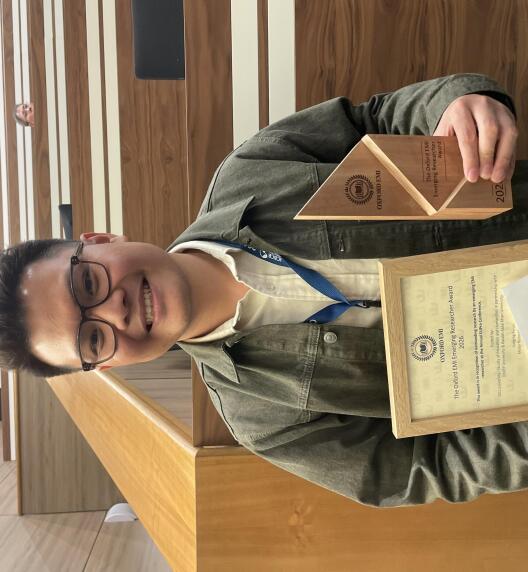
At the 4th Annual EliPro Conference, Tung was awarded the Emerging Researcher Award, presented by Oxford EMI, for his presentation entitled “A Mixed-Methods Study on the Effects of Global Englishes-Informed Pedagogy on Vietnamese University Students’ Perceptions.”
Congratulations on this well-deserved achievement!

Jens Folkerts
Working title: Fremdsprachliche Hörverstehenskompetenz unterrichten: Eine designbasierte Studie zur Entwicklung von Prinzipien für kompetenzorientiertes Unterrichten von Hörverstehen im Fach Englisch
Abstract:
Jens's PhD project focuses on developing design principles for teaching listening competence in a second language classroom. He takes a design-based research approach, collaborating closely with schools in North Rhine-Westphalia. Based on findings from an extensive Analysis and Exploration phase, he conducted two design cycles, developing and implementing a co-designed teaching unit for year 9 that aims at fostering L2 listening holistically. Several empirical (especially qualitative) instruments were used throughout these teaching units to deepen the understanding of how the design of the teaching sequence was perceived by the different stakeholders.
This project is supervised by Prof. Dr. Julia Reckermann and Prof. Dr. Frauke Matz.
Sarah Lellé
Working title: Multilingually-sensitive ELT in Primary School
This project is supervised by Prof. Dr. Julia Reckermann and Prof. Dr. Ulrike Gut.
Hala Youssef
Working title: The Role of Educational Policies in Shaping Learners’ Attitudes towards Global Englishes
Abstract:
The awareness people have about Global Englishes is insufficient in many contexts including Syrian schools. This lack of awareness may lead to negative attitudes especially because it is accompanied by what we may call ‘misleading ideas’ from different sources including teachers and textbooks that consider standard British English to be the ‘correct’ form of English.
Tackling this issue in the present study starts with identifying the attitudes of learners towards varieties of English and the factors that affect them. To do so, analyzing the current situation is required and amendments to textbooks and teaching practices will be suggested.
It should also be noted that the schools in which the study will take place are chosen to cover a geographical context as wide as possible in order to achieve results with the highest possible accuracy. Also, the situation from a GELT perspective is very similar in many Arab countries as well as other developing countries which makes the results of this research generalizable to other regions of similar contexts.
This project is supervised by Prof. Dr. Julia Reckermann, Dr. Philipp Meer, and Prof. Dr. Ulrike Gut.
Christina Lennert
Working title: Chatbots in the Language Classroom: Providing Individualized Vocabulary for Young Foreign Language Learners
This project is supervised by Prof. Dr. Dominik Rumlich and Prof. Dr. Julia Reckermann.
Marius Ritter
Working title: "What's Happening?" - Developing Aspiring Teachers' Professional Vision with Regards to Fostering Speaking Competences in the Primary EFL Classroom
Abstract:
Teacher professionalisation through the use of authentic classroom video has become an important practice in university teacher education. Educational science research has shown that video can be an effective tool to foster teachers’ professional vision (TPV). However, this construct is highly subject and context specific. My dissertation focuses on comparing the development of TPV between two university teaching courses: One using video as a primary teaching resource and another using other material such as audio and transcripts to talk about authentic lessons. A content focus is placed on fostering speaking competences in young learner English classrooms. The dissertation thus focuses on establishing foundational aspects of a speaking-conducive learning environment for young learners and how these aspects may be observable in a teacher education class. It also explores the applicability of TPV to the context of English language education and tackles conceptual issues with how studies focused on TPV are commonly designed in educational sciences.
This project is supervised by Prof. Dr. Frauke Matz and Prof. Dr. Julia Reckermann.
Ghazi Takal
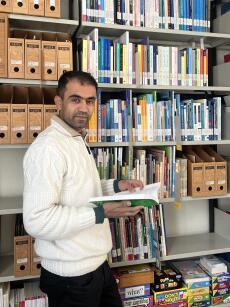
Working title: The Impact of Captioned Videos on Afghan EFL (English as a Foreign Language) Learners' Vocabulary Learning
Abstract:
This doctoral thesis is aimed at investigating whether captioned videos (i.e., videos with second language subtitles) facilitate second language vocabulary learning among Afghan high school English as a foreign language learners. Although previous research studies have examined the effects of captioned videos on intermediate and high proficiency learners, evidence remains inconclusive regarding low proficiency learners, individuals with limited prior experience with captioned videos, learners with different first and second language typologies, and learners in under-resource educational contexts. In addition, previous studies seem to be modest in their scope when it comes to vocabulary conceptualization, and their assessment procedures. This study employs a quasi-experimental design incorporating a pre-test, immediate post-test and a delayed post-test. The sampling consists of 68 Afghan high school students, selected through convenience sampling procedure. The participants are assigned to experimental and comparison groups with comparable level of language proficiency and vocabulary size. Following a pre-test, the experimental group watches a three-minute documentary with captions, whereas, the comparison group watches the same documentary without any captions. Vocabulary learning is assessed through the use of 20 target items, representing different word classes and word knowledge dimensions. The data are analyzed through SPSS with a multivariate factorial analysis of variance to examine the effects of captions on learning multiple dimensions of word knowledge.
This project is supervised by Prof. Dr. Ulrike Gut, Dr. Romana Kopečková, and Prof. Dr. Julia Reckermann.