

"Religion and Politics"

Cluster of Excellence at the University of Münster

Established in 2007, the Cluster of Excellence ‘Religion and Politics’ will continue to study the complex relationship between religion and politics across epochs and cultures until 2027. The approximately 150 researchers from 20 disciplines in the humanities and social Sciences focus on Europe and the Mediterranean region, and their interconnections with the Middle East, Africa, North America and Latin America. The Cluster is the largest of its kind in Germany and the only Cluster of Excellence to focus on religion. Since its inception the Cluster addresses a wide range of historical and contemporary issues. continue
Slider Storm
© exc/L. Kerl/N. Stichweh

“‘We are entering what is in some respects completely new territory’“

The research project ‘News from China? –  Knowledge-ressources, Knowledge-acquisition and Knowledge-transfer of Missionaries in China in the 19./20. Century’ at the Cluster of Excellence ‘Religion and Politics’ addresses the key question of for what purpose and in what context Christian missionaries acquired so-called ‘knowledge of China’ during the period in question. Sinologist and project leader Kerstin Storm and doctoral candidate Lisa Kerl report on their work with the sources and their findings on how knowledge was transferred to individuals, groups and institutions across nations.
 Read more

Bild News Interview Lohwasser
© EXC/Richard Sliwka

“The lion-headed Apedemak may not be a god in the Egyptian sense at all”

Egyptologist Angelika Lohwasser from the Cluster of Excellence “Religion and Politics” is studying the relationship between cult and kingship in the ancient kingdom of Kush, Egypt’s southern neighbour. Since Kush was annexed to Pharaonic Egypt as a colony in the 2nd millennium BCE, later periods also show many Egyptian influences there. As a result, researchers have a strongly Egyptian or Egyptological perspective on Kushite culture and religion. In this interview, Lohwasser talks about how she takes a new, non-Egyptian perspective on the kingdom of Kush, and in particular the relationship between the Egyptian god Amun and the Kushite god Apedemak. Read more

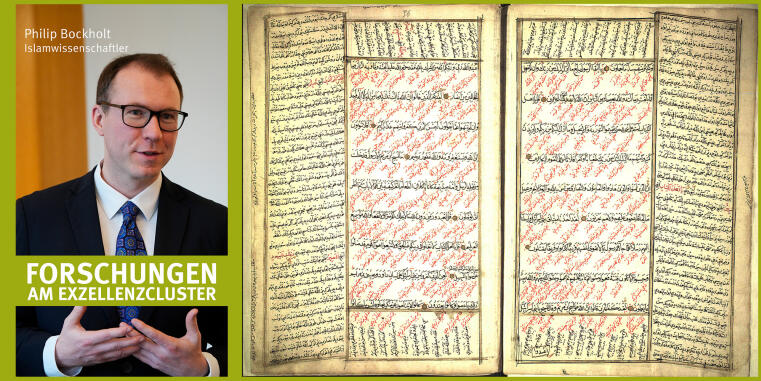
Slider Bockholt
© exc/Istanbul, Süleymaniye-Bibliothek

“Those commissioning the work, as well as scribes, owners and readers – these all shaped the translations and turned the transcripts into a ‘living’ work”

The research project led by Islamic studies scholar Philip Bockholt at the Cluster of Excellence ‘Religion and Politics’ focuses on Arabic-Ottoman translations of works of Quranic exegesis (Arabic: tafsīr). In this interview, he discusses why translations from Arabic into Turkish were so significant, what adaptations can be observed in the texts during the process of translation, and what role these translations played in disseminating religious knowledge. Read more