
“Research into Laconia is really taking off at the moment“
Interview with Historian Hans-Beck
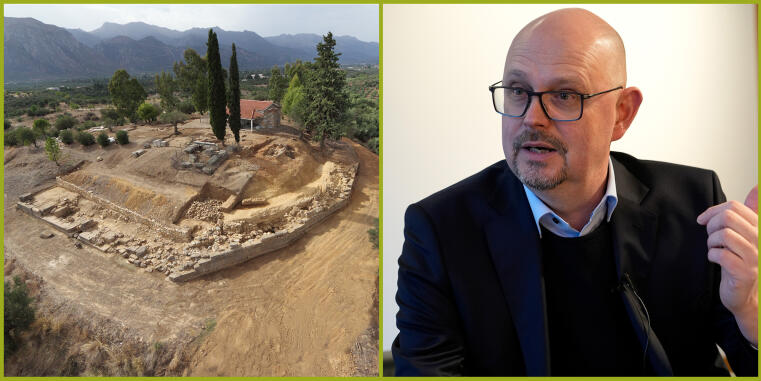
How did forms of belonging develop in ancient Greece, and which role did Amyklaion play as a central hub in Laconia? Historian Hans Beck's Research project, “Belonging in/to Laconia. An archaeohistorical study on the Sanctuary of Apollo at Amyklai and its surroundings”, at the Cluster of Excellence “Religion and Politics” explores this question. The subject of the study is the hill of Agia Kyriaki, 5 km south of Sparta, which has long been associated with the ancient cult center of Apollo Amyklaios. The research complements excavations that have been taking place on site for more than 20 years.
Prof. Beck, you are part of an archaeological-historical study of the sanctuary of Apollo Amyklaios and its surroundings. Can you briefly outline the project in what is today southern Greece and your involvement in it?
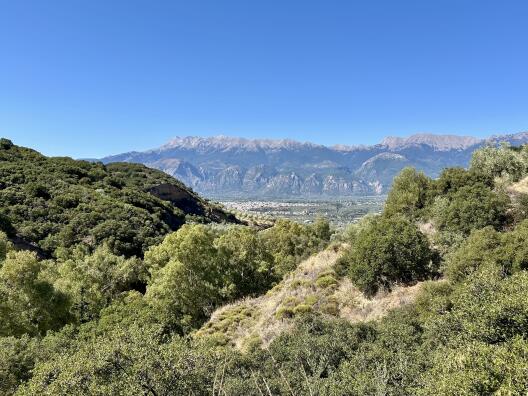
Hans Beck: Led by archaeologist Stavros Vlizos, the Amykles Research Project (ARP) has been conducting archaeological field research at the sanctuary of Apollo on the hill of the Aghia Kyriaki Church near Amykles for around two decades. This sanctuary is located in Laconia, a region in the south of the Peloponnese, about five kilometres south of modern-day Sparta. The project’s main focus is to understand the architectural design of the sanctuary and to reconstruct its famous Throne of Apollo. The latter consisted of an imposing pedestal on which stood a 14-metre-high bronze statue of Apollo – a spectacular monument that rose like a beacon above the plain of Sparta! The view over the landscape reminds us that the sanctuary did not stand in isolation. Rather, written sources tell us that it was surrounded by a settlement; and, a few kilometres away, there was another, smaller sanctuary. In short, it was a lively area that we know little about to this day. In our Cluster project, Sophia Nomicos and I are searching for clues, our aim being to understand the local context of the Apollo sanctuary – from the point of view of its own surroundings and not always with regard to Sparta.
You complement the field studies with historical research on the role of the Amyklaion in the complex relations between Sparta and the local Laconian communities. What is working with the other researchers in an interdisciplinary way like?
Hans Beck: That is precisely the crux of the matter. On the one hand, archaeological research, using a wide range of methods, reveals the significance of the sanctuary: besides our excavations on the hill, we have carried out surveys and geophysical prospections; our partners from Kalamata have complemented this with LiDAR, an optical remote sensing technique using lasers, in order to gain an overview of a large area. Working with the geophysics department in Münster has been particularly valuable in these parts of the project. On the other hand, local worlds of meaning cannot be gauged solely from material findings; also required are written sources, which are the everyday business of historians. Often these point beyond the local horizon to interconnected sacred landscapes and cultural spaces. Our project has therefore been interdisciplinary and transdisciplinary from the outset; it is, in this sense, ‘archaeohistorical’. Historical religious research on ancient Greece cannot do without archaeology, and material research is left hanging in the air if it fails to engage with historical scholarship.
There have been excavations on Kyriaki Hill for a good 20 years, and the University of Münster has been involved since 2022. Have you been on site during the excavations; or, more specifically, how do you actually go about your research?
Hans Beck: Sophia Nomicos has been working in Amyklai since 2022, her partnership with the ARP goes back even further. In 2023, we participated in the excavations on the hill for the first time through my chair, and in 2024, the EXC survey project began with its own Münster cohort. I myself am always on site in Sparta during the excavations, but my main task is to review the literary and documentary sources thoroughly. This work takes place in Münster and at the Swedish Institute in Athens, our partner institution, which supports us. What is worked out in the libraries, for example from the reports by Thucydides, Xenophon and Pausanias, must then be taken to the field. Understanding the sources depends very much on knowledge of the historical topography, with our own Research Centre for Historical Regional Studies of Ancient Greece (Epichorios) in Münster helping us in this regard. I therefore spend a lot of time during the excavations researching the settlement and sacred geography – in the Eurotas Valley, but also beyond, in the neighbouring areas of the Parnon Mountains and down to Cape Maleas and Cape Tainaron. Some things are so hidden there that it is impossible to proceed without local knowledge. A local worker on our excavation has helped us more than once to identify landmarks that could not be found in the literature alone. The scholar and writer Pausanias (‘Description of Greece’, 2nd century CE) often says that he relies on the expertise of locals, known as epichorioi. I now understand better than ever what he meant.

Your project description says that your methodology deliberately deviates from the thematic focus of the literary sources preserved. Why, and what do you hope to achieve?
Hans Beck: The literary sources are focused on Sparta. This begins with Tyrtaios’ battle paraenesis and continues through the genre of historiography in the following centuries: the special case of Sparta, warring state and heroism, a society holistically oriented towards the military. The whole programme, in fact, right up to the absurdities of how Sparta is seen in the modern period. I have always found this over-privileging of Sparta and the fascination with it that it has engendered to be unsatisfactory, if not irritating. Up to now, it has also shaped the image of the Amyklaion, at least in historical research. The perspective is always on the significance of the sanctuary for Sparta and its warrior elite. We have taken a decidedly different position here. We are concerned on the one hand with situating the sanctuary within the immediate local area, and on the other with answering burning questions about its connectivity with other cult sites in the southern Peloponnese. The strength of our approach lies in the fact that we take the Amyklaion itself seriously and do not see it merely as a dependency of Sparta. Admittedly, this has a lot to do with the local shift that we have been promoting for years and which has also left its mark on our work in other ways.
Can you already say anything from a historical perspective about the relationships between local Laconian communities and the role of the Amyklaion here?
Hans Beck: Amyklai played a central role in the classical period (5th and 4th centuries BCE) as the site of the ‘Hyacinthia’, one of the great Spartan festivals in honour of Apollo and his companion Hyacinthos. Researchers sometimes even refer to it as the Spartan “national festival”. As you can see, the narrative is being ramped up here to give meaning to the Spartan perspective. But we have long known that the Hyacinthia were open to all kinds of people – Spartans, Lacedaemonians and foreigners, men and women, free and unfree. This strongly integrative character clearly extends beyond the polis of Sparta. A comparison with cult practices in other sanctuaries of Apollo in the southern Peloponnese has revealed a clear coherence in the findings. The Spartans do not stand out as a separate group, but are part of a network that connects the various local elites in the region. Applying this perspective to the Amyklaion yields a different picture, one that is not about Spartan demonstrations of power and rigid hierarchies, but about communication among elites as equals. The Amyklaion was not simply a satellite of Sparta, but a central local space that facilitates communication on an equal footing.
What did these elites talk about, for example?
Hans Beck: Essentially, it was about negotiating joint strategies for action, i.e. political power. It is clear that Sparta had been the dominant city in the region since the 8th century. However, it was practically impossible to implement direct rule over the settlements in the lower Eurotas valley and further towards Cape Tainaron and Cape Maleas. The Spartans’ claim to leadership therefore had to be bolstered by the elites of the other cities – who since ancient times have usually been grouped together under the label of Perioikoi.
How did the local situation in the Amyklaion help a sense of belonging emerge in the region? How exactly do you define this ‘belonging’?
Hans Beck: I have just hinted at this: we know that the cultural traditions of the Lacedaemonians mentioned above are older than those of the Spartans. Unlike the latter, we already encounter the Lacedaemonians in the findings of the so-called Linear B tablets from the late Bronze Age. Their palace centre has recently been located near Aghios Vasileios, a good 10 km south of the Amyklaion hill. Since then, we have been engaged in lively and sometimes heated discussions about the relationship between the two sites. The question of belonging has become a central theme in these discussions. We will have to wait and see how the findings unfold in the coming years. At this time, we observe that the people in the region developed a lively sense of belonging ever since the time of the grand palaces; they established a sentiment of belonging to place, people, and to a proto-political organisation.
Your project belongs to the Cluster’s research field ‘Religious diversity and legal-political unity’. How are belonging and religion linked in Laconia?
Hans Beck: Reference to the late Bronze Age shows that we are dealing with long periods of time in antiquity, in the context of our project a good 1,000 years – from the late Bronze Age to Hellenism. When it comes to structural questions, we must therefore always keep the vibrant diachronic dynamics in mind. Religion, belief in gods and cultic practices are themselves subject to profound changes over such a long period of time. In my opinion, one connecting element – and this is what makes our work on site so meaningful – is the continuity of the natural space and cult topography that frame these processes: the hill of Agia Kyriaki, identified today with a holy figure of Christianity, but originally a place of worship for Bronze Age religion; then a place of hero worship; then a central sanctuary in the genesis of Greek religion, with its own pantheon and ritual script; subsequently, reinterpretations of space and religion under the influence of the Roman Empire, up to the aforementioned Christianisation of the hill. Amyklai not only accompanied the long duration of things, but also imprinted upon them its very own, local hallmarks.
What do you personally find so fascinating about your research, and why is it important?
Hans Beck: Research into Laconia is really taking off at the moment. Localising the Bronze Age palace is providing impetus for understanding the cultural landscape of the Eurotas Valley – and, conversely, it also raises new questions. Incidentally, there is a lot going on in Sparta itself. New EU structural measures, including a new museum of antiquities, are swiftly transforming the city. Our project is thus part of a lively international research debate as well as exciting local dynamics. Together with the ARP, our Münster Department of Ancient History has the unique opportunity to help shape these processes, specifically to clarify the relationship between the most important sanctuary in the southern Peloponnese and its immediate surroundings as well as other places of worship in the region. This also involves renegotiating the fundamental question of the Spartans and Lacedaemonians. I find it electrifying to be able to contribute to this. Our Cluster project has enabled Sophia Nomicos and me to build a great team of scholars and students. Sparta is fascinating, of course, but beyond Sparta lies a cultural landscape with immense potential for research and discovery – and which will keep our team busy. (pie/tec)