
The MAGIX-Experiment
The future electron accelerator MESA (Mainz Energy-recovering Superconducting Accelerator) at the Johannes Gutenberg University Mainz focuses on investigations to verify the Standard Model of particle physics. Its main research areas include the search for dark photons, which are candidates for dark matter, and precision measurements of fundamental constants, such as the proton radius or the electroweak mixing angle (Weinberg angle). The first components of the MESA accelerator have been tested since 2017, and the first beam time is expected by 2027.

The MAGIX experiment (MAinz Gas Injection Target EXperiment) is located in the energy-recovery linac (ERL) sector of the accelerator. Here, beam energies up to 105 MeV with a current of 1 mA (and later up to 10 mA) can be achieved. MAGIX is a fixed-target experiment with high luminosity (1035 cm-2 s-1), consisting of a jet target and two multi-purpose magnetic spectrometers that can move in a circular path around the interaction point to measure the angles and momenta of the scattered electrons.

To fulfill the experimental requirements of MAGIX, a state-of-the-art target is needed. For the ERL to operate, the target must be thin enough to minimize beam energy loss. Conversely, high target density is required to achieve the necessary luminosity.
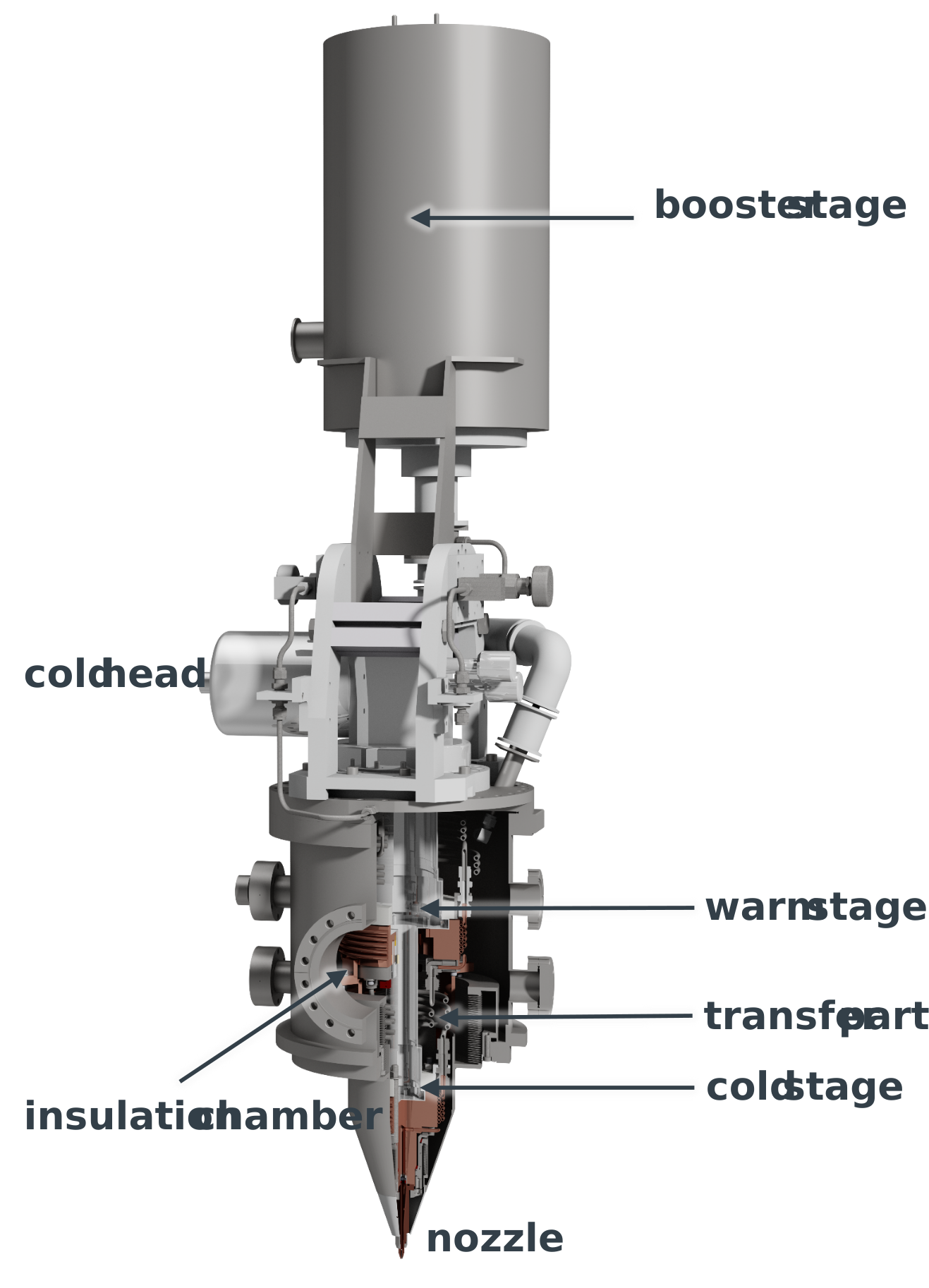
Additionally, the target must be windowless to avoid an irreducible background and beam energy loss in window materials. It must also be operable with various gases depending on experimental needs. To meet these challenges, MAGIX will use a cryogenic, windowless jet target that can be operated with hydrogen, helium, and almost all heavier gases.
When operated with hydrogen, the MAGIX jet target can deliver a high-density jet of up to 1018 atoms/cm2 at the interaction point. This jet target was designed and constructed within our working group.
Since 2017 the MAGIX target is operated at the A1 experiment in Mainz. Similar to the future MAGIX setup, the A1 experiment features three magnetic spectrometers and is located at the Mainz Microtron (MAMI).
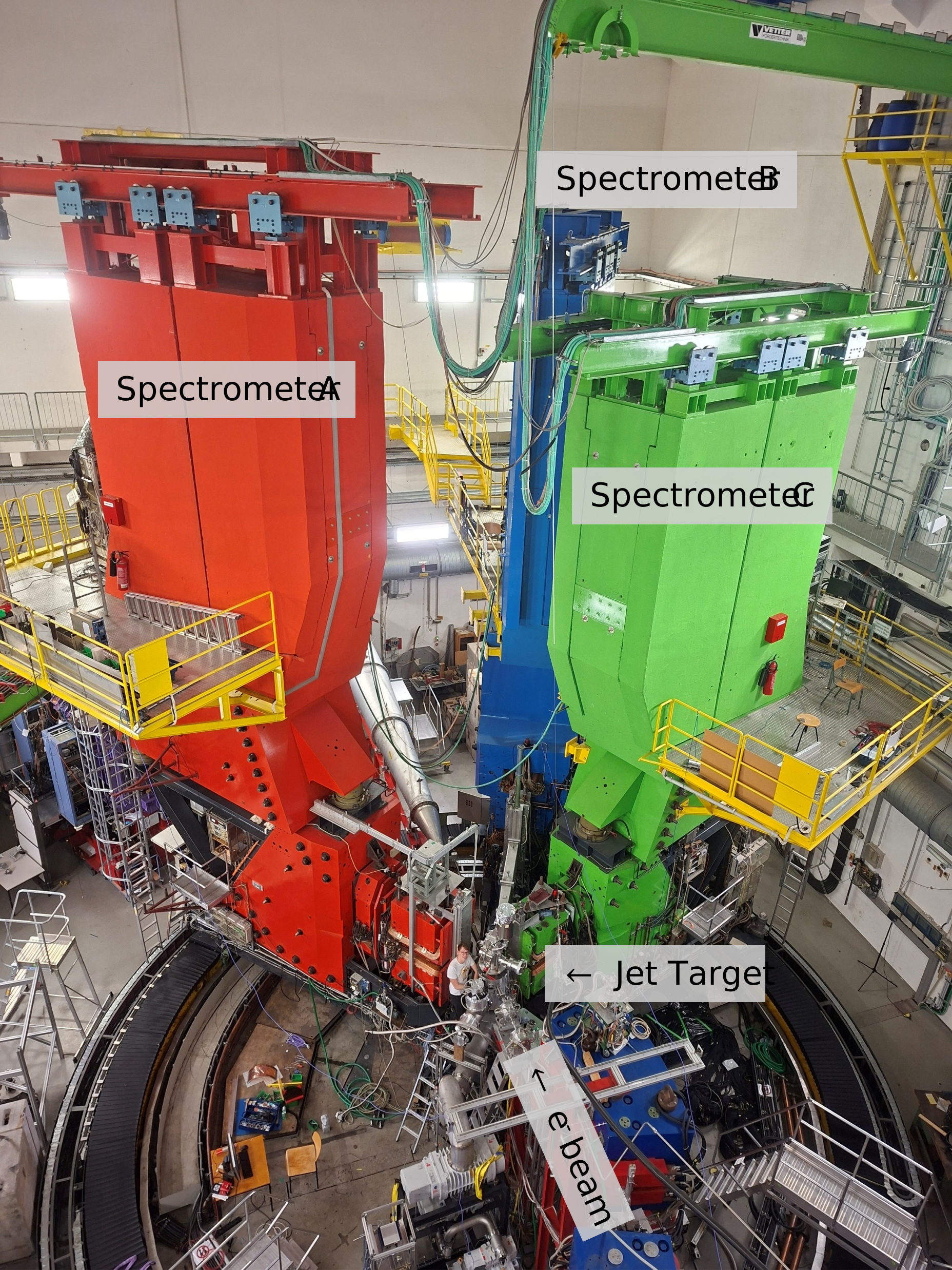
In these experiments, the elastic scattering of an electron beam with protons from the jet target is investigated. These initial measurements provide valuable insights into the performance of the MAGIX target in combination with an electron accelerator, allowing for optimizations (in the target, scattering chamber, pumping system, and beamline) to guarantee a seamless startup at MESA. Furthermore, these measurements enable form factor analyses.
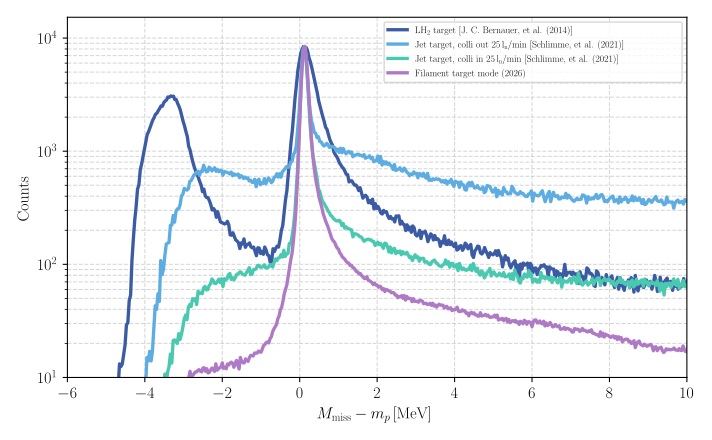
In spring and summer 2026, the MAGIX target was operated in a filament target mode at A1/MAMI, interacting with the electron beam.
It was first used with hydrogen to further investigate the proton radius puzzle, and later with argon to study argon nuclear structure and provide electron-scattering data relevant to neutrino–argon interaction modeling for experiments such as DUNE. This operation further reduced background compared to earlier measurements, enabling cleaner, more precise, and nearly background-free measurements.
In autumn 2026, a further electron-beam campaign was carried out with the MAGIX target, this time using helium-4 in gas-jet mode. The operating parameters were first predicted using computational fluid dynamics (CFD) simulations.

Measurements were performed at several kinematic settings to investigate the monopole resonance in helium-4 with high precision and under nearly background-free conditions.
Bachelor's, master's, and PhD students have the opportunity to work on several key tasks contributing to the further development of the MAGIX target through projects involving nozzle and target component simulations, vacuum and jet development, testing of new target components, and analysis of beam-time data.