Koala Experiment
A precise knowledge of the differential elastic (anti-)proton-proton cross-section is essential for the analysis of the data collected at PANDA experiment, as it forms the basis for an accurate determination of luminosity. As in the Rutherford experiment, the luminosity can be determined from the count rate of elastic (anti-)proton-proton scattering, with the differential cross-section of the reaction serving as a reference quantity. Particularly in the region of small momentum transfers, where Coulomb and nuclear scattering interfere, the available data have so far been insufficient. This is where the KOALA experiment comes in: the experiment measures the differential elastic (anti-)proton-proton cross-section over a wide range of momentum transfers with high precision, thereby enabling a reliable determination of luminosity for the PANDA experiment. The measurement is based on a coincidence between a forward-scattered (anti-)proton and a recoil proton. The internal cryogenic target required for this is being developed and fabricated by our research group.
This initial research question has evolved into a standalone experiment for the SIS18 particle accelerator, which will be carried out in the coming years in the ‘Cave C’ experimental hall at GSI in Darmstadt. The measurements will not only be significant for determining luminosity at the PANDA experiment, but will also provide new insights into the strong interaction in the low-energy range.
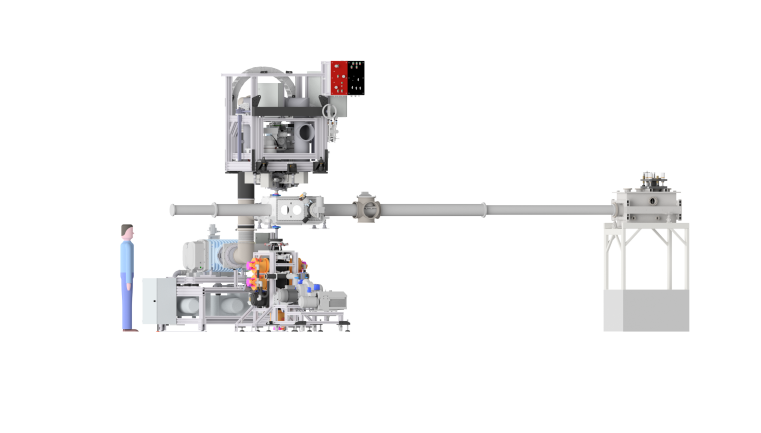
The target source for the KOALA experiment in Cave C is currently under development. Before it is installed in the experiment, numerous tests will be carried out to precisely characterise its properties and tailor them to specific requirements.