
The BESIII experiment
The BESIII-Experiment (BEijing Spectrometer) is an internal experiment at the accelerator complex BEPC-II (Beijing Electron Positron Collider) at the institute for high energy physics (IHEP) in Beijing. Electrons and positrons are accelerated in two distinct storage rings before being brought to collision at center-of-mass energies between 1.84 and 5.6 GeV.
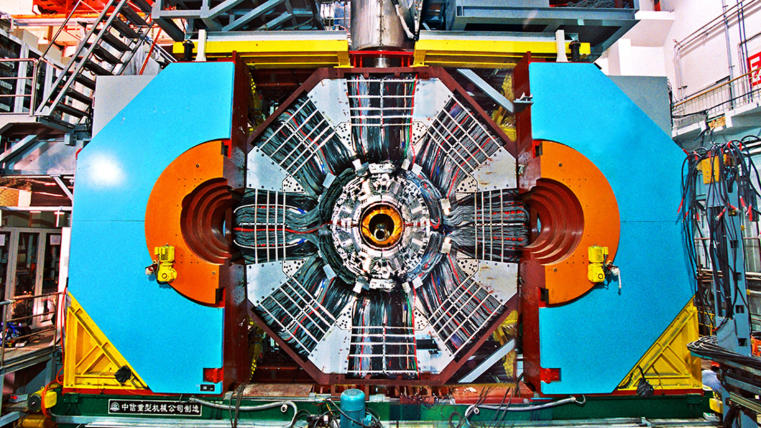
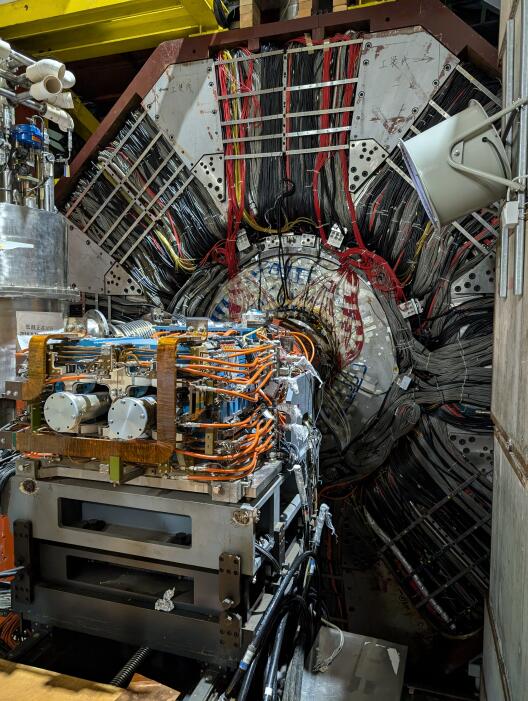
The BESIII-Spectrometer is built right around the interaction point. Within its shell-like structure, a drift chamber, time-of-flight detector, electromagnetic calorimeter and a muon detector are used to reconstruct final state particles.
One of the main objectives of the BESIII-Experiment is the investigation of the charmonium spectrum. Mesons (qq̅ pairs) are denoted as charmonium when they are built up by a charm anti-charm (cc̅ ) quark pair. A prominent example for such a charmonium is the JPC=1-- J/ψ. Its discovery in the year 1974 at the same time meant the discovery of the charm quark itself. Ever since this first detection numerous other states were found and successfully classified into the charmonium spectrum.
Apart from the aforementioned mesons (qq̅ ) and the baryons (qqq), the strong interaction also allows more exotic systems consisting of four quarks (tetraquarks or molecules), five quarks (pentaquarks), a mixture of quarks and gluons (hybrids) and glueballs, consisting entirely of gluons.

Over the years, many more states were discovered than originally predicted for the spectrum of conventional (cc̅ ) charmonium. Thus, these supernumerous states need to be regarded as exotic particles. The BESIII-Experiment is one of the leading experiments in the search for such exotic states and in the attempt to resolve their nature.
This project is not limited to the charmonium sector, but also deals intensively with the investigation of exotic states in lower mass regions. This is also one of the research foci of our working group. Using partial wave analyses, we investigate decays of the charmonia ηc and ψ(2S) into light mesons consisting of u, d, and s quarks. In the decays studied, candidates for exotic particles, such as the potential hybrid state π1(1600) or the glueball candidates f0(1370), f0(1500), and f0(1710), can be produced as intermediate states. The analyses performed serve both to identify such exotic particles and to precisely measure the properties of ηc and ψ(2S).