Transcript
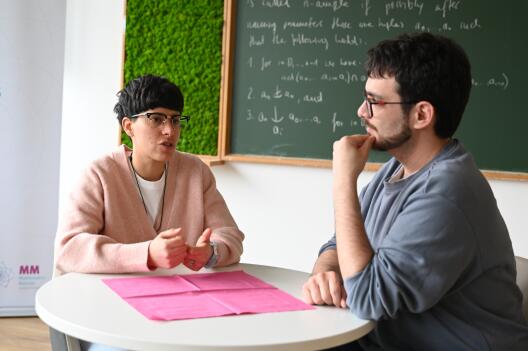
Carlo: From Mathematics Münster. This is "On a tangent", the podcast where we tell the stories behind the mathematics and explore the fascinating path that leads early career researchers to Münster. My name is Carl Kaul. I'm a PhD student in arithmetic geometry, and I have the privilege to bring new stories to you in the month to come. For the fourth episode of the season, I am joined by Benjamin Brück. Benjamin, Pursuit a mathematical training in Germany at the University of Münster and Bielefeld University, where he completed his undergraduate, master's and doctoral degrees. Following his PhD in 2020, he worked as a postdoctoral researcher at the University of Copenhagen and as a Hermann Weyl-Instructor at ETH Zurich. Subsequently, he returned to the University of Münster, completing his habilitation in 2025. Since 2024 he has also served as an investigator in a young research group joined with Robin Sroka, focusing on high dimensional cohomology of arithmetic groups. So it's great to have you, Benjamin. The podcast typically starts with the question of what is your first mathematical memory in your life?
Benjamin: First mathematical memory? I think the first thing that has something with math to do was in elementary school when we did, was a game called, I think, „Eckenrechnen“ or something. Where the teacher gave some kind of calculations you need to do in your head and then the point was somewhat to be quicker than the others. And I remember that I was good, but I wasn't the best in our class. This is something I still remember, and actually, until today, somehow doing calculations quickly in my head is not really my top strength, I would say. Now I try to push that to the computer when possible nowadays.
Carlo: Right.
Benjamin: And the first actually more mathematical thing that I remember, is when I was maybe in year 5 or 6 in school, some 11, 12 years old, and there was some kind of math extra classes, I think. But they weren't offered at our school, but at a town nearby. And my math teacher - So I liked the mathematics in school there - and at some point, my math teacher suggested that if I like this, maybe I could also go to these. They weren't quite extra classes but somehow meetings maybe once per week or every other week, I don‘t really known, maybe in the afternoon and then there were some, nice exercise, nice topics presented that you didn't need in school, but that was somehow interesting exercise to solve for something. This is something I really enjoyed.
Carlo: So you were 11 or 12. That early on there you got offer something like this?
Benjamin: Yeah. I mean it's very nice. I'm actually not sure who organised this nowadays. I just know the town where it was and this is where the teacher lived. I think this is why you need the classes. And probably there were teachers actually from the school there, but there weren't only people from one school. And that was somehow very enjoyable. I mean, of course you didn't need to do any exams or something. But it was just , for example, something about exponential growth is something I still remember and found very cool at that point because it seemed so counterintuitive with what I.
Carlo: Yeah. I think it's rare that these types of things are offered at that early stage. I think usually it's only later that you have these advanced classes. But it's very nice that someone took initiative. Where was this?
Benjamin: I mean, so I grew up near, Frankfurt, on the countryside there. The classes were in, Genhausen and this was maybe 15, 20 minutes away from where I lived at that time.
Carlo: So but it was already clear during the beginning of the high school of your high school that you really liked math and that you were good at math. And so it started early on.
Benjamin: Yeah, somewhat. I think I basically always enjoyed a math class system. Yeah.
Carlo: And how was your, your typical day in high school. So did you privately think about math or how did it look.
Benjamin: Yeah I mean, okay, so I mentioned this extra class that I took at this age. But apart from that, I don't think I did a lot, the mathematical things besides school, at that time. Okay. Maybe actually at age 11, 12, I don't remember how exactly nowaday. But later on, towards the end, I in general did more music at that time. I was singing, also afterwards continued in different choirs and had some singing classes and played organ. And at that time I was more so in, okay I also played video games and these kind of things, but, say from the more so other things that I did besides school were more into music, especially in the last years, maybe, you know, ages 15 till 17, more video games, and then towards the end of school more music.
Carlo: So was it like a church choir, or? Because you also said you play the organ. You can only do that in the church, right?
Benjamin: Yeah That's true. So actually, my, So I started with piano. Well, okay. At the very beginning, I start with recorder class. But already the teacher there was the, the person who played the organ in our town. And then when I learned, the piano with her at some point, I also got interested, I mean, I don't know how I first got interested in the the organ, but definitely my teacher also played organ, so she also showed it to me at some point. And this is how I got into the organ. And she was also. So the first choir that I sang in was also the one she did , so She was the, the conductor there. So yeah, that was church related. I mean she was employed in our town to play the organ there.
Carlo: Was it also a possibility in your head that you might want to pursue music further, or was it more a hobby for you always?
Benjamin: No, it was more of a hobby, actually always. I enjoyed it and also I mean, especially towards the end of school, I did I mean, I invested more time in it, but I, I don't know, it's nothing that I seriously thought about actually doing as a job at some point later on.
Carlo: Okay. Did you always want to pursue mathematics further or when did you realise that this might be something you want to study, you want to pursue?
Benjamin: Yeah. I think it was pretty clear to me that I would wanted to do something science like, I mean, I wasn't super fixed to math until the end of school, I would say. But, I also like chemistry and physics, for example, biology, but less in school, but then towards the end, I think in the last years of school, it was clear that I wanted to study something and that I wanted to do either math or physics.
Carlo: Okay.
Benjamin: And, then I think there were, two things that influenced me, well, both away from physics and towards math. And, so the first thing was a physics event. This was again, something our Physics teacher somehow suggested. A physics, one day event where you could, go to to Darmstadt. So this wasn't far away from where I lived. And it was some basic introduction about something with the experiments performed at CERN at this time.
Carlo: Oh, okay.
Benjamin: And, so the the background was somewhat interesting. There were explanations in the morning on how, I mean, a very short introduction for I don't know, 18 year olds, about how that works and what kind of Collider experiments are conducted there. And that was something I really enjoyed, but then the afternoon we were, I think they thought it was the cool part where we could analyse actual data coming from this experience. And I also thought first, it's super cool of all, but I don't know, for me, what we did all afternoon was to look at some kind of tables and statistics there, which wasn't super exciting to me. So I thought probably at least this part of the experimental part wasn't so much something that I found very interesting.
Carlo: Yeah.
Benjamin: So this is something that maybe, shift me a bit away from physics. And then actually, another thing, at one of these, through playing organ, I got to know one person who studied. So she was a PhD student in math at that time. And she recommended to me some, also some extra activity, that was by the University of Stuttgart that was called „Korrespondenzzirkel“. And they, I would say now, in retrospect, basically they send you every week or every month and exercise sheet a bit, as it is now as you have it in regular math lectures in the first semesters. So, there was a few pages, text about, for example, complex numbers. I remember it was an introduction about complex numbers. And then there were maybe, I don't know, ten pages or something like this with an introduction, what it is about and some examples. And then you could, they also had an exercise sheet and you could solve the exercise and send them to, send the exercise to them, and you got them back, correctly. And that was very nice because the, again somehow they just picked, of course, the nice topics that were, that could be presented well, and this is something I really enjoyed because then it was challenging and interesting and…
Carlo: But you never had any classes as was all you had to teach everything to, to yourself. Um, you only had these exercises or?
Benjamin: So in this course. Yeah. You only got the I think I never met someone in person. I mean, you got the, the great exercise sheets back with some comments on the side, but that's all. Yeah. You just otherwise got some text once per month, and then…
Carlo: You didn't share this with anybody. You really did this on your own? You didn't have a group or something, which..
Benjamin: No, I did, I mean, I don't remember maybe I might be that. I mean, it wasn't a secret thing that I talked to someone about it, but it's not that we solved it in a group. It was really just. And it was also, for me, the motivation, because I told the student, that I was, I mean, student at that point, that I was interested in maybe doing math, but wasn't quite sure what when actually did.
Carlo: Uh, okay.
Benjamin: Yeah. And, I don't know. I think in school it's very hard to, to get an idea of what one does in mathematics after school. And then she said, actually that was a bit similar for her. And here is something that she did and, yeah..
Carlo: Yeah, I can really relate to both of your parents. Actually, it's a bit funny because I also had this certain thing. For me I think it was even worse because it was online during corona time. But, so I really thought before this, wow, that's so exciting, we're going to talk about this. And then what we actually did was really unexciting to me. And there was also a program at my hometown university, but it was a bit easier because it was offered in person. That's why I was I was asking and, It would have probably been hard for you to go to Darmstadt because it's not so near right?.
Benjamin: Right. There wasn't really. So I later on when I started realised that there were a few people who also went to university classes during school, but for me, that was never so much as an option because I wasn't so close to any university. I mean, okay, Frankfurt would probably have been the closest, but still.
Carlo: Yeah.
Benjamin: Not close. Yeah, I don't know, doable. But..
Carlo: Did you have a. So you said you met this mathematics PhD student, at your organ playing, and so did math and music have a connection for you at that time, or was it just both passions of yours and you didn't connect them in any way? Because people are always saying math and music is like a typical thing. And I think actually, you really see that among PhD students, for example also in Münster, many people are very musically talented.
Benjamin: Yeah. That's true. I mean, I'm not sure how much is it? So. Okay, for me personally, it wasn't so much of a connection. I just enjoyed both. It might be that it attracts similar people.
Carlo: Yeah, I think that's true.
Benjamin: Might also be that people from similar background are into, I mean get music classes and do maths later on. So not so sure. But yeah, definitely for me it was I don't know, I never thought it through so much the connection, for me that were just two different things that I liked and that were very enjoyable.
Carlo: And after you graduate from school, did you start studying immediately? Or how did this go?
Benjamin: Yes. Yes, I started immediately. So the actually the months in between, I used to finish some organ classes. I mean, you can do some kind of basically exam in organ at a certain level. And that is something I did right after school. But that was just for the, I know there are these few months in between where you, so a lot of music during that summer. And then in i don’t know October, I started studying math right away.
Carlo: And where did you study?
Benjamin: Actually here in Munster.
Carlo: How did this happen? Because it's not so near from Frankfurt. Or from the area.
Benjamin: Yeah, that's true. So I knew that after school I wanted to do, I wanted to move away. And I thought maybe not, I mean, I was looking for something at a distance that was still doable for a weekend home at some point, but not, I don't know. So a lot of my friends went to Darmstadt and I thought that was, for me, a bit too close. I wanted to see something else. And then I also wanted to go to some kind of student town, I knew that. And then I think at this point I looked at the, from „Zeit“ there was the „Studienführer“ that recommended because I had no idea where the mathematics departments were big or something. And there recommended, I think Bonn, Münster and a few other places where on top of the list and Münster, I thought, oh, this sounds like a student town. And roughly the distance that I was looking for. I think I was only in Münster. I mean, maybe once before I actually moved here. I thought it was something new and a lot of students sounded good. Everyone was saying, yeah, this is a nice tall and therefore saying, I know it from the „Tatort“.
Carlo: Yeah, right. Like did it meet your expectations at this point?
Benjamin: Yes it did. I mean, okay, probably a lot of other towns would have as well had nice atmosphere. No, that actually the especially the first years, when I started to study were very, very nice. Having all these people that are also interested in the same thing, in this mathematics class, this was something I enjoyed a lot. And Münster was also great, but I think in retrospect I would have enjoyed it in many cities.
Carlo: Of course, of course. Did you have a minor when studying?
Benjamin: Physics.
Carlo: Ah, okay. So you came back to physics, nonetheless?
Benjamin: Yeah. I mean right, the theoretical part I still liked.
Carlo: And it's, I think if you do a minor of physics with math and you have to do mostly theoretical physics, right?.
Benjamin: Yes, exactly. Actually, well okay, you need to go to also experimental physics classes.
Carlo: Uh, okay.
Benjamin: So some experiments are conducted for you. I mean, I would have been also fine with doing some experiments, but I think we didn't need to do any. I never did any, I was just. And the theory part, I still find it interesting.
Carlo: I think, I also really liked theoretical physics. And I think it even helps you sometimes with, with your math. I think the way of thinking is very different but can also be beneficial sometimes.
Benjamin: Also things you get some kind of intuition. Also some things are just I mean the physics classes in the math part were always a few semesters ahead of what we learned in mathematics, like solving partial differential equations already in the first semester and.
Carlo: But a slightly different way. Right?
Benjamin: Yeah, in a different way right. Of course. And you need to skip many steps on the way to be able to do this. But it was still nice to have this perspective for why you would maybe be interested in the math questions.
Carlo: And did you also do your masters in Münster then?
Benjamin: Yes, most of it. So the last semester was in Lyon for writing the master's thesis.
Carlo: How did this possibility appear for you? So was there some connection with a Münster professor?
Benjamin: Yes. So I asked at that point, I asked Katrin Tent about, I knew that I wanted to go to another place at some point. And I think I realised that towards the beginning of my masters, but there was already comparably late, because you need to plan in advance and so on. And then I wrote my, I mean, my bachelor thesis I had written with her and then asked her at that point that I wanted to go somewhere else. And I thought probably for the master's thesis would be the right time, because otherwise there wasn't much more time. And ask whether she had recommendations of places, and this is how I got to. I think she also recommended some other places, but Lyon sounded nice. And I also learned some French in school.
Carlo: That's very helpfull.
Benjamin: So I thought this would also be a nice occasion too.
Carlo: Was it in Lyon that you got into your current research topic, or was it already before or later?
Benjamin: No, actually it changed a bit. So in, so what I did in Lyon was, a combination of auto morphisms of. So I mean, nowadays I'm doing geometric group theory more with say topological direction.
Carlo: Mhm.
Benjamin: And I was going to geometric group theory class in Münster by Katrin Tent. And the master thesis was somehow combining geometric group theory and model theory. And it is something that I enjoyed, but I realised that I enjoyed the geometric group theory part of it more. And then afterwards it was clear to me, that I wanted to do something in geometric group theory. So in that sense, it was helpful, but it was I mean, the model theory part wasn't bad, but it was clear for me that the geometric group theory was the one that I wanted to pursue.
Carlo: And did you realise immediately, or was it clear to you maybe that you wanted to pursue a PhD after your master's?
Benjamin: At that point yeah. I mean, not when I started to study, but towards the last years, I had the impression that especially during the master's thesis, It was for me. Well, basically the first time that I could actually read research articles. I mean, still took a lot of time at that point and so on, and I thought it would be somehow a shame to stop now where one arrived at the at the end of, I mean, at the beginning of what was actually, current research. And then I thought, but I definitely want to do a PhD to do also something on my own. I mean, the master's thesis was a bit independent, but yeah, it would be now some more shame to stop.
Carlo: I really relate to that. I think if you have studied so much that you have finally come to the point to be able to read some newer research, it's just, then you have to continue because you put in all that work. And also it gets nice and nice in some sense, right? Because you understand more and more of the theory and more connections. And so this was at least for me the path. So I also didn't know, whether I wanted, to go on at the beginning of my bachelor's or even at the end. But once I learned more and more algebraic geometry and then I had such a knowledge map in my head and I thought, now I need to really do something with it. So I really relate to this motivation as well. So how did your PhD applications or your decisions where to go? How was this process for you?
Benjamin: So I was in Lyon at that time. And there I asked for, - How did that actually go? - So I remember I asked my, my advisors there. So. Okay. Katrin Tent was the advisor, but she was the official one in Münster. But I wasn't really, I wasn't in Münster at that time. I think, right, for me, it was also an option. I also considered staying in Münster at that point, but I think Katrin was about to or maybe had, it wasn't clear whether she would stay in Münster, I think, at that point. So then I asked also my advisors in Lyon whether they had recommendations for people in geometric group theory. Mhm. And so my at that point girlfriend was studying in Wuppertal. I thought somewhere roughly in the area so that it would still be possible to see each other at least on the weekends and so on. And then they gave me a list of names, and I had to look at what these people did at their web pages. Yeah. Right. This is how I got there.
Carlo: So this was in Bielefeld, right?
Benjamin: In Bielefeld, right.
Carlo: And how did your life between Münster and Bielefeld compare for you?
Benjamin: The largest difference definitely is that. I still get it wrong today. In Münster, you need to put in the mensa, the the cutlery on the plates, right? And in Bielefeld, you always need to put it next to the plates.
Carlo: Oh, okay.
Benjamin: And in both places. The people working there will complain if you do it incorrectly.
Carlo: Yeah. Of course.
Benjamin: So that was the culture shock, that for five years, was taught the hard way to always put the cutlery on the plates. Apart from that. I mean, Bielefeld is much less of a tourist town certainly. I don't know, I like Bielefeld, but it's less of a town that you would know from a „Tatort“ or that people say, I mean, Münster, you often have people say, oh, I saw this in the town, but it seems like a nice place. And Bielefeld people don't relate a lot to that in the city. But living there was fine. And the apartment actually, I think I was also lucky to go to the department at that time. The group was very active when I came in and what I actually, what I liked, was there weren't so many PhD students in the group, so I think we had probably even more postdocs than PhD students. So I still had enough PhD students in the same group to talk, to say about the topics, typical for a PhD student. That was still already clear that we were integrating the same lunch group, for example. So one already what's there at the conversations about publishing in journals and these kind of things, which I found interesting and couldn't. So for me, that was a. And also the people in the group were very inviting. And I remember in the first week I, or maybe second week, so there was an archive seminar where you need to present. So every week someone presented an article that had come to the archive in the week before. And I remember I went there for the first time, and then one of the postdocs immediately told me, so why don't you do it next week? And I somehow I think I had never maybe I knew that the archive existed, but I certainly hadn't gone to it and and looked for articles. So the stuff in my master's thesis was all published things. And then I looked at it on that sign it. So I first need to get an introduction on how the architect works, and then looked into articles on the archive to find something interesting. So, so in that sense, it was nice to, I don't know, I was integrated in the group quickly and the other ones were very open to that. That was very enjoyable.
Carlo: I just learned a few weeks ago that you can subscribe to the archive. And last night I subscribed to the relevant topics for me. No, I'm also an archive expert.
Benjamin: Great. Yeah.
Carlo: And after. After Bielefeld. Where did you go then?
Benjamin: So I want, my first postdoc was in Copenhagen. But that was right at the beginning of Covid times. It was always supposed to be just half a year. So I already knew when I applied for postdocs, I basically got two positions, one in Zurich, and that was the one that then followed afterwards, but would only start in October. And then Copenhagen was supposed to be the half year before going to Zurich and after the end of the PhD. And in the end, I wasn't a lot in Copenhagen in person because one couldn't cross the borders at that point.
Carlo: And that's a shame, right? Because Copenhagen is really beautiful.
Benjamin: Yeah. It is, I mean, I was in the end then there was this first summer where everything opened suddenly. And that was very nice. Then I went, but I think I was maybe for 5 or 6 weeks, only in Copenhagen in person. But actually this was, for me, still a very influential time because most of the project that I worked on in the in the following years, really I got in this time.
Carlo: Wow.
Benjamin: Well, online with some people in meetings because especially in the first, at least for me, in Copenhagen, the people weren't mentioned necessarily in Copenhagen, but everyone was open to do some kind of social activity. And there, I don't know, after the Oberseminar, there was some kind of dinner on zoom and these kind of things. So I got to know people actually reasonably well, I would say. And also then, when I went to Copenhagen, I started a few projects that really influenced the work in the years afterwards a lot. And then I moved to Zurich, in October.
Carlo: How long did you stay in Zurich?
Benjamin: For? Three years.
Carlo: Oh, okay. And so this was probably the time where you developed all these project, all these ideas you've gotten in Copenhagen, or how would you describe.
Benjamin: I mean, I also did some other things in Zurich, but I would say that a lot of the time I spent in Zurich, I was actually working on the projects from Copenhagen. So for a lot together with Robin. He was also here in Münster.
Carlo: You met him in Zurich, or?
Benjamin: In Copenhagen. Actually I had been to Copenhagen a year before, and, so I knew Robin from summer school, because I, he said he was in Copenhagen. And I was about to give a seminar to talk in Copenhagen, then asked him about the group in Copenhagen. And this is how we got to talk over this, the summer school was in Paris, but by chance, Robin was there and said, ah, I am in Copenhagen. And I knew I was about to give this talk there, but didn't know much about the department.
Carlo: Yeah.
Benjamin: So we already knew each other and at the summer school had talked about different topics. And when I came to Copenhagen, we also want to or when, I know started the position which was still in Germany but online. We were looking for topics to work on together. And then the Zurich time a lot was, I mean, there were many. So initially there was just one project, but it became clear that the, in order to solve this, there were many steps on the way that need to be done. And then these, I don't know, came a side project or well, maybe not even side project, but need to be done first. And there are other collaborators joined who weren't in Copenhagen person but came from this Copenhagen connection. I also started some collaborations with people in Zurich, but I would say the main research direction was still with this Copenhagen group and people then from the US who were, I don't know, related to Robin and Peter [Patzt], who was at that point also in Copenhagen.
Carlo: And after the break you realise you wanted to go back to my Münster?
Benjamin: My wife still stayed. I mean, she worked in Bielefeld at that point. And then, so she at first she wanted to move to Switzerland, but then in Covid times there weren't a lot of jobs advertised. And at some point it became, clear that it wasn't maybe not worth it anymore for applying anything, because my position would end in only a year and a half later. And then it seemed like. So I wanted to be back more in something that is in or no distance. That is okay from Bielefeld, say, or that was my first priority to search something there. And this is at that point I contacted, Katrin again, was asking about whether what kind of possibilities there could be in Münster for positions. Because topic wise it somehow fit in here Münster also very well with me.
Carlo: Yeah. Of course.
Benjamin: Okay in principle also Bielefeld could have been an option, but at that point I went more mathematically, say the in Copenhagen that was more, I was more in the topology group. And there are close connections to several people here, and it was clear that somehow that could be a good, I mean, topic wise, a good connection. And then this is how I first contacted Katrin, ask about options and this then in the end.
Carlo: Yeah, cool. And do you now live in Münster or?
Benjamin: No, I mainly live in Bielefeld. I also have a room in a shared flat here in Münster. Okay, but say the main focus is in Bielefeld.
Carlo: Okay, so when you are in Münster, what do you like to do most? If you have time for that, outside the university.
Benjamin: In Münster. So. Okay, now I have to say, now the days where I'm in Münster are mostly, really quite work field.
Carlo: Makes sense.
Benjamin: Because I try to package the work in these days. To have it more right to focus here in Münster bit more on the work part. But I, so here, for example, I go running. I still meet some friends from when I studied. A few are still here. This was actually also nice. I didn't need to start from scratch again.
Carlo: Right. So where do you go running? I also go running. That's why I'm asking.
Benjamin: Here in Münster, I mostly go around the „Aasee“. This is not far from where my place is here. I Bielefeld, I go more into the the areas around it. I find actually, I like the city in Münster, but the countryside around it is, maybe it's a bit flat.
Carlo: Yeah, right.
Benjamin: Which is okay for running, but I prefer a bit more hilly area.
Carlo: It's better in Bielefeld, right?
Benjamin: Yeah, right. Or running as much. Or. I mean, if one likes running in a bit more. it's much easier there. Go to the „Teutoburger“ Forest and then.
Carlo: Cool. So do you. Probably you don't have much time besides mathematics and your family, but do you pursue any other hobbies or any other things you do to relax after hard days of doing research?
Benjamin: Yeah. I mean, as you said, it has changed a lot now. I mean, my son is two years old and since then it changed a lot. I mean, before I still did more music and more running. Now, I don't know, often the days are, I don't know. So I usually after work, I pick up my son from Day-care. I mean, when I'm in Bielefeld and then the afternoon I spent with him. I actually also go running with him. I mean with a jogging stroller.
Carlo: That's so cool.
Benjamin: So this is something nice. But then basically, until he's in bed, it's very much.
Carlo: Of course. You still try to pursue music a bit?
Benjamin: A bit, but not a lot. I mean, I didn't start a choir at the moment. I mean, you still have an electronic piano at home. I played a bit organ again at the end of last year, but somehow. Yeah, not that much anymore. Also, now I feel like, actually, I like the running part maybe a little bit more because it's more „stupid“. So I get that at some point. I mean, in school I was more looking for a challenge. Now the organ was also somehow, you need to think, it's a quite comparatively technical instruments. Singing is much more, i don’t known natural or closer to the body say. But now I also prefer the more, so I start running only actually only during Covid times and thought it was a nice. I like its stupidity in some sense after a day of work. So yeah.
Carlo: Cool.
Benjamin: I mean do you just the usual stuff like meeting friends and so on playing board games.
Carlo: Now that we've gotten to know Benyamin, we will come to the second part of this podcast, the so-called „A or B“ game. For this game, which will consist of roughly 30 „A or B“ questions. I will ask Benjamin to answer as quickly as possible in order to get an idea about his intuitive thoughts.
Carlo: 0 or 1?
Benjamin: zero.
Carlo: Analysis or algebra?
Benjamin: Algebra.
Carlo: Coffee or tea?
Benjamin: In the morning, Tea and later on, Coffee.
Carlo: Okay. That's fair. The beach or the mountains?
Benjamin: The mountains
Carlo: Snooze or waking up?
Benjamin: Waking up.
Carlo: Order or chaos?
Benjamin: Order.
Carlo: Autumn or spring?
Benjamin: Spring.
Carlo: Python or Julia?
Benjamin: Julia.
Carlo: Homotopy or homology.
Benjamin: Homotopy.
Carlo: Top dimensional or co-dimension two?
Benjamin: Top dimensional.
Carlo: Model theory or astrophysics?
Benjamin: Oh, that's a tough one. Oh, that's very hard to decide. Both. Know this one I need to skip.
Carlo: Okay. Tits building of free factor complexes?
Benjamin: Mhm. Refactor complexes.
Carlo: Lyon or Oxford?
Benjamin: Lyon.
Carlo: Copenhagen or Zurich?
Benjamin: Oh, that's a very tough one. Um, Copenhagen.
Carlo: Geometry or combinatorics?
Benjamin: Geometry.
Carlo: Annecy or Amboise.
Benjamin: Oh, Amboise.
Carlo: Conceptual proofs or technical proofs.
Benjamin: Unfortunately, I end up more with the technical proofs usually.
Carlo: work at home or work in the office.
Benjamin: Yeah, sure. A bit between two, maybe. Work? Yeah. Work at home.
Carlo: Playing the organ or singing?
Benjamin: Singing.
Carlo: Invented or discovered?
Benjamin: Invented.
Carlo: Mensa or cook at home?
Benjamin: Mensa.
Carlo: Clapping or knocking?
Benjamin: Knocking.
Carlo: To be or not to be.
Benjamin: To be.
Carlo: Right. So you've already done it. This was my, I don't know, 25, „A or B“ questions and for the for the final part of the podcast, I always ask some five questions, five very general questions, very open questions. Where I will ask you to answer like in 1 or 2 sentences, as briefly as possible, but yeah. So the first question is, what is your favourite mathematical theorem? It's quite a tough one.
Benjamin: Yeah, that's a tough one. Favourite theorem?
Carlo: I got this question because I helped with the orientation period of new students. Like the first week they come to the university, and I think that's the kind of, they don't know many theorems, of course, but it's a good icebreaker.
Benjamin: I don't know, maybe I like Cantor's theorem saying that there are basically arbitrarily big Cardinals, so that there can be infinities of different sizes, something I find very fascinating.
Carlo: Yeah that's true. That's also, you can also good for like science communication. It's always a nice like header. So there are different infinities.
Benjamin: Are not what you would think.
Carlo: Yeah I think I also learned this before going to the university. I was really excited about this. That's fine. Yeah. Which of your results or achievements are you most proud of. So it doesn't have to be math, but it can be math.
Benjamin: I mean, in math I would say, I like this paper about symplectic groups with Robin, where we showed, well, something about high degree homology of symplectic groups, it was a long project where a lot of things went in and took place in many places.
Carlo: Which mathematical field might you have chosen, if not your current one?
Benjamin: I mean, I feel like I'm a bit in between fields somewhere, and this is something I really enjoy. So I'm somewhere, as I said, doing geometric group theory. But I'm somewhere between topology, group theory, sometimes geometry, combinatorics. So I think with any of these, I could have become happy.
Carlo: Okay. Is there something in your, professional life you might have done differently from the viewpoint of today?
Benjamin: No, I don't think there is something very specific. I mean, of course, you wouldn't have never known if you had to decide differently, but it's not like a regret, a certain decision.
Carlo: Great. And what advice would you give a student considering mathematics research today? So this may be the toughest one for the end.
Benjamin: Like a PhD Student?
Carlo: No like a bachelor student.
Benjamin: I think it's good to look into different topics and to choose one that one actually likes. Because it takes some time to develop some mathematical, how do you say? Taste, I would say. For me, I tried different mathematical directions. And I mean, for me, before it was always super hard to judge whether I would like this direction or not. And only after doing it for some time, I realised that some topics I just like more and some kind of techniques. So I would suggest to try that and also to be fine with changing to something else if one realise this is not the type mathematics.
Carlo: Yeah, this can be really hard, but I think it's great advice. So thank you very much. It was great getting to know you. And now we will go to the second part were we will get to know something about your research as well.
Benjamin: Okay. Yeah. Thanks.
Carlo: If you enjoyed the conversation with Benjamin as much as I did, please consider sharing this episode with a friend or colleague. In the show notes. You can also find a link to the video part of my conversation with Benjamin, where he demonstrates how the geometry of moduli spaces of graphs governs the cohomology of outer automorphism groups. I'm Carlo and I will catch you on the next tangent.