

Indispensable for exams
Located on Scharnhorststraße, and sitting behind unremarkable walls and along tidy corridors, the staff in the central examinations offices perform invaluable work. They offer support for undergraduates and PhD students at the University of Münster, from the first to the last examinations they take.
The main task: the administration of studies
Daniela Mutze (33) loves her work so much that she would like to be doing it until she’s “old and grey”, as she says. In the examinations office, she works in the bachelor’s degree section and is responsible for undergraduates whose last names begin with M, N, T, X and Y.
While the examinations office dealing with the Faculties of Mathematics and Natural Sciences has largely arranged its responsibilities by subject, the office where Daniela Mutze works arranges things by name. As a result, this means that staff there have to be well acquainted with the examinations regulations existing in all eight faculties; at the same time, however, the people working here are flexible.
Irrespective of the system for distributing things, the administrative work relating to examinations is becoming ever more complex. Daniela Mutze has been working in the examinations office since 2014, and she says that the number of changes to the examinations regulations is increasing, as is the number of courses being offered. Her colleague Luca Winkler, whose office is a few doors further along, looks after students doing a master’s degree and he agrees with Daniela. However, he finds his way around the regulations pretty quickly, he says, due to the similar structure they all have and because of their recurring content.
Nowadays, working fast and writing ad hoc replies are not as necessary as they used to be. Students communicate most of their questions by email today, which gives staff more time for any research they may have to do, especially as regards complex questions. In their work, the staff provide assistance not only to students but also to the faculties. They deal with registrations for and deregistrations from examinations – even organising this in some faculties – and accept final dissertations, forwarding them on to the relevant assessors. They also issue overviews of examination results and various other certificates.
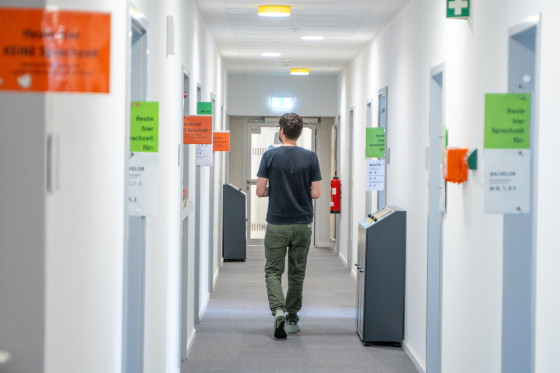
The tasks which the offices undertake are very varied and their diversity is matched by that of the three dozen people working at the two large examinations offices on Scharnhorststraße. While Luca Winkler likes the routine of the job especially, Daniela Mutze loves the variety involved. She loves the complex links with the Academy of Fine Arts and the University of Applied Sciences or with the University’s own examinations offices, and she recalls what it was like when she returned to work after her periods of maternity leave: “I felt like a novice, but I was soon back in the swing of things thanks to the good internal communications we have here and thanks to my experience.”
More than a sideline: PhDs
Simone Krause is another one who is committed to a good administration of exams. She looks after PhD students from the fields of Mathematics, IT, Chemistry and Pharmacy, and Physics – as well as doctorates in education (Dr. paed.). “I can’t imagine any better job,” she says. What she likes is the mixture of routine and tricky issues – and there’s enough of both in her everyday work. On the one hand she is responsible for a sophisticated system which enables her to keep sight of the status and the deadlines relating to any PhD dissertation. She also has regular contact with the various faculties, who often make her work easier. “The supervision carried out at the various institutes is very good: the lecturers know how things run,” she explains with a smile. And on the other hand, her field of work is changing. Interdisciplinary PhDs, new regulations, and the increase in international programmes – so-called cotutelles – not only give rise to a lot of variety but also entail a lot of work for everyone involved.
In the advice she offers students, whether on the phone or in person, Simone Krause is always friendly in the two languages she works in. After all, PhDs are a field in which English is indispensable. Often, she doesn’t see or talk to many of the PhD students for a long time after they have registered. Most of them she only sees again when they want to hand in their dissertations. This, though, is when the guidance she offers moves up a gear or two. The final phase of a PhD dissertation is a fast-moving process – from an administrative point of view, too. Nevertheless, there are regulations which have to be complied with. When a dissertation is circulated to all members of a faculty who are entitled to supervise a PhD, these have the opportunity to read both it and the assessment. Only after the dissertation has been accepted unanimously can the PhD student’s defence of it take place – which is a “very rigorous” procedure, as Simone Krause emphasises. This, she says, is a question of quality assurance.
The face of the future: the new CMS
While the everyday business of the examinations offices is to provide support for today’s undergraduates and PhD students, there is a project team which for some time now has been working on the ‘examinations office of the future’. Two members of this team are Kerstin Wohlgemuth and Kirsten Kuhrmann. The task which they have is to incorporate the “examinations” component in the University’s new Campus Management System, thereby replacing the old “POS” system. “For months on end,” explains Kerstin Wohlgemuth, “the team gathered together all the requirements and used them to draw up 300 test cases.” The perspectives which offices, faculties and students all had were included equally. When work was done on these fictitious cases, it became clear what would function and what wouldn’t.
The process was necessary because SAP offers no software for a university’s specific examinations system. Instead, a framework has to be adapted and its content added. Working together with the Center for Information Technology (CIT) is absolutely essential here. “In the meantime,” says Kerstin Wohlgemuth, “we have a pretty good feeling for what we can put into practice with CIT and what needs to be done by an external software company.” One challenge in the process, she says, is to incorporate the examinations regulations – with all their content and conditions – into one clearly presented, well-functioning IT system.
One advantage which the new system has is the large self-administration section for students, who can make bookings, register for examinations, look at course performances and statistics, and download documents such as the ‘Transcript of Records’. One aim for the future is to make it possible to upload certificates and forms. “Thanks to the new system,” says Kirsten Kuhrmann, “students don’t need to come into the examinations office so often; they benefit from increased digitalisation.” The faculties also benefit as they can work more independently through the SAP system. “The project will mean more uniformity in the administration of examinations,” adds Kerstin Wohlgemuth.
The process is not yet complete. At the end of the year, all students who begin their studies at the University should be able to manage examinations admin in SAP, where around 300 degree courses will be stored. The “POS” system will, however, still be around for a few years yet at the University – until the students currently registered there have completed their studies. Nevertheless, the direction everything is going in is clear: the examinations offices at the University of Münster are working intensively on their digital future.
Author: André Bednarz
This article was first published in the University newspaper wissen|leben, No. 5, 22 July 2026.
Background info: several offices, one mission
For anyone studying at the University of Münster and working towards a degree, there is one central institution – apart from the Student Admissions Office – which they cannot avoid: the examinations office. “Office” in the singular is not really right, though: at our University there is not just the one examinations office. “Examinations Office I” is responsible for no fewer than eight Faculties in the Humanities and Social Sciences; the “Examinations Office for the Faculties of Mathematics and Natural Sciences” handles Faculties 10 to 14; in addition, the Faculties of Law and of Economics each have their own examinations office; and lastly, the North Rhine-Westphalian Examinations Office for Medicine, Psychotherapy, and Pharmacy – Düsseldorf Regional Government” is responsible for the Medical Faculty. On this two-page spread we explain the tasks which the examinations offices have, we look at the people working there, and we show why the staff there play a decisive role in the successful administration of examinations in every degree course (as well as in every PhD course).