

University PhD award goes to Dr. Hellmann
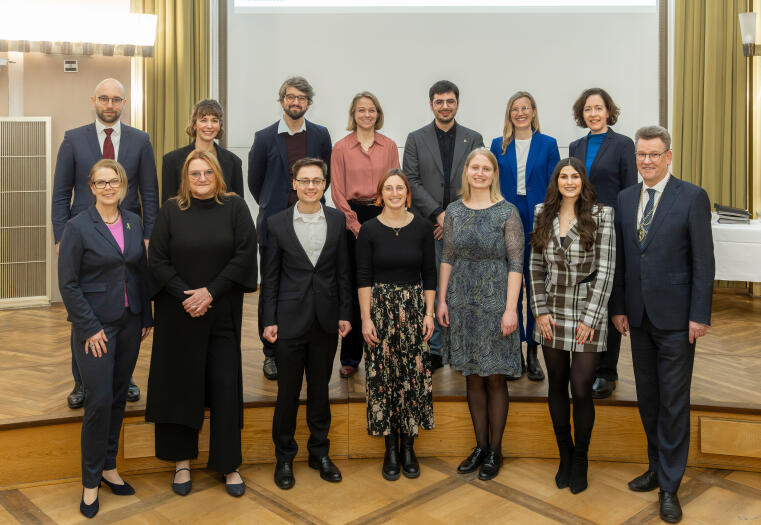
Every year, the University of Münster honors its best doctorate candidates - whose dissertations have been awarded the grade "summa cum laude" - in a ceremony in the auditorium of the "Schloss", where it also awards the University Dissertation Awards fot the best doctoral thesis in each Faculty. This year, the honor in the Faculty of Biology went to Dr. Margareta Hellmann for her work on the role of the cell wall in the immune response to an often lethal fungus. Cryptococcus neoformans is the name of the culprit, and the name already gives it away: the fungus hides from the immune system. But how does it do that?
Dr. Hellmann performed her doctorate in Prof. Dr. Bruno Moerschbacher's group at the Institute for Biology and Biotechnology of Plants. Sounds surprising, given the topic. But Prof. Moerschbacher's team hypothesized more than 20 years ago that plant-damaging fungi - such as mildew and rust fungi, which cause enormous damage in agriculture - cover their cells with a kind of invisibility cloak that protects them from detection by the plant's immune system. To do so, they use enzymes to convert the protective chitin in their cell walls into chitosan as soon as they penetrate into plant tissue. Chitosan is less stable than chitin, but then, once inside the host plant, the fungus is well protected from environmental influences. Plants have long since "learned" that the presence of chitin signals a fungal attack and activate their immune system in response. However, the plant is blind to chitosan - voilá! Since then, the research group in Münster has been investigating the fungal enzymes - known as chitin deacetylases - that are responsible for this conversion of chitin to chitosan. These enzymes are, of course, essential for the success of the fungus and are, therefore, also good starting points for successful plant protection.
The American research team led by Prof. Dr. Jennifer Lodge - now at Duke University in Durham, North Carolina - took up this hypothesis to explain the high pathogenicity of Cryptococcus and has since been working on developing a strategy for a vaccine against this often fatal fungal infection. A few years ago, the Americans contacted the team in Münster after it had characterized one of the four enzymes of Cryptococcus that could be involved in the conversion of chitin to chitosan and had published the results in the Proceedings of the National Academy of Sciences of the United States of America. Dr. Hellmann used this contact for her doctoral project and began to characterize the other three enzymes of the fungus as well. This proved to be a lengthy process, so Dr. Hellmann developed methods for analyzing the enzyme products, i.e., the fungal chitosans, in parallel. She first tested these methods on conventional crab chitosan and, in doing so, solved - quasi en passant - one of the hotly debated problems in chitin/chitosan research that had been around for decades. The acetic acid groups in chitosan are neither randomly distributed, as most chitosan researchers had assumed, nor arranged in blocks, as a minority kept insisting. In fact, they are surprisingly evenly distributed. And this has consequences for detection by or hiding from the human and plant immune systems. Together with the Americans, Dr. Hellmann is now trying to use these and other findings from her doctoral thesis to improve the vaccination strategy. And together with the Münster team and its start-up CARAPAX biotechnologies, they also aim to optimize the efficiency of chitosan-based plant protection products.
Dr. Hellmann financed her doctoral research with a scholarship from the German Academic Scholarship Foundation, and her current postdoctoral phase in Münster with a DFG research project. She already has an impressive list of 12 publications, some of which in highly reputed journals. A further 15, for which all data is already available, are currently in various stages of preparation or review. This not only testifies to the high significance of her research, but also to her willingness and ability to cooperate with other research teams worldwide - not just her colleagues in the USA. It will be exciting to follow her future career path. We are already looking forward to the surprises that lie ahead.