
Molecular choreography: How the p97 protein regulates cellular quality control
The p97 protein plays a central role in cellular quality control by preparing defective or no-longer-needed proteins for degradation and recycling. Researchers at the University of Münster, in collaboration with the University of Duisburg-Essen, have investigated how p97 and its auxiliary proteins interact in this process. The study has now been published in the journal Nature Communications.
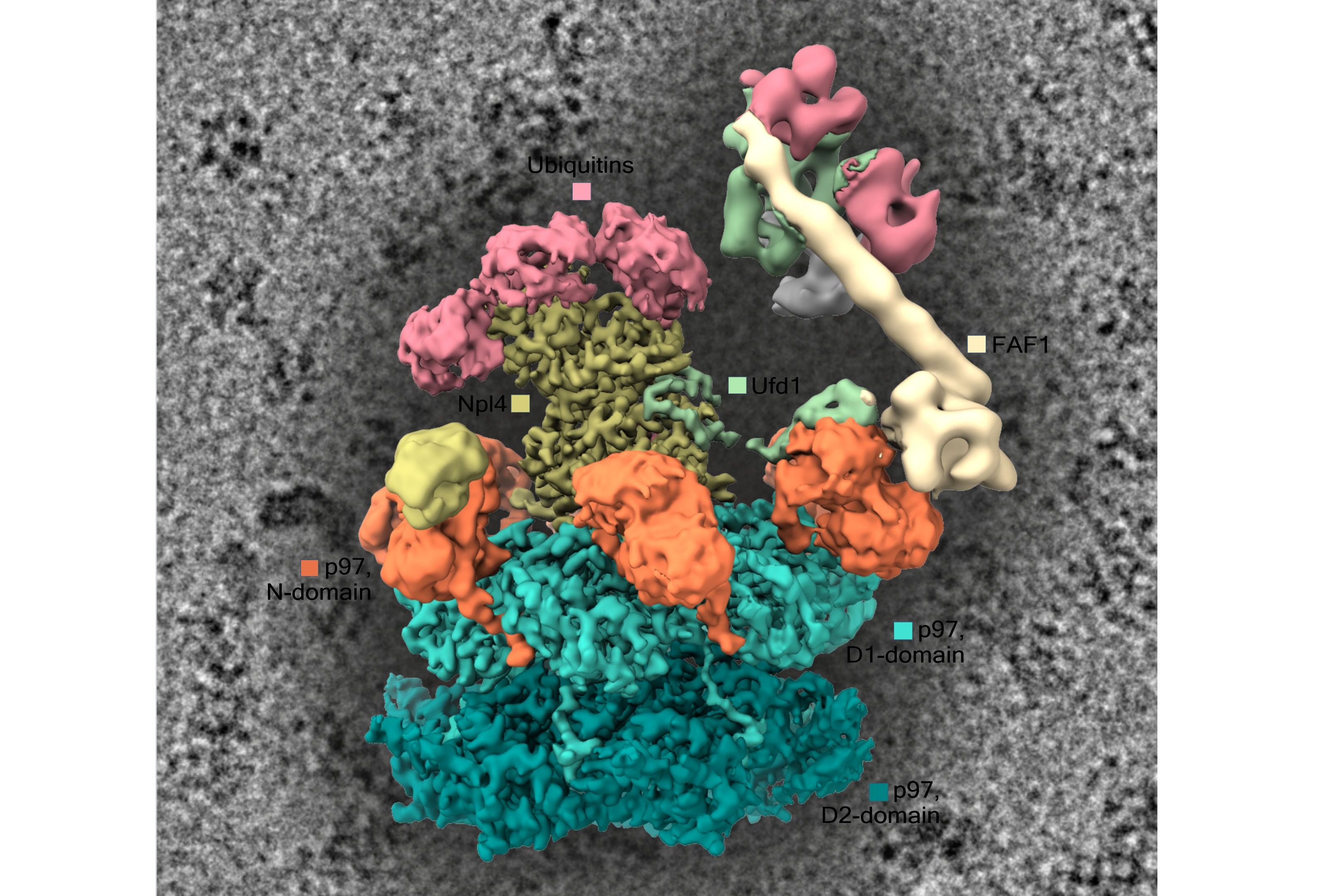
“To understand how cells regulate their protein balance and what happens when this system is disrupted, we need to understand how p97 works,” explains research group leader Prof. Christos Gatsogiannis from the Institute of Medical Physics and Biophysics. It is already known that p97 does not act alone, but works in conjunction with many so-called adapter proteins. However, there is no answer to the question of exactly how the proteins interact – at least not yet: “By combining biochemical experiments with the imaging technique of cryo-electron microscopy, we were able to visualise the various possible arrangements of the protein complex at near-atomic resolution. From this, we were able to deduce how the individual components synchronise their conformations through a dynamically coordinated interaction,” says the study’s lead author, Athina Drakonaki, describing the scientific approach.
It became apparent that it is the coordinated activity of p97 and the auxiliary proteins that enables the efficient processing of non-functional proteins. Whilst p97 mechanically processes the protein, its own structure also changes. To stabilise the process, the adapter proteins react flexibly: Ufd1 and Npl4, for example, alter their position, whilst FAF1 adjusts its distance from the complex as required. “The components therefore do not work independently, but complement one another like dancers in a precisely coordinated choreography to jointly control the processing of the substrate. These findings provide insights into an essential mechanism of cellular protein quality control. In the longer term, this fundamental understanding opens up groundbreaking medical applications in targeted cancer therapy and the treatment of neurodegenerative diseases. At the same time, the study results form the basis for investigations into how p97 interacts with other accessory proteins,” concludes Gatsogiannis, who is already thinking about the next steps in the research.
The work was funded by the German Research Foundation (DFG) as part of the Collaborative Research Centre 1430 ‘Molecular Mechanisms of Cell State Transitions’.
Original publication
Drakonaki, A., van den Boom, J., Kröning, A. et al. Structural dynamics of substrate processing by the p97-Ufd1-Npl4-FAF1 machinery. Nat Commun 17, 11081 (2026). https://doi.org/10.1038/s41467-026-78639-x