
Spiritual abuse in spiritual communities was driven by pressure and arbitrariness
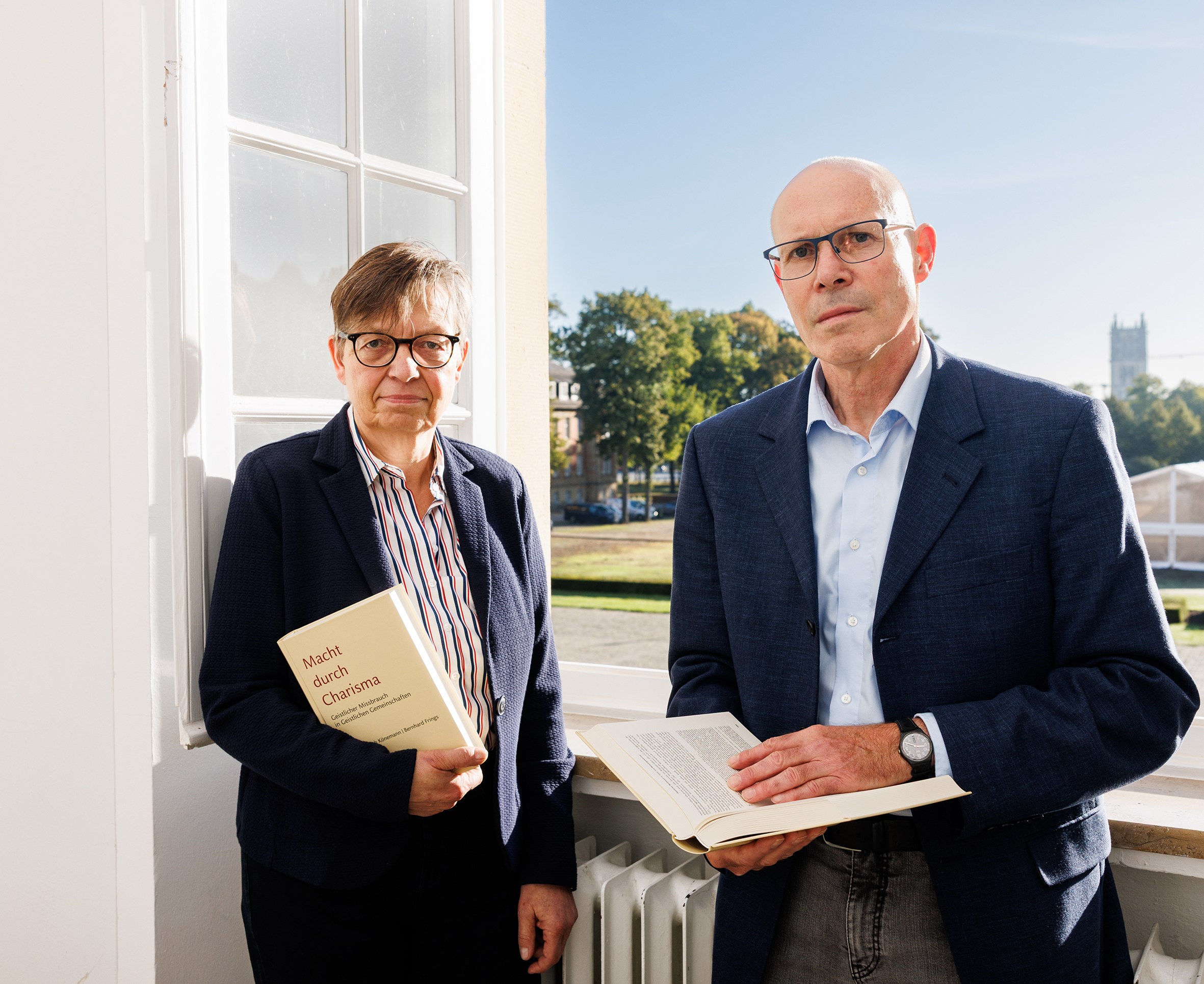
Sexual abuse by priests, members of a religious order and educators has shaken the Catholic Church worldwide over the past decades. By contrast, another form of abuse has received far less attention – spiritual abuse. In a pilot study based on the example of two spiritual communities in the Dioceses of Osnabrück and Münster, researchers at the University of Münster have spent the past three and a half years investigating this abuse of power, its forms and characteristics, and the theological conditions that give rise to it. Prof Dr Judith Könemann and Dr Bernhard Frings from the Faculty of Catholic Theology have summarised the results of their study in a monograph entitled “Macht durch Charisma. Geistlicher Missbrauch in Geistlichen Gemeinschaften” (“Power through Charisma. Spiritual Abuse in Spiritual Communities”), which is also available online (https://doi.org/10.17438/25270).
‘Spiritual communities continue to fascinate many people. They represent the desire to live one’s faith intensively, radically and decisively, to give space to the longing for a religious “more”, and ultimately to find oneself as a person,’ explains the study’s director, Judith Könemann. ‘The leadership figures’ charisma played a decisive role in this attraction, as they were role models for the members in many respects.’ The positive view of the spiritual communities, most of which emerged within the Catholic Church in the second half of the 20th century, and the intention not to prevent the “good” under any circumstances, shaped the attitudes of those responsible in the dioceses and at the same time governed how they dealt with the communities and acted toward them. However, this attitude ensured that any concerns were set aside. Grievances were relativised and trivialised, and the credibility of those who voiced them was diminished.
The analysis further showed that theology itself, in the form of argumentative patterns, concepts and content, provided a legitimising backdrop for spiritual abuse. This involved instrumentalising elements such as obedience, humility, freedom, discipleship, devotion or the doctrine of original sin, as well as certain theological modes of thought.
Definition
According to the study’s authors, spiritual abuse is the inadmissible and incessant power-driven intervention in spiritual life, in the spirituality of another person. At its innermost core, the abuse consists of gaining power over the other’s conscience and innermost (spiritual) self through the use and within the horizon of a spiritual doctrine. Using the vocabulary of “opening”, the abuser demands and enforces the self-abandonment, self-surrender, and submission of the other.
In the cases examined, the exercise of power took place through an interplay of various strategies and different practices such as indoctrination, control, selection and overburdening. They were often enforced through shaming, pressure, “withdrawal of love” or arbitrariness. In both communities, normalisation practices were also massively applied to enforce the respective leadership’s ideas. This happened particularly intensively through the women.
The study
For the first time in the German-speaking world, the phenomenon of spiritual abuse in spiritual communities is the focus of a scholarly study based on a broad qualitative-empirical study combined with extensive archival investigation. In addition to investigating the abusive incidents, the researchers also examined the actions of the dioceses toward the communities. The specific subjects of the current investigation are the ‘Christusgemeinschaft’ in the Diocese of Osnabrück, with its connection to the religious community of the Thuine Franciscan Sisters, and the community ‘Totus Tuus New Evangelisation’ in the Diocese of Münster, which was dissolved in 2021.
The study’s database consists of 117 interviews. The team interviewed people who responded to a call for “affected persons or former members” (81 interviews), as well as people who do not describe themselves as affected but have knowledge of the communities, e.g. through their work or role in the diocese. In addition, the dioceses provided extensive documentation on file; the researchers supplemented all of this with their own research in the diocesan archives.
‘Spiritual abuse must be taken seriously and recognised alongside sexual abuse as “a distinct form of abuse”,’ says Judith Könemann. The findings of the study are intended to help prevent such abuse in the future through appropriate structures and attitudes. Explanatory patterns that exclude systemic causes, trivialise grievances, but do not lead to action are now considered obsolete.
The study was commissioned and funded by the Dioceses of Osnabrück and Münster, the Congregation of the Thuine Franciscan Sisters of the Holy Martyr George at Thuine, and the German Bishops’ Conference, represented by the Association of German Dioceses. Notwithstanding funding provided by the aforementioned church sponsors, the research project worked independently of their clients.
Quotes from interviews with affected persons who took part in the study:
“She was a person who radiated something, she had charisma.”
“[S]he captivated people, yes, because she inspired them, because she had charisma.”
“[She] was intelligent, she had something that could inspire a person.”
Original publication: Könemann, Judith and Bernhard Frings: Macht durch Charisma. Geistlicher Missbrauch in Geistlichen Gemeinschaften. Münster 2026. DOI: https.//doi.org/10.17438/25270