
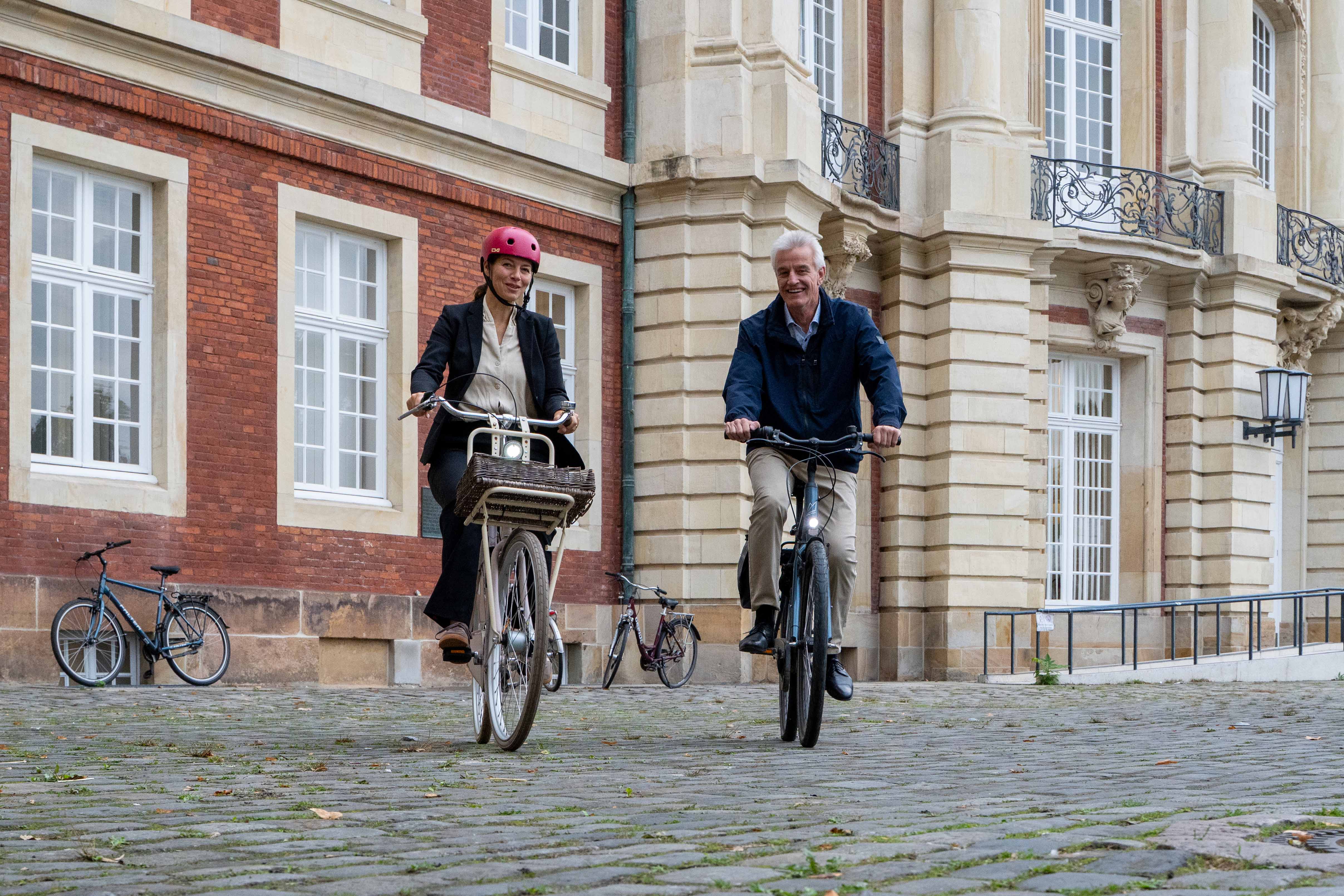
A moving start
Susanne Menzel-Riedl admits she was never a “star athlete”, but she certainly feels a “strong urge to be active”. She does not need to explain this slight distinction further on this early morning as the three of us hop on our bicycles and set off on a University tour. For the photographer Johannes Wulf and me, it quickly becomes clear that there’s some truth to the latter part of how she describes herself – the new Rector of the University of Münster pedals hard, and we make rapid progress.
Susanne Menzel-Riedl is familiar with Münster and the University she has headed since 1 October. From 1996 to 2002 she studied biology, educational theory and English here (as well as in Senegal and the USA). After completing her doctorate in Göttingen, she returned to Münster in 2010 where she lived in the Geistviertel, not far from Hammer Straße, for five years. But her career path veered from Münster in 2008 when she accepted an appointment at the University of Osnabrück in Lower Saxony as a professor of biology didactics. From that point forward, she focused on her work in Osnabrück and was elected University president in 2019. Furthermore, much has changed at the University of Münster in recent years and there is plenty for her to discover. So, off we go from the Schloss via Hittorfstraße towards “HomaLa”, the Horstmarer Landweg, where a large part of the sports facilities is located.
With a view of the lush green lawn and the reddish-brown tartan track, it is time for the first break. The native of Siegen-Wittgenstein reports that she runs six to eight kilometres about twice a week – she often has her running shoes in her luggage on business trips. “I like the feeling of exploring cities while running, but I prefer being out in nature.” This may stem from the fact that she grew up in a small village near Bad Berleburg in the middle of the idyllic and forested Rothaargebirge and remained there until her Abitur in 1995.
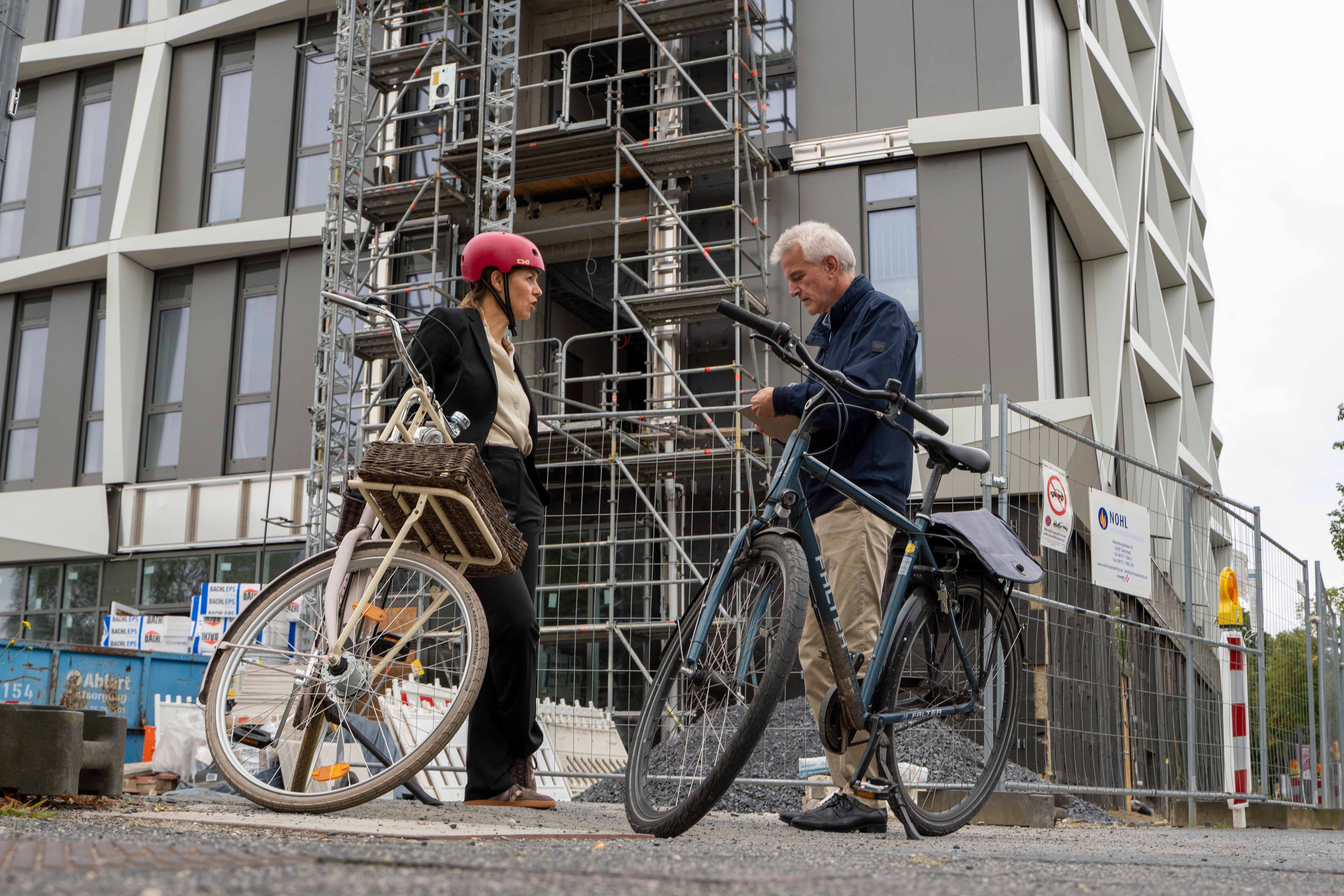
And while we observe the hustle and bustle on Wilhelm-Klemm-Straße not far from the chemistry lecture hall building, we talk about her beginnings at the University of Münster and her studies. It quickly becomes apparent that Susanne Menzel-Riedl has a special connection to the natural sciences. After one semester of law, she felt at the time that those studies were not right for her. It was different with her second choice, biology. “I thoroughly enjoyed studying this subject from the very beginning”, the 50-year-old recalls. “I invested a lot of time and had to work hard to acquire the additional basic knowledge in chemistry and physics. But it was wonderful and rewarding.” Nevertheless, what remains most vivid in her memory is the stimulating mix of her subjects: the combination of natural sciences, educational theory and English studies. “I felt that I was diving into fundamentally different worlds within a few hours.”
We turn into Albert-Schweitzer-Straße but immediately keep left to ride across the medical campus – a more or less self-contained area with numerous clinics and research institutes, the overarching bed towers, little car traffic and many pedestrians. Quite a few of them are wearing white coats. At her previous post at the University of Osnabrück, Susanne Menzel-Riedl had no direct contact with a clinic or a faculty of medicine. “But I am reasonably well-informed on the subject, especially since I frequently dealt with related issues as the chair of the Lower Saxony State University Conference.”
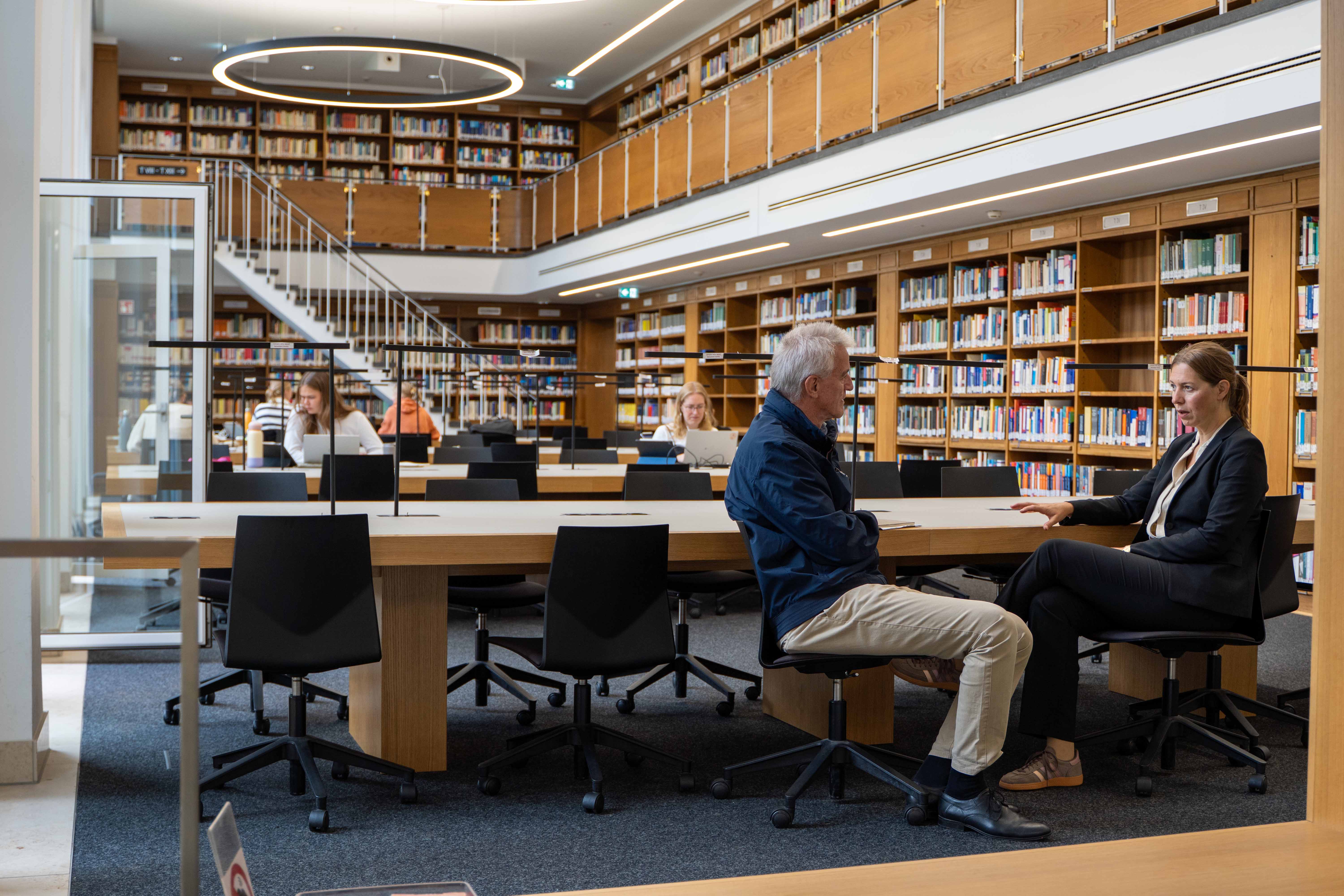
On the final leg of our tour, we leave the bikes behind. “Let’s go inside,” Susanne Menzel-Riedl suggests at St Peter's Church. Easier said than done. But as luck would have it, the door is open. We let the silence wash over us. As the church of the former Jesuit college, St Peter's Church is not just any church – it’s the nucleus of the University. The basilica, built in the 16th century, also has a special meaning for Susanne Menzel-Riedl: this is where she married her husband Raphael in 2012.
The respite is followed by a final sprint back to the Schloss. “You have no idea how happy I am to now be able to cycle to work almost every day,” she says as we wait at a red light at Schlossplatz and let numerous cyclists pass us. This point is entirely understandable when one knows that for many years, Susanne Menzel-Riedl had to rely on the Deutsche Bahn as a permanent commuter – and often felt let down. Now she knows it will take her between twelve and fifteen minutes from home to the Schloss and back. The name of her bicycle perfectly matches her urge to be active: Gazelle.
Author: Norbert Robers
This article is from the university newspaper wissen|leben no. 6, 7 October 2026.