
New geological archive discovered: Fossilised wood reveals 300 million years of Earth’s history
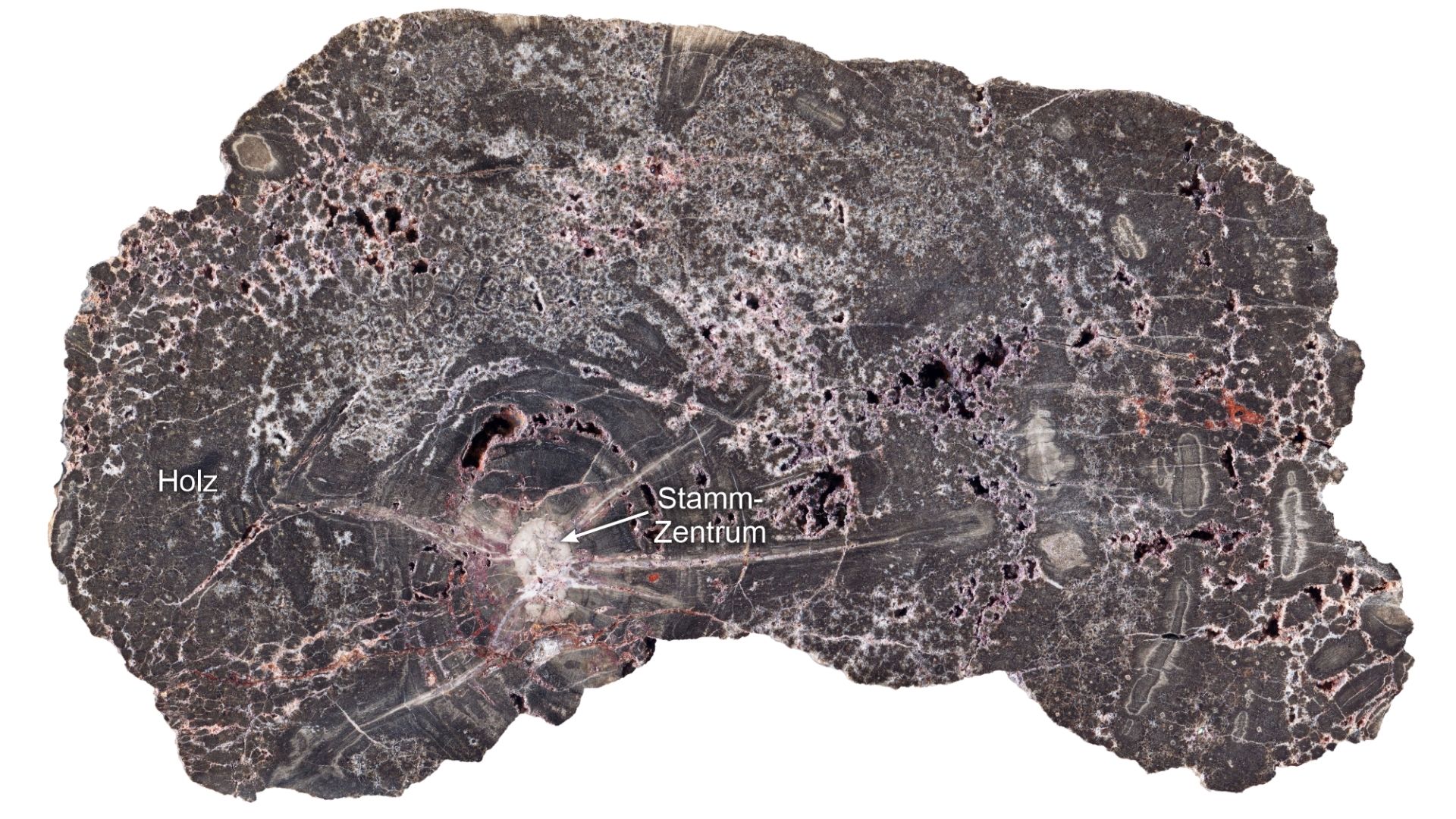
Many people are familiar with fossilised wood as a decorative item from the museum shop. However, the fact that it can preserve the geological history of entire regions spanning millions of years is a new discovery. A research team led by geologist Dr Steffen Trümper from the University of Münster has now demonstrated for the first time that fossilised wood is a natural archive, from which the geological history of an entire region over hundreds of millions of years can be deduced. The findings extend the previously known timescales of wood mineralisation. They show that fossilised wood can record the history of subsidence in a geological basin and reveal tectonic events on a timescale of hundreds of millions of years. Specifically, the study focuses on the Saale Basin, a sedimentary basin that formed around 300 million years ago in what is now central Germany and whose rocks are among the oldest in the large Central European Basin System. The study has been published in the journal Scientific Reports.
The key lies in the quartz, which has permeated and replaced the wood during the fossilisation process. Initially, dissolved silicic acid penetrates the dead wood, templating the cell walls and thus preserving the finest anatomical structures. Over millions of years, these initial siliceous deposits eventually crystallised into quartz, replacing the original tissue bit by bit. The study shows that the preservation of these fossils is far more nuanced than previously thought in terms of structure, geochemistry and the age of the quartz phases. The research team identified five successive generations of silicic acid. Each of these generations contains information about the temperature, pressure and composition of the solutions from which they formed. They document five stages spanning a period of 200 million years from the late Carboniferous to the Early Cretaceous. If the subsequent uplift to the Earth’s surface is taken into account, this period extends to as much as 300 million years. This is the longest documented sequence of successive wood mineralisation stages to date.
To analyse these ‘time capsules’, the team combined numerous techniques. Using quartz cathodoluminescence, fluid inclusions, oxygen and silicon isotopes, Raman thermometry, electron-probe microanalysis and scanning-electron microscopy, as well as so-called in-situ U-Pb dating – a geochronological method for determining the age of rocks and minerals – the five stages were reconstructed. “The tiny fluid inclusions in the quartz were particularly revealing, as they preserve information about the exact conditions during crystal growth,” explains Steffen Trümper. For example, the team demonstrated that parts of the wood were once located at a depth of three to five and a half kilometres at temperatures of 160 to 240 degrees Celsius.
The findings have significance that extends far beyond the Kyffhäuser. “It is astonishing that a fossil, often no bigger than the palm of a hand, encapsulates the geological history of an entire region spanning hundreds of millions of years,” says Steffen Trümper. “A sequence of five stages of mineralisation has never before been documented in fossilised wood. As fossilised wood occurs in many rock formations worldwide, this opens up a valuable source of information. It provides science with a new tool for tracing the evolution of continents.” However, the analyses show that the suitability of fossilised wood for basin analysis depends less on the tectonic setting and more on the climatic and sedimentological conditions during its burial.
In addition to the University of Münster, the Georg August University of Göttingen, the Karlsruhe Institute of Technology, the Museum für Naturkunde Chemnitz and the TU Bergakademie Freiberg were involved in the study.
Original publication
Trümper, S., Franz, M., Sosa, G., van den Kerkhof, A., Zeh, A., Tatzel, M., Kronz, A., Techmer, K., Di Rocco, T., Pack, A. & Rößler, R. (2026): Fossil wood cells record 300 million years of Europe’s tectonic history. Scientific Reports 16:22068. DOI: 10.1038/s41598-026-60054-3