
Plant Immunity
Talented, up-and-coming students of synthetic biology will be meeting in Paris this November. Every year, interdisciplinary student teams from all over the world present their research projects in the ‘International Genetically Engineered Machine’ (iGEM) competition. Expert juries assess the projects based, among other things, on their impact in solving societal challenges and environmental problems. This is the fourth year that a team from the University of Münster is participating in the competition.
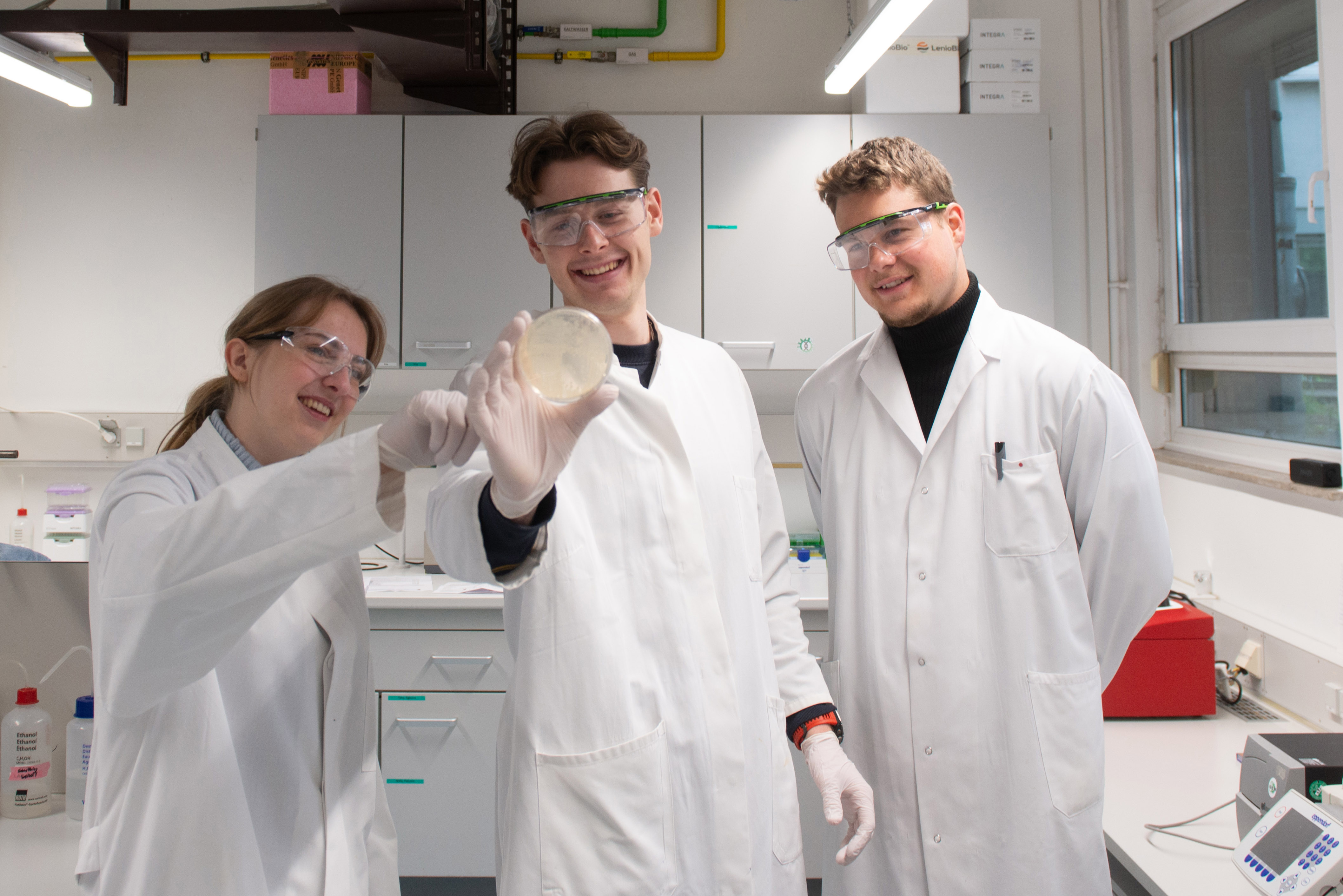
In their research project “P.A.C. Immunity”, the Münster students are addressing the challenge of food security. ‘One consequence of climate change is that pathogens spread more easily, particularly in plants. In the long term, this contributes to resource scarcity,’ explains Simon Jankord, who is part of the three-person coordination team. One possible solution is to strengthen the plant’s immune system. By giving its natural immune system a ‘software update’, the plant recognises and combats pathogens much more quickly. ‘We make a tiny modification to an existing immune gene. This enables the plant to mount a faster, tissue-specific immune response,’ says co-coordinator Annika Ritzerfeld. The students plan to present a “proof of concept” to the jury in November, which can then be developed further. This would make it possible to breed resistant plants far more quickly than before.
In addition to its technical development, the fifteen-member team that includes numerous biotechnology students particularly values the personal insights the project provides. ‘The organisation also fosters our personal and methodological skills and provides us with many experiences we wouldn’t otherwise gain during our studies,’ says Lennart Pianka, the third member of the coordination trio.
Ahead of the main competition, there will be a number of opportunities at upcoming international conferences to exchange ideas with other iGEM research groups. In mid-May the University of Münster team won the prize for the best project presentation at the “BFH European Meetup” in Hamburg. From 10 to 12 July groups from all over the world are invited to the Schloss in Münster for the “International Junior Jam” – three days packed with presentations, workshops and networking opportunities.
The research group is being funded by the University of Münster. However, it also relies on sponsorships to finance its participation in the competition. ‘The subject matter is specialised and not always easy to grasp,’ admits Lennart Pianka. ‘For this reason, it is often difficult to convey the novelty of our approach to sponsors outside the field.’ Consequently, many of the sponsors come from the biotechnology sector. ‘As there are now many iGEM teams in Germany, the market is highly competitive,’ says Simon Jankord. ‘A large part of what we do involves finding foundations, companies and major donors who believe in “P.A.C. Immunity”.’
Author: Tim Zemlicka
This article is from the University newspaper wissen|leben issue 4, 17 June 2026.