
A switch for the right rhythm
Professor Ralf Stanewsky from the Institute for Neuro- and Behavioural Biology was recently surprised by what his fruit flies had demonstrated in the lab – they had managed to restart their internal clock through their own behaviour.
For the experiments, the results of which were reported in the journal Science, Dr. Angelica Coculla was inspired by studies with human volunteers from the 1960s. Students were asked to live in a bunker without daylight for extended periods. “It was observed that the sleep-wake rhythm did not get out of control but stabilised at just over 24 hours,” she explained. The subjects were allowed to turn the light on and off as they pleased. This is where the circadian experiments with fruit flies differ significantly,as scientists in laboratories around the world usually dictate the conditions.
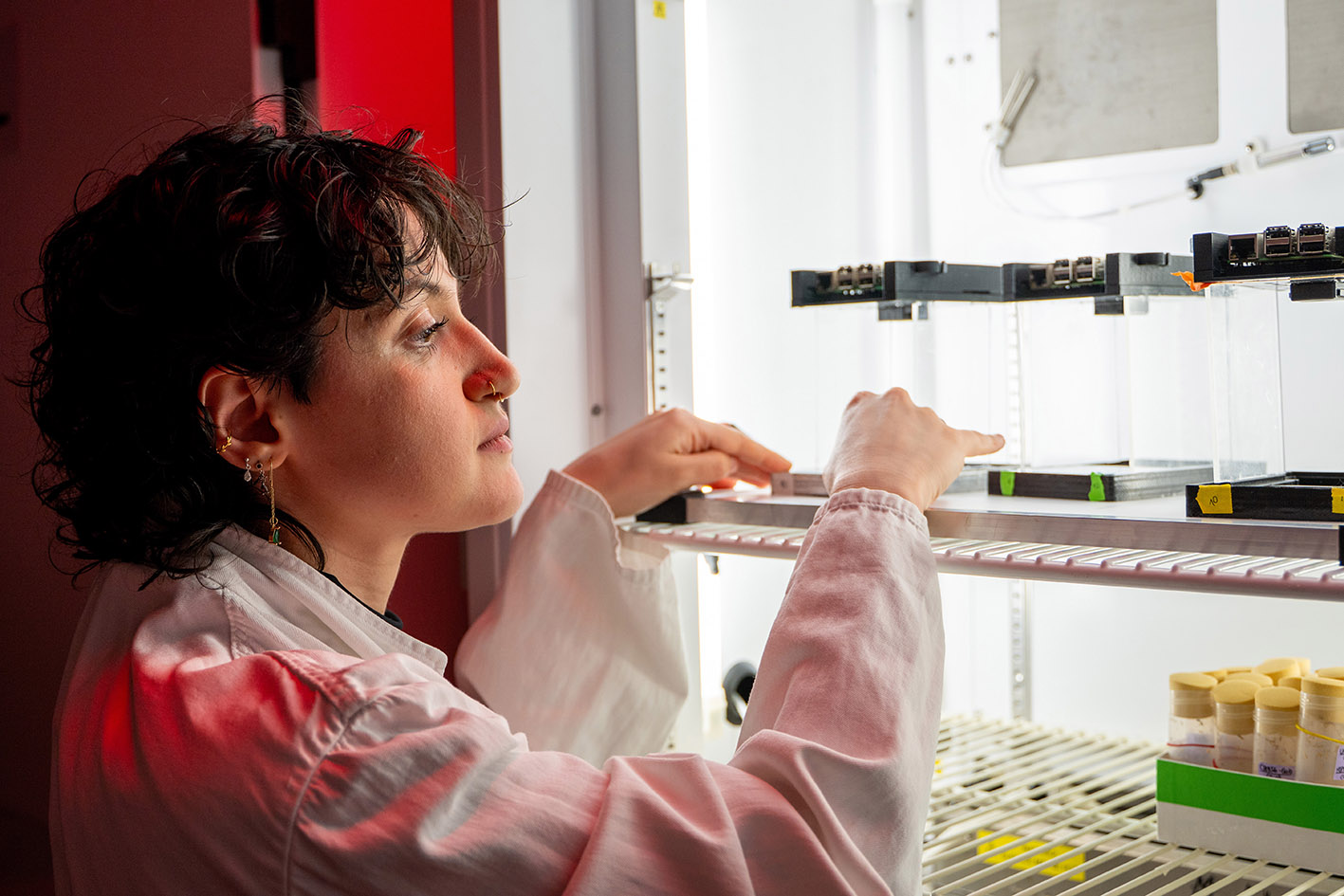
Fruit flies cannot press a light switch. But with an experimental setup that the workshop of the Faculty of Biology specifically designed and constructed for this purpose, Angelica Coculla gave them the freedom to move back and forth between a bright and a dark location. Previously, she had disrupted the internal clock of the flies through constant illumination.
Most flies appeared to prefer a dark corner of their habitat where there was enough food. “I would have expected them to stay there,” says Ralf Stanewsky. But the flies regularly left their comfortable spot. Through their visits to the illuminated side, they restarted their internal clock; the light impulses were obviously an important lever of the molecular signal cascade. With the molecular rhythm, the sleep-wake cycle returned. “This was accompanied by longer continuous sleep phases, indicating improved sleep quality,” explains Angelica Coculla. The results underscore how important temporal organisation is for the organism from a physiological perspective, which also applies to humans, adds Ralf Stanewsky.
From an evolutionary perspective, the temporal structuring of the day is also important. Through synchronised activity phases, for example, animals of the same species can more easily find mating partners, or can minimise the risk of encountering predators during their precisely timed wake phase. Experts call this the “temporal niche” in which animals are active. Angelica Coculla showed in her doctoral thesis that the protein HSP83 contributes to fruit flies maintaining their temporal niche. If the protein does not function properly, the flies’ circadian rhythm becomes more flexible. This can be helpful when animals need to adapt to changing environmental conditions.
The studies were funded by the German Research Foundation (DFG) as part of the Transregio Collaborative Research Centre (SFB-TRR) 212 „NC3.
Author: Christina Hoppenbrock
This article was updated on 3 July 2026. The original version appeared in the university newspaper wissen|leben, issue no. 4, 17 June 2026.
References:
Angelica Coculla, Luis Garcia Rodriguez, Maite Ogueta, and Ralf Stanewsky (2026): Fruit flies actively restart their circadian clock by proactively shaping their environment. Science Vol 393, Issue 6806, pp. 98-104; DOI: 10.1126/science.adw2239
Coculla A. et al. (2026): Hsp90 buffers behavioral variability by regulating Pdf transcription in clock neurons of Drosophila melanogaster. PLOS Genetics; DOI: 10.1371/journal.pgen.1012044
Further information
- Original publication in "Science"
- Science Perspective: Making time / Flies seek out darkness to restart their biological clocks
- Original publication in „PLOS Genetics“
- SFB-TRR 212 „NC³“
- Joint Institute for Individualisation in a Changing Environment (JICE)
- Stanewsky's lab at the am Institute for Neuro- and Behavioural Biology
- The June issue of the university newspaper as a PDF (in German)
- All issues of the university newspaper at a glance