

Conserving cultural and natural treasures
A Westphalian “Bridgerton” …?
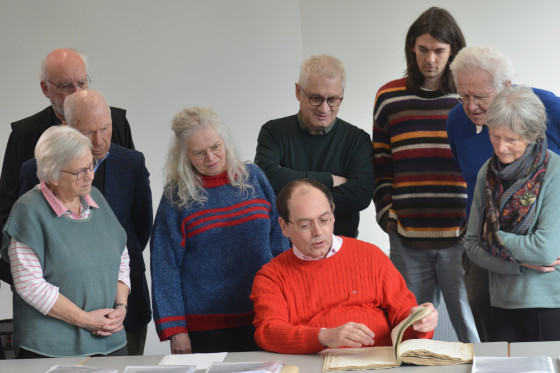
The collection of musical scores known as the “Fürst zu Bentheimsche Musikaliensammlung” comprises around 1,900 volumes and, at the University of Münster, the Institute of Musicology regularly deciphers historical scores, letters and documents from the collection and its contemporary world. The focus of Citizen Science project is on researching and reviving four large-scale works composed between 1776 and 1804. Münster’s Pro Musica Orchestra is performing the works in a series of concerts.
Before the works of Johann Friedrich Klöffler, to take one example, can be heard again after more than 200 years, there is a lot of work that has to be done – anything from deciphering the manuscripts and an edition and transcribing them into modern musical notation to enable the pieces to be rehearsed, to searching for more items in the archives. This is because the interest which everyone involved has – whether they are musical scholars, ordinary citizens or students – goes far beyond the attractive sound of the music. On the basis of old books, contracts and letters the team members open up the historical background to the pieces.
“Bridgerton” atmosphere becomes tangible when Dr. Daniel Glowotz from the Institute of Musicology quotes from historical documents relating to a wedding which occasioned one of the compositions examined. These documents contain what for modern ears are unusual modes of address, which are partly in French and written using pen and ink. Weddings among the aristocracy rarely had anything to do with feelings, but in most cases with politics and money. The court at Steinfurt, says Glowotz, also made sure that any possible bride-to-be was able to play the harpsichord. “For Juliane Wilhelmine zu Bentheim-Steinfurt,” he adds, “one letter tells us that a then fashionable pianoforte was commissioned.” The team of researchers went to get an idea of where this instrument could once be heard – in Steinfurt’s Bagno park, where the concert hall built by Juliane Wilhelmine’s father-in-law, Count Carl, is still in use today.
Defying climate change with the knowledge of the many
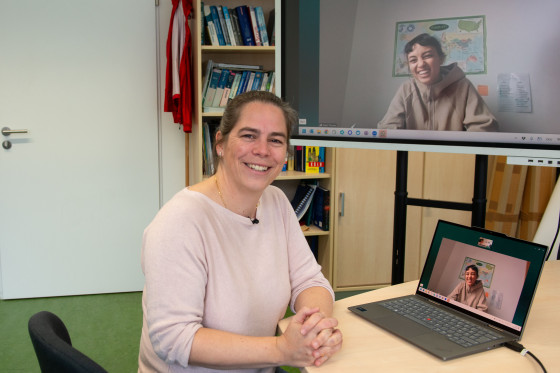
In December she will be setting out once again on a field trip. Sitting in Lisbon, Selani Thomas has organised a video call from there with her professor in the Geo 1 Building at the University of Münster. “I’ll be gone for quite some time,” she says with a laugh. “After a flight lasting anything between 15 and 20 hours, there’ll be a six-hour journey by bus, after which I’ll be taking a boat to another island – where another six hours on a bus await me,” she says. “At the end, someone from the village will be picking me up.”
Masters graduate Selani Thomas will have large-scale maps and aerial photographs of the region in her luggage – for so-called participatory mapping: in workshops, residents from primary school age upwards write down their knowledge on the maps. This might comprise geographical details – for example, frequently used routes – or also agreements within the community regarding common resources. The idea is to find out how people notice changes and regulate their daily lives accordingly. As Angela Schwering explains it, “The aim of the project is to provide the Hanunoo-Mangyan community with arguments in political debates for improving their situation.” It also serves to help people learn from one another, she adds. “The indigenous population is less concerned with getting the maximum out of nature; rather, people work with the resources they have and want to conserve them.”
Save the date:
The Münster University Foundation and the Innovation Office invite anyone interested to come along for an afternoon dedicated to civic engagement in science and research. The event – entitled “Join in with our activities, discussions and research” – begins at 17:00 hours on Tuesday, April 21 in the Studiobühne (Domplatz 23). The highlight of the afternoon will be the celebration of the winning projects in the 2025 Münster University Foundation Citizen Science competition. The keynote speech at the ceremony will involve a topical issue: Prof. Michael Quante from the Department of Philosophy will talk on the subject of “Science in society – for sure!?” Admission is free, and registrations can be made online.
Author: Brigitte Heeke
This article is taken from the university newspaper "wissen|leben", issue no. 2, 1 April 2026.