
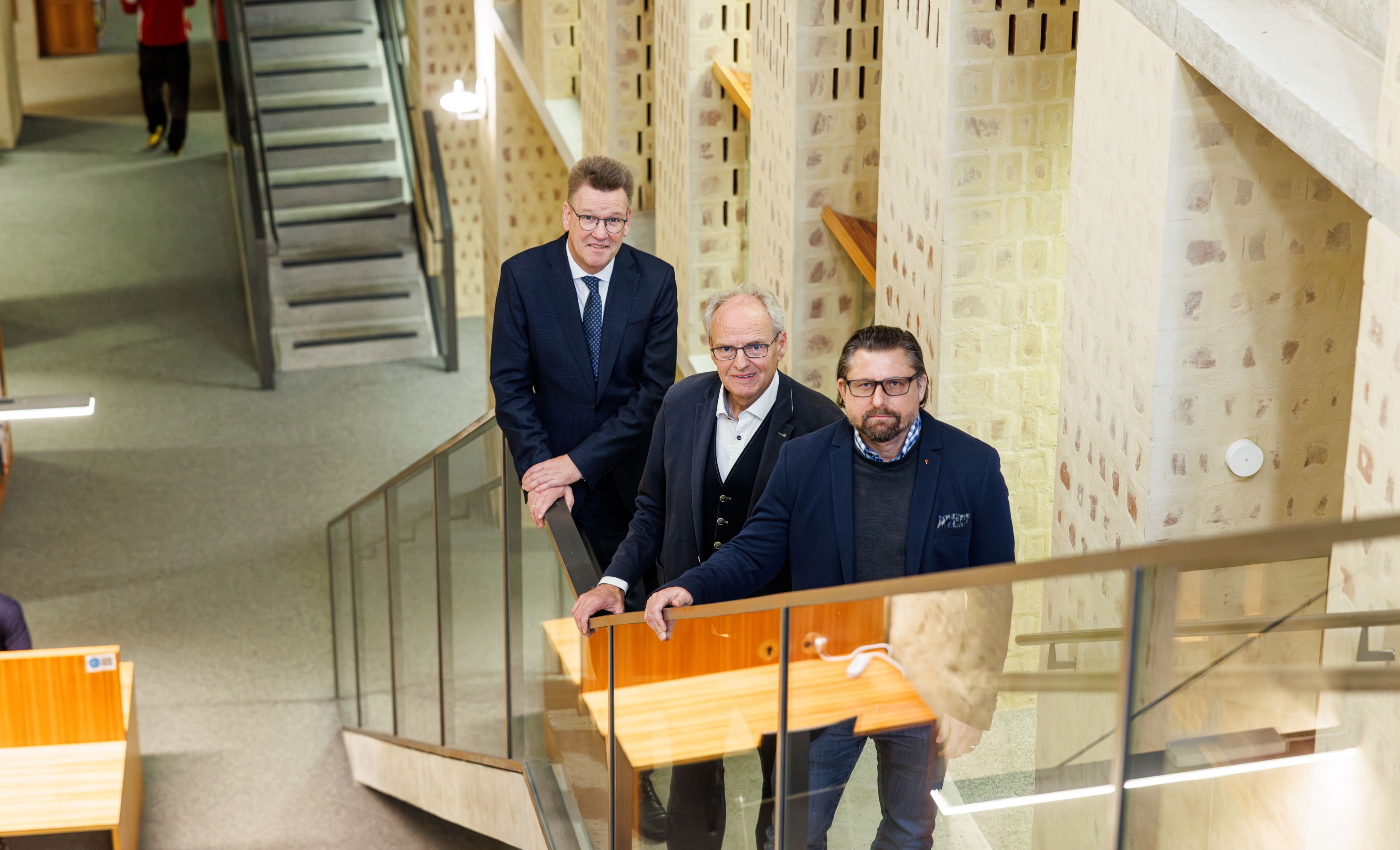
The Union of Academies funds two projects with almost €20 million
Strong boost for the humanities: On 28 November the Joint Science Conference of the German federal government and the German states announced that the University of Münster would participate in the new Academies Programme with two research projects. The projects will run for 25 and 15 years respectively with total funding amounting to just under 20 million euros. The programme, coordinated by the Union of German Academies of Sciences and Humanities, supports long-term research projects, especially in the humanities. The projects “The Vatican and the Persecution of Jews in Europe”, headed by church historian Prof Hubert Wolf, and “The Crocodile and Human Mummies of Tebtunis”, involving ancient historian Prof Patrick Sänger, will begin on 1 January 2026. In both endeavours, the researchers will analyse historical sources and make them accessible with the help of artificial intelligence (AI).
The Vatican project team, headed by Hubert Wolf together with theologian Prof Michael Seewald and information systems scholar Prof Jan vom Brocke, will receive a total of 15.4 million euros over 25 years by the German federal government, the North Rhine-Westphalian Academy of Sciences, Humanities and the Arts, and the Berlin-Brandenburg Academy of Sciences and Humanities. The researchers aim to study around 10,000 petitions addressed to the Vatican by Jewish people during the Nazi era. Patrick Sänger and his colleagues in Cologne will receive 4.3 million euros from the German federal government and the state of North Rhine-Westphalia to investigate, over a period of 15 years, several thousand Greek-language papyrus fragments from Egypt.
“The funding by the Union of Academies is an acknowledgement of the outstanding humanities and historical research at the University of Münster. We are proud that the teams led by Hubert Wolf and Patrick Sänger will be able to expand their important and ambitious work with primary sources for many years to come – benefiting both scholarship and the general public,” remarked the Rector of the University of Münster, Prof Johannes Wessels.
Hubert Wolf emphasised the importance of the financial support, explaining that “the funding creates excellent conditions for examining the petitions of persecuted Jewish people and approaching the crucial topic of ‘the Vatican and the Shoah’ in a responsible scholarly manner, including all its bright and darker chapters, over the next 25 years.” Given the current state of affairs, he added, there was nothing more important than making the life stories of Jewish victims publicly visible. “The University of Münster provides outstanding conditions for this work,” he said.
Patrick Sänger stressed that the funding reflects the growing interest in exploring unpublished papyrus collections using AI. The extended project period will make it possible to robustly evaluate the use of AI methods in fragment matching. This, he noted, could benefit papyrological research as a whole. It is also significant that the papyrus fragments being used as test material for the project belong to the collection of the Bancroft Library (University of California, Berkeley). “This will clearly raise the international visibility of the University of Münster’s Research Centre for Papyrology,” he added.
Through the Academies Programme, the Union of Academies – an association of eight German academies of sciences and humanities – supports the cataloguing, preservation and study of the world’s cultural heritage. It is currently the largest long-term research programme for basic humanities and social science research in Germany. Only projects of high scholarly relevance with durations of between twelve and 25 years receive funding. With Friday’s decision, four new projects from or involving North Rhine-Westphalia have been approved, and together they will receive around 42 million euros.
Three projects at the University of Münster are already supported by the Academies Programme: “Novum Testamentum Graecum: Editio Critica Maior” led by Prof Holger Strutwolf (since 2008), “Dialect Atlas of Central Western Germany” involving Prof Helmut Spiekermann from the German Studies department (since 2016), and “Heinrich Scholz and the School of Münster”, headed by philosopher Prof Nico Strohbach (since 2023).
The new Academies projects at the University of Münster in detail
The Vatican and the Persecution of Jews in Europe
(Locations: Münster and Berlin; joint project of the North Rhine-Westphalian Academy of Sciences, Humanities and the Arts and the Berlin-Brandenburg Academy of Sciences and Humanities)
During the Shoah, thousands of Jewish people wrote petitions to Pope Pius XII and the Vatican. In these letters, they described their living conditions and suffering in striking detail while expressing hope for rescue. Written by men, women and young people across Europe, the letters represent a broad spectrum of Jewish life before and during National Socialism. The petitions, together with documents regarding the Vatican’s responses and internal processes, have been accessible to researchers in the Vatican archives only since 2020.
The corpus consists of around 10,000 petitions with approximately 17,000 pages in at least 17 languages. In addition, there are over 55,000 pages of documents related to decision-making processes within the Vatican in twelve languages. Three scholars at the University of Münster aim to analyse this unique and yet unknown trove of data with their team: Dr Hubert Wolf, Professor of Medieval and Modern Church History and one of the leading experts on the Vatican archives; Dr Michael Seewald, Professor of Dogmatics and Leibniz Prize recipient; and Dr Jan vom Brocke, Professor of Information Systems and Director of the European Research Center for Information Systems (ERCIS).
Their research project, “The Vatican and the Persecution of Jews in Europe. Petitions to the Pope and Their Path through the Vatican Institutions. Digital Edition and Analysis of a Corpus of Sources Not Accessible to the Public”, pursues two main goals:
– to reconstruct the stories behind the petitions and publish the letters and Vatican decisions in a digital edition;
– and to answer central research questions through the analysis of the sources using modern AI methods: Who were the petitioners? What specifically did they request of the Pope? What happened to their petitions within the Vatican?
For the first time, this will also allow differentiated answers to unresolved questions concerning the stance of the Pope and the Curia towards the Shoah.
All documents, data sets for every person mentioned in the sources, and reconstructed individual cases will be made available on a user-friendly and multilingual website – for both scholars and the greater public, and especially for the victims, their families and descendants.
The Crocodile and Human Mummies of Tebtunis
(Locations: Cologne and Münster)
Around 20,000 fragments of Hellenistic papyri have been kept in the Bancroft Library at the University of California, Berkeley since the 1930s. They are inscribed with ancient Greek texts of various genres: great works of literature, royal decrees, fragments of official or private correspondence, contracts, official reports, tax receipts and many other documents.
Roughly 1,050 of these fragments so far have been fully or partly edited and published. However, the majority of the collection remains unstudied. All of the texts originate from the same archaeological site. They were discovered in winter 1899/1900 during excavations in the ancient city of Tebtunis, present-day Tell Umm el-Baragat in Egypt. The city was an important cultic centre of the crocodile god Sobek. After their initial use, the papyri were repurposed in the manufacture of human and crocodile mummies.
In the Academies project “The Crocodile and Human Mummies of Tebtunis: AI-Supported Fragment Matching and Editorial Analysis of Hellenistic Papyri from the Bancroft Library (Berkeley)”, Prof Charikleia Armoni, curator of the papyrus collection at the University of Cologne, Prof Jürgen Hammerstaedt from Cologne’s Institute of Classical Studies, and Dr Patrick Sänger, Professor of Ancient History at the University of Münster, aim to analyse, edit and publish these artefacts.
By applying suitable AI-supported methods – so-called fragment matching – the researchers plan to reunite the many thousands of unedited fragments that were separated when the mummies were dismantled, thereby unlocking the full scholarly value of the sources. The project also aims to build an international network of early-career researchers trained in text editing and familiar with cutting-edge methodologies – ensuring the continued study of papyrological sources and the advancement of knowledge about Hellenistic Egypt.
The researchers from Cologne and Münster are supported by the Center for the Tebtunis Papyri in Berkeley and the Cologne Center for eHumanities (CCeH). They plan to develop a publication platform to make the results accessible to international papyrological and ancient history researchers – and to the general public.