Accreditation

A blue pictogram of an award featuring a wavy edge at the top and two loops at the bottom.
© Uni MS - Web und Design

All bachelor's and master's degree programmes must be accredited by law. The accreditation process ensures that a programme meets the statutory criteria for degree programme design (in accordance with the Study Accreditation Ordinance (StudakVO)). Successful accreditation is documented by conferral of the Accreditation Council seal. For this quality assurance procedure, there are basically two possible paths: internal accreditation and external programme accreditation.

Internal accreditation has been conducted at the University of Münster since the introduction of the quality management system (QMS). The requirements for internal accreditation are based on the processes provided in the University's own QMS. With the Rectorate's decision on accreditation, degree programmes receive the Accreditation Council seal as well as confirmation of compliance with the requirements of the quality management system (in accordance with the QM regulations).

Due to legal requirements, a few degree programmes need to be externally accredited (e.g. the full-time Catholic theology programme and some international joint study programmes).

More information on degree programme accreditation (QM portal)
  • Internal accreditation

    The internal accreditation process at the University of Münster consists of the following elements:

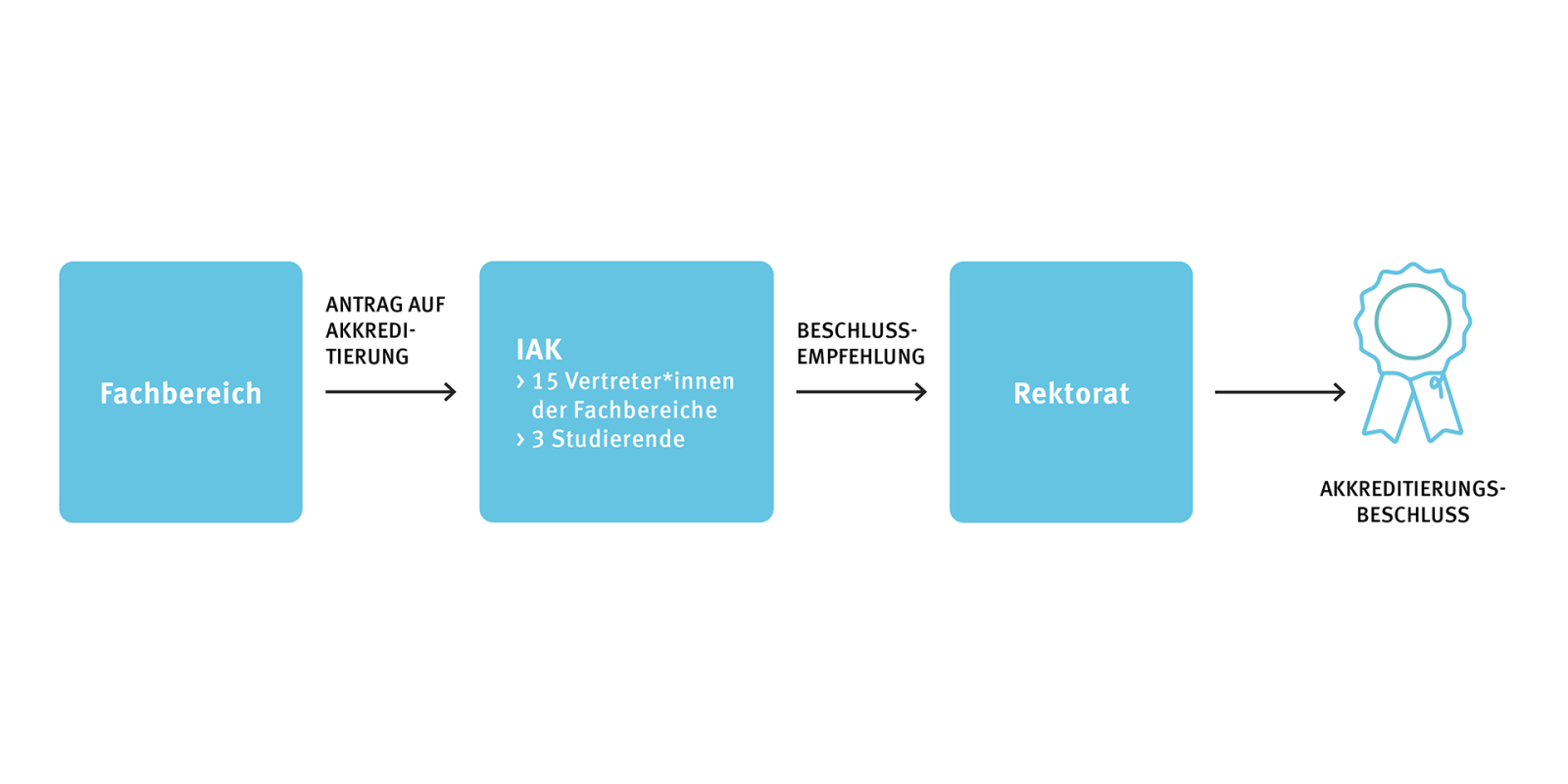
    At an agreed-upon time before the expiration of the current accreditation period, the responsible faculty submits an application for reaccreditation to the Internal Accreditation Committee (IAC). The result of the quality assurance meeting (QAM) plays the most important role in the decision on internal accreditation.

    The figure shows the steps involved in the internal accreditation process: application - review by the IAC - decision by the Rectorate
    © Uni Münster - Web und Design

    IAC review and Rectorate decision

    The Internal Accreditation Committee (IAC) formulates a recommendation for a decision based on the submitted documents, including the expert assessment from the quality assurance meeting, possibly a statement, and other documents related to the degree programme. Based on this recommendation, the Rectorate decides on whether to accredit the programme. The new accreditation period begins seamlessly upon the expiration of the previous one.

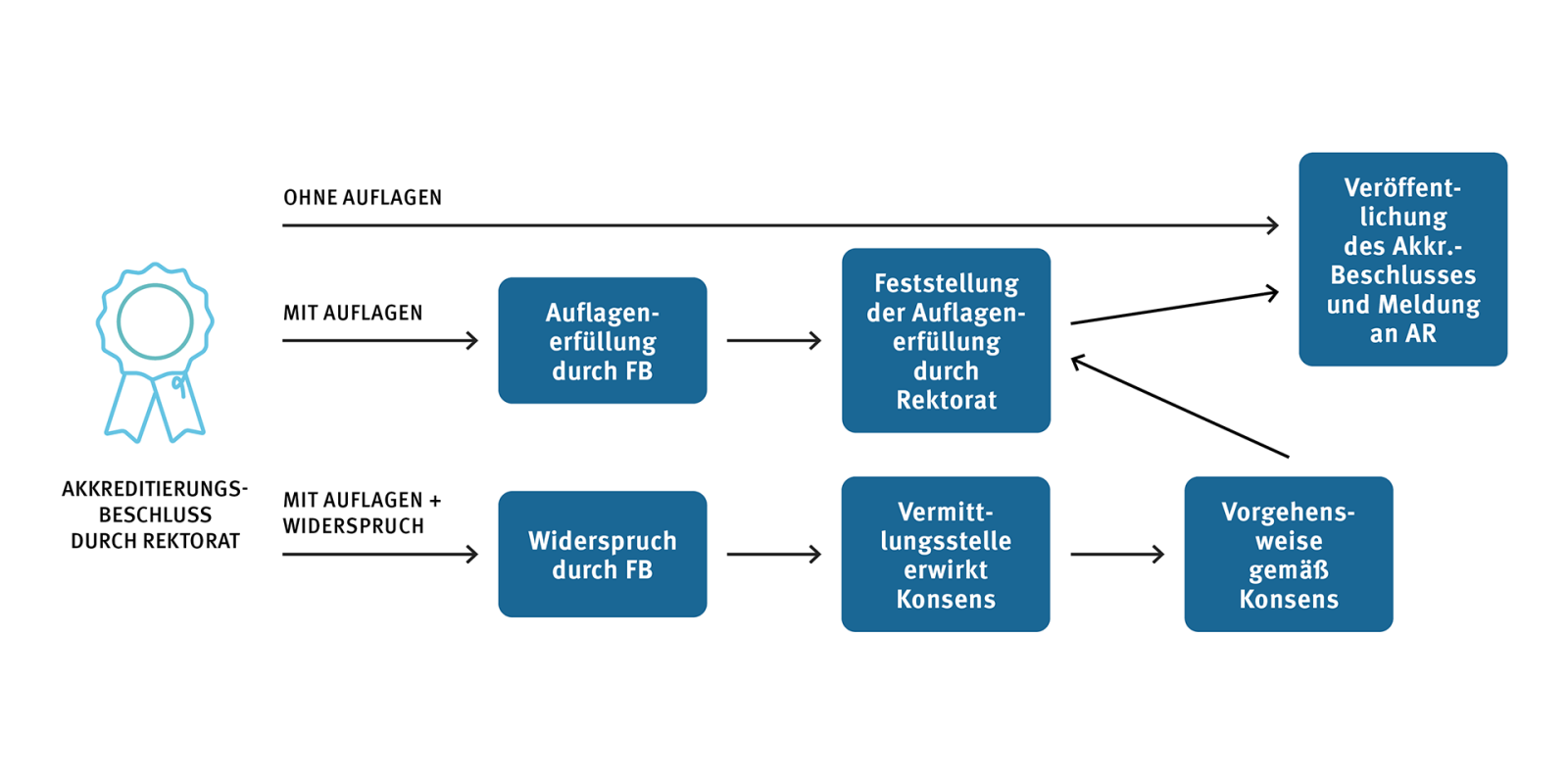
    Accreditation can be granted with conditions attached, which the responsible faculty must meet within twelve months as a rule.

    If a faculty does not agree with the Rectorate's accreditation decision, it may choose to file an objection with the internal accreditation mediation office. In this case, the mediation office takes action with the goal of establishing a consensus. If mediation is not successful, an external programme accreditation is carried out.

    The result of the accreditation procedure is published by the Accreditation Council.

    The graphic shows the process variants for internal accreditation following the accreditation decision by the Rectorate.
    © Uni Münster - Web und Design
  • External programme accreditation

    In a few exceptional cases, a degree programme may require external programme accreditation due to statutory regulations. In this case, an external accreditation agency is commissioned to establish a group of experts and conduct an evaluation procedure. The entire process is coordinated and accompanied by Dept. 1.4. It consists of the following steps:

    Dept. 1.4 provides the faculties with a guide and a template for creating a self-report, which must contain essential information about the concept of the degree programme. The self-report on the degree programme serves as the basis for the evaluation which is carried out by the external accreditation agency.

    The procedure concludes with an accreditation report, with which the University of Münster applies for accreditation to the Accreditation Council. If the group of experts identifies deficiencies (so-called "monita"), the faculty can respond by either rectifying the deficiencies immediately following the evaluation (quality improvement loop), or it waits for the Accreditation Council's decision and remedies the deficiencies as part of the conditions it must meet to obtain accreditation. The exact procedure is agreed upon between the faculty and Dept. 1.4.

    Decision by the Accreditation Council

    As soon as the final accreditation report is available, Dept. 1.4 applies for accreditation to the Accreditation Council and informs the respective faculty of the decision. If the accreditation decision includes conditions, these must be implemented within one year.

    After the accreditation process is completed, the faculty is advised to evaluate the results of this process internally. It can also be helpful to develop solutions for conditions within the framework of a degree programme conference. Sometimes the experts involved in reviewing the programme offer recommendations which should be discussed in this context.

    The result of the accreditation procedure is published by the Accreditation Council.