
A confident team-player
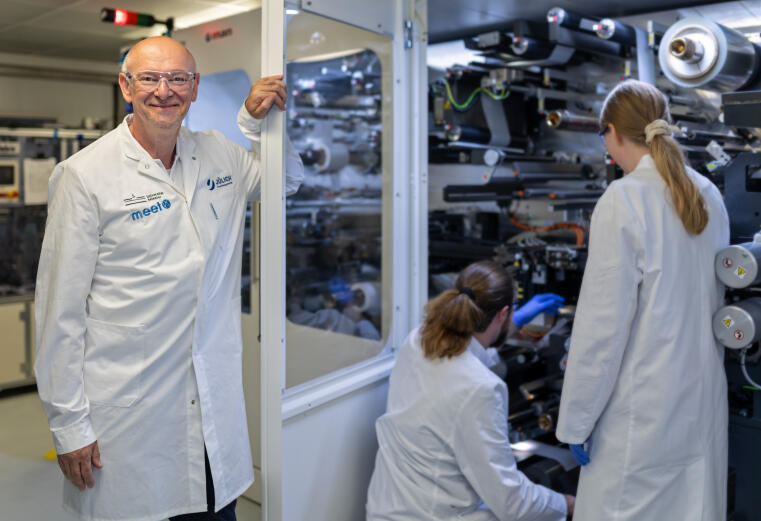
It is no coincidence that, right at the beginning of our conversation, Martin Winter goes into great detail regarding batteries and their research. Straight away, he starts talking about the Italian Alessandro Volta and the voltaic pile, named after him, of zinc and copper discs stacked on top of each other which he presented to the French Consul, Napoleon Bonaparte, on 7 November 1800. The invention by Volta of the first electric battery represented a decisive step forward in the history of electricity and, incidentally, preserved frogs – whose legs were able to conduct electricity – from extinction. While he was still at school, Winter dreamed of a career as an historian. Things turned out differently, but he still enjoys immersing himself in history. “Almost all of my lectures include an historical background,” he says.
It is probably precisely these distinctive communicative skills, combined with his technical knowledge, which have made the 60-year-old chemist one of the world’s most successful professors of materials science, energy and electrochemistry. Today, it is no mean feat to be able to keep track of all the honours he has received. Numerous medals and awards, the German Order of Merit 1st Class, two honorary professorships in Taiwan: in thirty years, the Director of the MEET Battery Research Center at the University of Münster and the Münster Helmholtz Institute has collected more than 60 accolades. Just recently, in July 2025, the European Academy of Sciences and Arts appointed him as a member. But no: in spite of the pleasure at every single honour, Winter prefers not to view this form of praise at too personal a level, but more pragmatically. The reason the prizes are so valuable, he stresses, is that “they afford me a degree of freedom and strengthen the subject overall.”
However, Winter – who moved from Graz Technical University to Münster in 2008 – is not a person who plays down his achievements. Why should he? “My strength is in organising the overall conditions for scientific excellence,” says the native of Osnabrück and father of four. “I can motivate and I can initiate.” With a twinkle in his eye, he adds that “you have to blow your own trumpet – and I confess that I’m certainly receptive to praise.” This is one side of his personality: that of the confident man of many talents who can nevertheless assert that he is “not an outstanding chemist”. The other side shows a convinced team-player who is on first-name terms with everyone at MEET (founded in 2009), who takes a personal interest in PhD students, who attaches importance to “always being approachable and treating people decently”, and who is happy to offer advice over a cup of coffee or a glass of wine in the evening.
Despite the “enormous pressure to succeed” – which Winter feels with regard to the energy transition demanded by the politicians and to MEET as a “showcase project” – he plans to work through till the age of 67. Although it all demands a lot of him, he is constantly busy all over the world as a speaker and as an adviser, often working into the early hours of the morning. However, he enjoys working with young people from all over the world, acting largely in a self-determined way, pursuing his own ideas and supporting those of other people, and proceeding in a very goal-oriented manner. “One big advantage we have is that nothing we produce gets thrown away.”
Of course, he needs his work/life balance, with time to take a deep breath and relax. For example, with his family or his (almost) daily walk around the 4.6 kilometres of Münster’s Promenade. He also enjoys cultural events and likes reading – preferably long articles in newspapers and magazines. Last but not least, Martin Winter has for many years now had a hobby which provides him with the ideal opportunity to combine what he cares about in addition to his work: discovering art and culture and immersing himself in history. He also collects stamps – in a big way: he has compiled 500 albums, including, naturally enough, some stamps depicting Alessandro Volta. Just how well suited this hobby is to Winter as a scientist and in private is demonstrated by his standards in this field too: “I attach a great deal of importance to accuracy and especially to completeness.”
Author: Norbert Robers
This article is from the brochure "Twelve months, twelve people", published in March 2026.
Download the entire brochure as a pdf file
To the other articles in the brochure "Twelve months, twelve people".