
A house with a lot of space
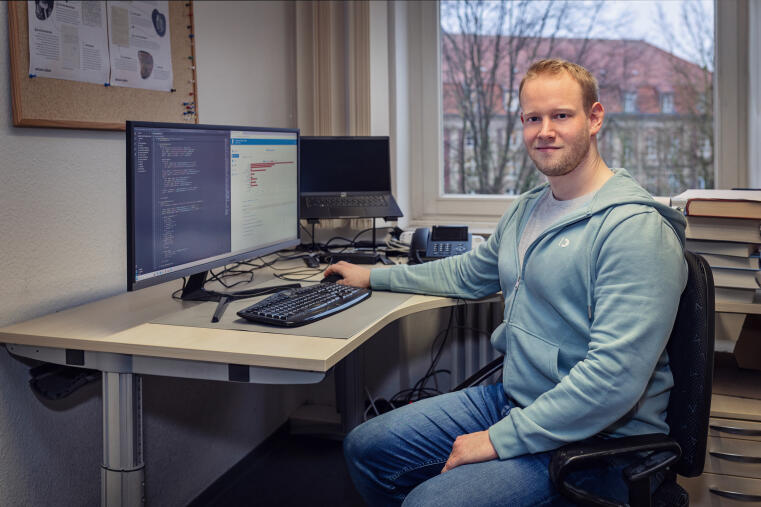
“Developing software is like building houses,” says Maik Kempe. Not until the bare brickwork has been completed do you begin work on installing the electrics. In his job, he says, work begins when you have a concept, drafts, a layout, a lot of team discussions and, last but not least, a solid foundation. Kempe, an historian and theologian, has been working at the Department of Medieval and Modern Church History at the Faculty of Catholic Theology since he graduated.
He created his first websites while still at school. He took on more and more work, learned more and, although an outsider, delved into software development. Today, at 34 and with a master’s degree in “Christianity in Culture and Society”, he is responsible for digital humanities at the chair. In his office on the second floor of the Hansahof, he works calmly and methodically on his projects, of which two currently have priority: setting up a database for the project “The Vatican and the Persecution of the Jews in Europe”; and completing his dissertation on the cultural politician Friedrich Althoff, who was responsible for many academic innovations at Münster.
In his dissertation, Kempe reconstructs the steps taken by the Prussian civil servant at the Faculty of Catholic Theology immediately after the Kulturkampf between the Catholic Church and Prussia in the 1870s. “Today the bishop can still veto professorial appointments,” Kempe explains. “Formerly, the dioceses looked especially to see that candidates for professorships were loyal to the Pope. In support of his unbureaucratic “authoritarian appointments policy” behind the scenes, Althoff haggled over many an appointment. “Some real horse-trading went on, as can be seen in the formulations, some coded, in his correspondence.”
In 1884 five new professors came to Münster who, in the eyes of the Prussian Ministry of Education, were politically reliable. Kempe is working with sources from twenty archives to shed light on these procedures. A comprehensive convolute from the Vatican archives forms the focus of the Academies project: around 10,000 petitions to the Pope from Jewish people during the Nazi period, plus the related correspondence, will be recorded, transcribed and researched over the next 25 years. The legibility of the approximately 17,000 pages – in at least 17 languages – varies greatly. There are further documents of over 55,000 pages, in twelve languages, on how decisions were made in the Vatican.
The project team led by church historian Prof. Hubert Wolf is working on the texts using a specially programmed input mask, researching everything else that can be discovered – for example, the papers’ state of preservation; information about the petitioners and their fate; and who processed the letters in the Vatican, and how. Not only research associates but also student assistants and citizen scientists collate the data in line with international standards for the digital humanities. To preserve the complex material digitally, a database will be necessary whose architecture will hold up for the entire duration of the project – building on the experience from the preceding project, “Asking the Pope for Help”.
“Anyone working with the completed datasets can glean much about the history behind them,” says Kempe. “What were the specific hardships which people underwent? Were there any major instances of people fleeing from certain regions? What influence did the Vatican bureaucracy have?” The data will be made available online to anyone interested. Two aims of the project are: firstly, to be a memorial to those persecuted and, secondly, to be of service to their descendants.
For Maik Kempe, both the petitions project and his own research are meaningful activities. “I’ll be glad, though, if the dissertation is completed soon,” he confesses. Then he’ll be able, he says, to devote himself entirely to the big “new building” – the database for the Academies project. As a dedicated software architect, Maik Kempe will ensure that the database has enough wellorganised space.
Author: Brigitte Heeke
This article is from the brochure "Twelve months, twelve people", published in March 2026.
Download the entire brochure as a pdf file
To the other articles in the brochure "Twelve months, twelve people".